BURRA FIRES
BURRA
SOUTH AUSTRALIA
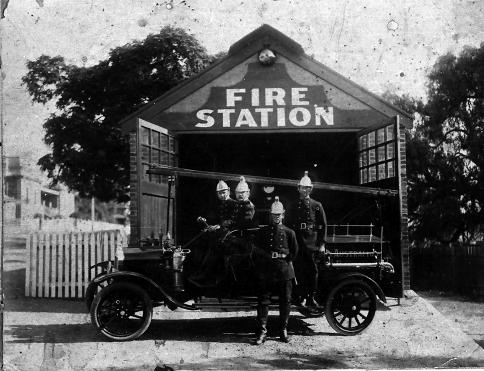
Burra Fire Station
1922
© Burra History Group 2008
Fire!
Miners’ Arms Hotel Destroyed By Fire Dec. 1878
At an inquest into the fire that destroyed the Miners’ Arms Hotel between 2 and 3 am on Tuesday last, the landlord Thomas Richardson explained that on Monday night after returning from the Corporation meeting closed the bar at about 11pm. and after giving Mr. Adams four glasses of beer for the billiard room went to bed. Sometime later, someone knocked for more beer and after he was told to go about his business, he said he thought the house was on fire.
Richardson got up and found much smoke with the fire mostly in casks under the bar parlour and cellar under the tap room. He sent for the Mine Fire Engine. There was an explosion from the other cellar to the east, sending flame through the floor and roof. A portion of the roof was removed to gain access. He thought a fire a few months ago was caused by matches falling through the floor and this fire might be so caused.
There was a half case of matches and a small lot of kerosene in the cellar. The cellar could be got at by any ill-natured person. There had been threats but he thought nothing of them.
Henry Skewes, who was sleeping in Room 10, said by the time he was roused and dressed and got out, the older part of the building was beyond saving. All effort went into saving furniture etc. from the unburnt parts.
Matthew Adams was lodging at the hotel at the time. At about 2.30am he heard Annie Garland in the passage and she showed that her room was full of smoke. He and Harry Vivian roused Richardson and everyone in the house. Going to the front, the whole cellar was ablaze as was the back. The constable, James Colman was roused between 2 and 3am on Tuesday and found the cellars strongly on fire. He sent for the fire engine and helped removing the furniture from the new section (the assembly room) into the street.
Sergent Bentley reported that on passing the verandah at about 11pm the bar lights were out, there were people in the billiard room, but no one was loitering.
The verdict was that there was no evidence to show how the fire originated.
Inquest into the fire on 16th Oct. 1879 that consumed Broad's Aberdeen Hotel.
John Broad slept the night in a downstairs room facing onto the main road. All other lodgers and servants had gone to bed and all seemed quiet and safe. About 2 a.m. he heard some crackling as of the lighting of a fire and thought it was the ostler who always lit the fire. He woke Mrs Broad and said the ostler was lighting the fire and it was not yet time. She went to the kitchen, but came back and said that all upstairs was on fire and he was to get up. He got up and called the men. He saw flames from upper windows and found the servant girl lying on the ground. She said she had jumped from the window. He sent for the police and then took out what furniture we could. The assembly room was saved, and the roof on the outer rooms was taken off to stop the fire. The furniture and stock was insured for £1,000 and the premises for £1,500. When he got outside flames were coming from three windows. Two of the [upper] rooms were occupied. He thought the fire started in the centre rooms. One window did for two rooms which were divided by a lath and plaster partition and occupied by a servant and a lodger respectively.
Ann Broad said there were six rooms upstairs. Only two were occupied: by a lodger and the servant girl, Ophelia Johnstone. She saw the upper rooms on fire along the passage. The man who slept upstairs was not exactly sober. He had a candle and wax matches to light his pipe. There were curtains at the window, but the table was not near them.
The servant girl, Ophelia Johnstone went to bed at 11.30 p.m. She put candle on chair by the bed and put it out once in bed. The man next door was then snoring. She was awakened by smoke and part of the room was aflame. The window was nailed down, but she broke the frame and got onto the verandah and jumped down. Fire could only have come from the next room as nowhere else was occupied. The man had been very free with his matches, throwing them down on the carpet before he went upstairs. While on the ground she saw the man come out on the verandah.
Thomas Long, labourer was on my way back to Farrell's Flat from Terowie after delivering sheep. He slept in the Aberdeen Hotel Tuesday night. Went to bed between 9 and 10p.m. He put the candle on the table by the bed and blew out the light when he went to bed. He was awakened by smoke and heard a female scream and break the glass. He got onto the verandah, he tried to go back for his clothes etc., but couldn't. He was quite sober. He lost a watch, boots, rug, blanket and other small things.
Henry Walker lives nearby and saw fire coming from the hotel windows at about 3a.m.
There were several other witnesses including the police, but they added little of significance. While it was clear that suspicion clearly pointed at some action by Thomas Long there was no clear evidence and the verdict was that fire started in the upper storey, but there was no evidence to show how it originated.
Fire in Aberdeen. November 1885
On Wednesday the wooden shops of Mr T. Harvey, bookmaker, were in flames about 3 p.m. The whole place was destroyed in a few minutes. With difficulty flames were prevented from spreading to his larger shop and adjoining dwelling. They were saved by a 2foot parapet wall. Sparks and smoke were carried by a strong wind across the street so for a time it was feared the houses belonging to Mr Ridgway would also be destroyed. This was averted though trees on the property were scorched, it is feared, to death. The origin of the fire is a mystery. Mr Harvey was absent from home for a day or two and Mrs Harvey was in the stone shop at the time. The lack of either a hydrant or a hose rendered the nearby fireplugs useless.
At the inquest into the fire Mrs Harvey reported that at 2.45pm a boy, Daniel Leyson, 14, apprentice at Sara & Dunstan’s, said a fire had broken out in one of our shops. When asked where, he said he found the shop full of smoke and couldn’t enter.
W. Gerard, a boy assistant said he returned from Mt. Bryan with the cart about 2.30pm and took grocery boxes from the cart and placed them behind the counter as usual. One box contained sugar, one matches and the other soap. He then fed the horses and went to his dinner. He and Mrs. Harvey left the shop and she locked the door. The boy, who did not smoke, always carried tandstickor matches in one of the boxes. They did not get back till the place was burnt down.
When Police Trooper Williams of Redruth arrived about 10 minutes after the fire commenced, every effort was being made to put it out. Next morning he examined the remains of the boxes. Probably the fire started in the boxes.
The verdict was insufficient evidence to establish the origin of the fire.
The Pig and Whistle Hotel Destroyed by Fire, February 1883
Elizabeth Calloway said at the inquest into this fire, that late on 27th Feb. she got up on a box to take down the bar lamp. It was hot, the box slipped and the lamp fell from her hands and broke as she fell from the box. Fire ran all over the place and called her husband when she couldn’t put it out. He threw buckets of water on the fire and tried to beat it out with a bag. After about 20 minutes he called Mr. Benny.
Edward Benny was roused early in the morning by someone running by the side of his house calling, ‘my house is on fire.’ Benny raised the alarm and turned on Mr. Henderson’s whistle and roused Constable Johnson and went to the fire.
By the time he saw it, he thought one or two persons would be of little use. People were doing little, but some of the little rooms had been cleared out. At about 3am the roof of the large room fell in, the roof of the other part having fallen in at about 2.45am.
John Calloway, who could not say he was sober at the time, said he threw buckets of water before rousing Mr. Benny. He claimed that he was not being pushed by any creditors, that he’d been offered £500 for the business. He owed Catchlove and Co of the unicorn Brewery one month’s rent and for one month’s beer and that although he had insured his furniture, clothing and stock for £500, he had no insurance for the building, but the owners were insured.
When asked if he knew how the fire was started, he said ‘no I don’t know anything about it. I did not wake up until the smoke woke me up, sometime after Mrs. Calloway came and told me.’
There were suggestions that members of the public had stood back refusing to assist with removing possessions and putting out the fire.
The verdict was ‘the fire was caused by the accidental upsetting of a kerosene lamp. Had Mr. Calloway been more energetic in saving the property the public would have assisted more freely.’
For some years after the fire the Pig and Whistle continued to operate as a hotel from rooms at the back of the premises, but it drew the ire of some members of the town labelling it an unsightly blot on the landscape that they hoped might be swept away by a good flood.
The Market Square Fire of 1883
The most disastrous fire in Burra’s history broke out on the morning of 6th January 1883 when the continuous note of steam whistles roused the town. A fire was destroying four of the newest shops in Kooringa and threatening many others. The fire underscored the need for a better water supply. Willing workers saved the surrounding buildings, but a reel would have helped greatly. At least the purchase of a reel would not be very costly and would protect business premises.
The total loss from the fire is estimated at about £4,000, almost all of which is covered by insurance. Nothing was saved from the four shops. Drew & Co.’s stores and other large shops on the other side were saved by willing work and the change in direction and then a drop in the wind.
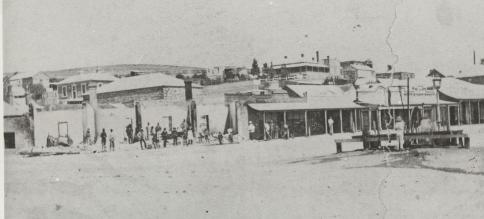
Inquest on the Market Square Fire. 1883
William Waterhouse the clerk of the National Bank, Kooringa noticed the fire in Doe’s shop at 2 a.m. and alerted P-C Johnson. John Kennedy a tailor was called by Mrs Snell at about 2.10 a.m. who said there was a fire. He ran and called Mr Wade, my employer and saw fire in Drew & Co.’s shops. He then ran across to it and met P-C Johnson. The fire was then in Doe’s shop. He broke into Mr Geake’s shop and got the books and cash box. He then climbed onto the verandah roof of Mr Geake’s. People then began to arrive with water buckets. The fire was then confined to Doe’s, next to Geake’s.
P-C J.W. Johnson said Mr Waterhouse reported the fire. He found Doe’s shop on fire; seemingly in the south-west corner and spreading towards the front. The wind was then from the south-east and Geake’s shop was in danger. He broke open Geake’s and Lane’s and procured the cash box, safe and books. The wind then shifted to the north-west and flames travelled along the roofs of the four shops, which were all ablaze within twenty minutes. Mr McBride and others helped to get the safe from Mr Packard’s office and the things from there and from Duff’s office. He was of the opinion that the fire originated where there were some marks on the wall caused by some inflammable material.
James Edward Doe the hairdresser left the shop at 9.20 p.m. Friday leaving no light burning. He had about ten gross of matches in fixtures next to Mr Geake’s. The contents were insured. All the matches were Tandstickor; he did not keep safety matches.
[Doe admitted being in some financial difficulties, but said his creditors were not pressing and he had always satisfied them by part payments and secured renewals. There was then some discussion about insurance during which it was revealed that some of the stock was insured by his suppliers in their own name - an action he says was unauthorised by him]
Richard Pascoe left the shop on Friday at 7.30 p.m. and did not return until hearing of the fire about 3.15 a.m. He went and found Doe. He didn’t know how the fire could have started. Doe had given him notice on Wednesday on account of the dull times. He
The aftermath of the fire in Market Square on 6th Jan 1883
would have left [his employment] on Saturday. He knew Doe was hard up and he used to buy candles regularly at Geake’s. [Doe had said he didn’t use candles for light, but used candle-grease for the strops.]
William Geake the grocer heard of the fire about 2.30 a.m. when it had just reached the Record office. Most of the fire was put out on his premises when he arrived and found the door had been broken open and books and cashbox taken out. He estimated damages at £15. Doe had bought a candle on the night previous to the fire.
The coroner made a long summing up and the jury had a lengthy consultation before deciding there was not sufficient evidence to show how the fire originated.
The German Chapel Fire. 27th July 1910
The old German Chapel at the rear of the Court House Hotel was destroyed by fire last week. The origin of the fire is a mystery. No alarm was raised. At about 10 p.m. a light was seen in the building, but was assumed to be a meeting. Even at 11 p.m. no one thought of a fire. Later a resident found the fire and tried to extinguish it with buckets of water from the creek, giving up only after falling in. Cpl Gibbons attended, but by then could only watch. The greatest losers are the Oddfellows Lodge in Aberdeen, who held meetings there and who lost their regalia, records and dispensation boards etc. The building was uninsured and Cpl Gibbons made diligent enquiries about the fire, but to no avail and after that Mr Winnall JP decided an inquest was unnecessary. The Germans held monthly meetings in it, but another place will now have to be arranged.
Market Square Fire in March 1910
The photo above shows the possessions that were hastily removed during a fire in Market Square in March 1910. During this fire the office of the Burra Record, the local newspaper was destroyed, putting it out of action for about three months. During 1914 and 1915 a fire bug lit several fires threatening business premises in Kooringa and Redruth and still there was no fire brigade in the town.
A Serious Conflagration 1915
The most serious conflagration which has occurred in Burra for a considerable number of years took place last week when the row of old stone buildings forming the south-eastern boundary of Market Square and belonging to Messrs Walker & Sons were completely gutted. About 11.30 on Tuesday, night, 2nd March the alarm was given by Mr. Harrap and although assistance was almost immediately forthcoming the flames had so great a hold that, without proper appliances it was impossible to check their advancement.
The fire evidently started in Mr. J. Allen’s office. Mr. G. Lord, who was one of the first on the scene, almost had the fire under control with a patent extinguisher but the machine became exhausted. The flames were practically subdued in the front room, but the back room continued to merrily blaze away. Mr. A. Walker then had a try with another extinguisher with similar success. Then the crowd got to work with buckets but the supply of water that could be pumped was insufficient to keep the buckets going and finally all efforts were directed to two objectives, viz. to save Pederson and Sons’ boot shop at one end of the row and Harrap’s pie shop at the other. Underneath the iron roof of the burning building right along the row was an old paling roof dry as tinder and once this started there was no stopping it burning without some appliances, a hydrant and hose, with very little exertion, would have confined the fire to the spot where it started. Fortunately Messrs Pederson and Sons had taken precautions in view of such an emergency. The fire was kept back from their roof by a high parapet wall, and they also had a 60ft.
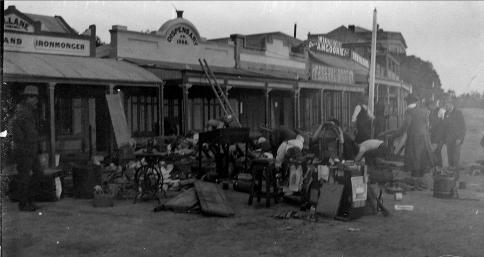
Fire at SM Lane’s Saddler and Ironmonger Shop 1910
hose running from the water supply which, with the strenuous efforts of hosts of willing workers; was sufficient to keep the fire from doing more than some slight injury to the wall and scorching the verandah.
Adjacent to Mr. Allen’s office on the other side the place was occupied by the owners, Messrs Walker and Sons. They had a considerable stock of crockery, tinware and linoleums, etc., in it, which was, practically all destroyed. Then came Mr. Harrap’s private residence. There was no saving this so all the furniture was removed, fortunately with very slight damage, as there was no insurance on it. Across a 12ft. right-of-way was the pie shop. Had it caught there would have been little chance of saving Mr. W. Truscott’s butcher shop or the business place of Mr. E. J. Harris. However, with the aid of wet bags
Fire at The Burra Mine The Loss of an Historical Landmark
16th December 1925
At 11am on Saturday morning smoke was seen issuing from the top of Morphett’s small engine house and later that short grass close by was alight. The residents in the vicinity quickly put out the grass fire and not realising the seriousness of the one that raged within Morphett’s shaft, never raised the alarm, trying to put it out themselves. Between 2 and 3pm this fire had reached such proportions that to fight it was out of the question
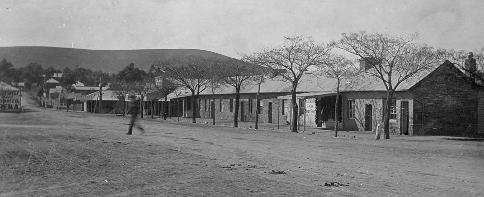
An early photograph of the cottages in market Square before the fire of 1915
on the roof on which a small hose was kept playing, the fire was confined to the original row of buildings. Nothing but commendation can be expressed for the way the crowd worked. At Pederson and Sons’ the toil was strenuous and to save the pie shop those who held the hose on the roof were subjected to the discomfort of dense clouds of smoke, which were met without flinching. M.-C Queale was active in superintending operations. There were so many good assistants that it would be unfair to particularize.
The contents of Mr. Allen’s office were insured for £30. It also contained the records and guernseys and other property of the Burra Football Club, which were all completely destroyed. The buildings were insured for £500 and Messrs Walker and Son’s stock for £300.
As is well known there have been several previous attempts at incendiarism in Burra during the last few months of 1914
Sept. 27th at the rear of the same row a fire was started.
Oct 2nd what looked like an attempt to burn down Mr. F. Harris’s place was made.
Oct 25th a similar attempt was made in regard to Mr. A. D. McLaren’s shop.
Nov 29th a further attempt was made to burn down the buildings, which were finally wiped out last Tuesday.
In connection with the attempt on 29th Nov. it will be remembered that after the fire was extinguished outside and nearly everyone had gone home. Mr. L. Day noticed a second
fire burning inside one of the rooms.
There is one thing that stands out prominently, and that is the absolute necessity that the Council should take immediate action regarding the formation of a Fire Brigade or at least that some appliances should be procured. If the fire had occurred amongst the business places on the other side of the street, with a favourable wind the damage would have been simply enormous.
Fire Bug 28th Oct. 1914
Another arson attempt has been made in Burra. A.D. McLaren’s grocery shop was the target on Monday soon after 11.30 p.m. Packing cases at the rear had been lit.
The 5th attack occurred on Monday. About 12.30 a.m. Monday morning Mrs Lord heard a noise and told her husband she thought someone was stealing chaff from their sheds. While investigating Mr Lord saw flames and smoke coming from the rear of Walker & Sons and found a crate of crockery packed in straw burning quite fiercely. He contacted M-C Queale and also wakened Mr A. Walker who put out the fire with a patent fire extinguisher.
The Fire Maniac in Burra September 1915
The Burra fire maniac has struck again and on Saturday around 10.30pm he tried to burn down W.J.C. Ewins drapery in Commercial Street. Luke Dya raised the alarm and the crowd from the picture show was soon there. The rear verandah and lean-to were ablaze and the shop roof was burning so the worst was feared. The thick smoke and the high fenced small yard made access difficult. Had the firs got a firm hold on the shop probably the whole block would have gone from Miss Snell’s corner. There is still no fire fighting equipment in Burra. After much effort the fire was extinguished. Two or three of the workers were much affected by smoke and the hard-working M-C Queale was rendered unconscious and had to be treated by Dr Steele. Though recovering, he still feels the effects. He was overcome trying to get to the books. That it was the work of an incendiary is undoubted.
Burra Town Council. 20th Oct. 1915
On Monday night the Mayor reported that Mr Sedgman of the Waterworks had written to the Hydraulic Engineer with reference to the recent fire drawing attention to the fact that the people had drawn water without first giving notice. He told M-C Queale that he had exceeded his duty in using the hydrant and when he noticed the fire he should have returned to his office and written and posted an application to use the water. The Department had now claimed the hydrant and taken possession of it.
Cr Killicoat suggested they inquire what notice they would require for use of water in the event of a fire.
Cr McBride suggested formal permission be asked for use of water in the event of a fire.
Cr Radford moved that and also to allow the Council to hold the hydrant. Carried.
Last Friday 24th January a fire swept most of the farms between Booborowie and the outskirts of Burra covering an area 12 miles long by approximately four miles wide. It was a day with a strong, hot wind raising clouds of dust known as a “brick fielder.”
A little after 10am smoke was seen rising over the hills and shortly after clouds of smoke were rolling over the town with calls for help coming from all directions with Drew and Crewes’ bulk store in danger and Elders Smith’s Saleyards on fire. In places the flames travelled at 30 miles an hour generating an enormous amount of heat igniting fires 50 yards ahead. In the darkness of the smoke and dust fire fighters sometimes lost one another and they and women and children in danger of being suffocated or burnt. The fire swept down on people from all quarters farmers who started out to assist their neighbours found their own properties in danger ten minutes later. An agonising telephone call to Burra “Send help or we’ll be burnt out” was answered with “Everybody’s at the fire, but we’ll try.” Shortly after the telephone rang with the message “Don’t send anyone, we’re burnt out.” It leapt roads and the railway quarry 100 yards wide and continued along Firewood Creek never stopping for a moment. Towards evening the wind dropped and the fire was got under control.
Forty miles away Murkaby Dam was covered with cinders from the fire.
Although no lives were lost, there were some narrow escapes. There was comparatively little loss of stock but harness, rabbits and foxes were wiped out by the hundred. At night the country as far as the eye could see was a huge illuminated city of haystacks and fences still burning and at sunrise an appalling scene of black desolation.
It started on O’Dea’s property at Booborowie in a small haystack possibly the result of phosphorus poison in rabbit baits, ignited by the heat of the day. Whilst property owners largely saved their stock, the losses of hay, pasture, fencing, sheds, trees, woodheaps, implements and vehicles was considerable. Most homesteads were saved but some were unfortunately destroyed. In all, this disastrous fire had swept over 30,000 cares of farmland and caused great misery.
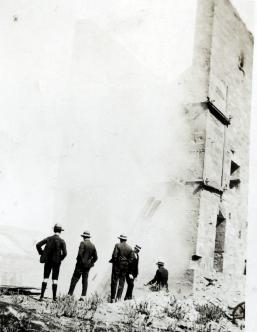
and soon not only the small engine house but also the big one over Morphett’s shaft was in flames. The woodwork of enormous dimensions burned like matches and as there was an immense amount, it took some time to burn. Towards midnight quite a crowd had collected to watch the blazing poppets, which supported the platform on which the big pulley wheel used when the mine was working drawing stuff up and down the shaft, was fixed, fall.
On this platform 50 feet high stood a life-sized figure of a miner holding a hammer and chisel that always attracted much attention and looked upon with feelings amounting to veneration from Burraites. Many sincere regrets were expressed when in company with the white-hot 5ft. diameter wheel it crashed to the ground. The wheel broke but the figure was not badly damaged. Morphett’s shaft, which is almost under the large engine house, is 600 feet deep and heavily timbered which was burning fiercely. The sight at night of the flames leaping to a great height was very beautiful. The next day with columns of smoke ascending one could hear the heavy timbers falling away and crashing to the water below. The inquest into the fire concluded it was caused by lads smoking out rabbits that lived in these old buildings. Old miners believe that it will take many weeks for the fire to burn itself out. The only thing left intact is the famed echo, which is as clear as ever.
Fire 29th Jan. 1930
Pearce’s Building was gutted by fire in the early hours of Monday. Mrs J. Kellock of Queen St. raised the alarm. She had been awake awaiting a bus to take a passenger from her house. Mr Kellock phoned the post office and the fire brigade was alerted. By the time the brigade arrived it was impossible to save the building and efforts had to be directed towards saving Horton Jennison’s motor garage and tyre retreading plant to the west and the Bank of Australasia to the east. The service station was alight, but Mr R. Brinkworth of Elder, Smith & Co. played Mr Jennison’s own hose on it till the brigade arrived and the building was saved. The facia of the bank also caught alight, but the brigade was able to save the building. Pearce’s Building is two storeys and the front portion comprised eight offices, four on the ground floor and four on the upper, with a vestibule and landing. The lower rooms were occupied by Mr M.W. Bednall solicitor and Mr E.A. Mummery dentist. The upper rooms were occupied by Mr Mummery, Miss Alice Wilson dressmaker and Miss N. Sorensen dressmaker. On the second floor at the rear of the building was a large hall known as the ‘Cheer-up Room’, which was destroyed. The fire appears to have started on the western side of the ground floor as Mr Mummery’s rooms and Miss Wilson’s are completely gutted and also Miss Sorensen’s on the top floor eastern side.
The offices of Mr Bednall were not ablaze, but fire was eating through the ceiling and doors. M-C Webster forced his way through the front window to save what was possible. Recognising that he would not know what was important to save, Miss Motley (Mr Bednall’s stenographer) pluckily entered the room through the window and defying the threat from burning rafters helped to rescue about £500 worth of Mr Bednall’s professional library. The office also held the greater number of the pamphlets of the History of the Burra Mine written by Mr Frank Treloar and these were mostly destroyed by water. Mr Bednall was in Kadina at the time, but being notified was back by 8.30 a.m.
The fire appears to have started on the ground floor on the western side in Mr Mummery’s back room. The building was constructed by the late John Pearce in 1914 and is part of his estate, owned by his daughters. It was notable in the war years as the home of the Cheer-up Society, formed early in 1915. Mr Pearce placed the hall at their disposal rent free for the war. The Red Cross and League of Loyal Women also had it rent free and till his death in 1927 Mr Pearce never made a charge for patriotic or charitable uses.
The origin of the fire is a mystery. Damage is estimated at £2,000.
5th January 1935 Fire Brigade Saves Huge Conflagration
In the early hours of Saturday morning a fire broke out in Mr. Wohling’s hairdressers shop, one of a block of five premises on the North side of Commercial Street, and before the alarm was given, the flames had got complete hold of the entire building and was threatening the buildings on either side. Mr. Frank Pascoe who was awakened by smoke entering his bedroom, lived two doors away from the fire raised the alarm by sprinting to the nearby Fire Station and roused the man in charge Mr. F. Spencer at 3:35am. By now flames could be seen licking up the verandah and a huge telephone pole in the street was well alight.
The blare of the siren roused the townsfolk and soon a large crowd had collected. By 3:45am three big hoses were playing on the fire,” The Record” office and Bowey’s fruit shop. Fortunately there is a fireplug in front of Mr. Pascoe’s and the water pressure was good. The buildings in danger were built 80 to 90 years ago having wooden ceilings and timber shingles beneath the galvanised iron roof added to the difficulty of fighting the fire. In less than 20 minutes it was seen that they were conquering the fire, but as the breeze sprang up flames could be seen in the adjoining roofs. There was no panic water was forced through under the eves absolutely deluging The Record office. Great damage was done to the roof and ceiling in the composing room at the Record being filled with water and destroying all the newspaper copy for Monday.
It was while some of the men had a large hose playing on the rear portions of the five shops that Mr. P. Byrne a firemen and Mr. Ron Burt each received severe shocks by coming in contact with live wires and were thrown heavily. The thoroughness of the firemen saved the rear room of Bowey’s although the long room alongside Wohling’s was destroyed. Needless to state not a thing was saved in Wohling’s as the front and middle portion of the premises were a roaring inferno when the Brigade was called. The total damage caused is estimated to be £2000. We must reiterate the work of the four local firemen who by their magnificent work and wonderful grasp they got of the situation have caused an intense feeling of confidence amongst residents, especially business folk as this fire was one of the biggest for many years and could easily have ended in a terrific conflagration.
Fires causing deaths
Despite the fact that there were many large and often dramatic fires destroying properties in Burra over the years, they rarely led to the loss of life. The deaths from fire were gen
erally women and children, involved in accidents with fires in their homes. This is not surprising in a time when the only lighting was by the flame of a lamp and fires were kept burning virtually all day in kitchens. The women and children were particularly vulnerable because they wore long dresses or gowns and handled fire each day in their homes. Men who drank heavily around camp fires occasionally rolled into the flames whilst asleep, sometimes without immediately waking up. The following are just a handful of instances of deaths from burning, recorded in ‘the Burra Record.’
Inquest on 3rd August 1877 at Burra Hospital on Thomas Bendall who died of blood poisoning when an arm became gangrenous after being badly burned when he fell into a fire as a result of a fit.
Obituary 9th January 1880.
Mrs William Baker [on 6th January] was trying to fill a kerosene lamp on the hob of a fire from a three-gallon tin of kerosene. The tin exploded engulfing her in flames and she died soon after. Her daughter Nelly, aged 3, was in a bath nearby and was severely burnt above the waist. She died at 5 a.m. the following day. The residence was near the Mintaro Railway Station.
Obituary & Inquest. 30th June 1882
An Aboriginal named Jimmy Wonga died at Burra Hospital as a result of burns received near Yatina. He deposed while dying that he had got drunk on brandy and had fallen into a fire without noticing it and on Sunday he couldn’t walk. He additionally deposed that Mr James of Mannanarie had given him one bottle of rum and Forrest a bottle of brandy at the same time and place., which Thomas James and David Forrest denied.
Dr John I. Sangster said both legs were badly burned - the left from foot to thigh and the right to the knee. Bone was exposed and both legs were in a state of mortification.
The verdict was death from burns received through falling into a fire while in a state of intoxication. [
[The registration of death says: Jemmy Wonga, died 27th June, aged 45, but the documents related to the cemetery records say burial was on 24th June!]
Obituary. 15th Nov. 1899
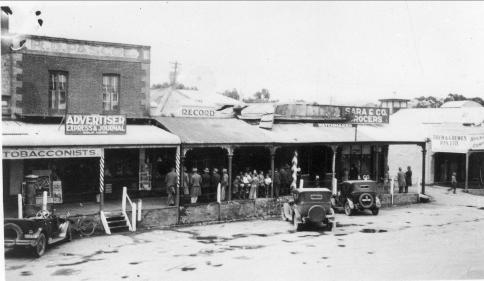
The Morning after the Fire in Commercial Street 5th Jan. 1935
Catherine Wade was helping her daughter, Mrs Hartnett, with the washing on Monday afternoon when her dress caught alight from a lighted stick falling from the laundry fire. Despite medical help Mrs Wade died at 2 a.m. on Tuesday morning. Mrs Hartnett received nasty burns to her hands and neck while trying to extinguish the flames. There was an inquest which returned a verdict of accidental death.
Obituary. 2nd Jan. 1901
Mrs Drake, widow of the late H.J. Drake, was singeing a goose about 11 a.m. when her dress caught fire. Her daughter managed to extinguish the flames by wrapping her in the covering from the sofa, but the burns resulted in her death about 3.20 p.m. She apparently ran about the room when the accident occurred because the curtains on the safe and cupboards, carpet, tablecloth, a mangle and a loaf of bread were also burnt or damaged. It is amazing the house was saved. Mrs Drake was a resident for 44 years, arriving in SA in 1850 and in 1857 marrying Mr Drake at St Luke’s Adelaide. They then came to Burra where Mr Drake died in 1871 at the age of 39. Mrs Drake then kept a boarding house. She leaves two sons; Francis Henry (married) Mayor of Port Wakefield and Robert, and also a daughter, Emily. [Born Maria Marshall: died 25th December 1900, aged 64]
Obituary. 28th Feb. 1900
Emmie Turner, aged 19, employed by Mr P. McLoughlin of Paratoo, died on her way to the Burra Hospital following her dress catching alight while ironing clothes on Thursday. [Registered as Emma Turner died 23rd February]
Today it may be difficult to understand how Emmie’s dress could catch fire whilst ironing. She would have been using a box iron that held hot coals from a fire as its source of heat, coals open to the air that could emit sparks.
The death registers of these early times in the District of Burra also record a series of children being scalded to death by falling into large pots, pans or baths.
Redruth Reformatory Fires. 19th Nov. 1902
Fire broke out in the reformatory laundry last Wednesday morning and destroyed the wood and iron building. In the afternoon a second fire started in ‘Hope Dormitory’ which burned all the girls’ clothes and the contents of five or six kerosene boxes used as a sort of cupboard. There is no doubt the first fire started accidentally from the old German box-iron. The iron was left on the floor with the coals black and apparently dead. Hettie Garrad had been using it and said she had known fire to fall out of the box onto the clothes while ironing. The wind had opened the door several times on the morning in question. The fire in the dormitory in the afternoon is more mysterious. The girls eventually put it out by removing a ventilator and a sheet of iron from the roof and using a hose.
Fires at the Offices of the Burra Record newspaper
Fire destroyed the offices of the Burra Record on three occasions.
In March 1910 the office in Market Square adjoining S.M. Lane’s Saddlery and Ironmonger shop. The fire destroyed all the back premises and with it all the type and the photographic studio. This is now being rebuilt two storeys high to become one of the largest and best lit studios anywhere. The neighbouring shop of S.M. Lane also suffered. Thanks are extended to all those who helped in containing the fire and especially to the men and women who ‘manned’ the pump in the middle of the night. Women pumped water to fill tubs and then men carried buckets to the fire, where a chain of eight got the water up to the top of the wall to pour it onto the fire. Water from tanks behind the building was also used. The front room was saved, but the machinery suffered through the heat and all the stationery was destroyed by smoke and the front windows were smashed. The wall the men had stood on was so weakened that it had to be rebuilt and it was very lucky that it survived to support the men without collapsing into the flames
with them. Thanks are also extended to the providers of tea, coffee and eatables during the fire fighting effort.
In January 1935 the office of the Burra Record in Commercial Street was destroyed by fire.
On the 19th Dec. 1950 part of the back premises of Matthew’s Emporium, Market Square burnt down during lunch hour yesterday. Mostly the fire was confined to the two-storey iron building once used as a photographic studio. The high narrow building acted like a chimney. Ray Bevan raised the alarm and volunteers did well salvaging linoleum, furniture and men’s clothing from fire and water damage. The fire brigade were prompt and contained the fire quickly. Although it started near a brick incinerator, it happens that it had not been lit for three days and so the origin remains unknown. Given the way the shops in the area are all joined and several drums of petrol were nearby, it is fortunate no worse result followed. An auxiliary fire fighting truck of Mr M.H. Tiver came from Aberdeen and was of great assistance.
Fire at Drew and Crewes’ bulk store, Aberdeen, 24 Aug. 1921
On Wednesday 17th August fire broke out in Drew & Crewes’ bulk store at Aberdeen. Mr Crewes was away on a trip to Melbourne, but Messrs J. Drew and K.R. Crewes were amongst the first to arrive. The fire reel was attached to a car and was soon in attendance. Smoke issued from everywhere, which made it hard to find the seat of the fire, which was under the floor. Water pressure was negligible and even when the engineer had shut down supplies to Kooringa and Aberdeen it remained very weak.
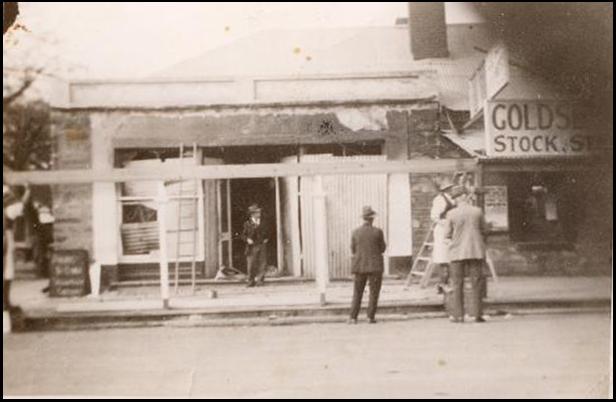
After a fire at the bakery c1930s
Buckets from a tank at the building were used and after taking up various parts of the floor the fire was extinguished after two hours. The smouldering fire must have shortly burst out and engulfed the whole building, had the alarm not been raised when it was. The origin remains a mystery and damage is assessed at about. £300. The failure of the water pressure was due to repairs being carried out on the engine. An inquest was deemed unnecessary by G. Sara JP acting as coroner.
Fire at the Old White Hart Hotel. 22 Mar. 1916
On Tuesday night last week [14 March] the old White Hart Hotel was nearly all destroyed by fire. It was used as the home of Mrs A. Sara and partly by the Boy Scouts for their gatherings. The house belonged to Mr James Reed. It was one of the oldest buildings in the town, being built 65 years ago [1851]. It comprised 22 rooms and was not insured. The fire broke out when no one was at home. The Boy Scouts were at the Institute giving a concert and the alarm was raised during the interval. Captain Truscott was raised by the bell rung by Mr Crewes. He got the hose and hydrant, but then had trouble getting to Aberdeen. Several cars sped past without stopping and eventually mr Lord got his car out and took Mr Truscott to the fire. They arrived within 20 minutes of the fire being discovered, but lack of practice still delayed then from plying the fire with water. The front part of the house was then saved. Mrs Sara’s furniture had already been largely saved except for the kitchen and her own bedroom. The Scouts’ Rooms and equipment were saved. In the process the water from the hose brought down a ceiling on top of a number of men, but fortunately it was lath and plaster and did little damage except to blacken them. The origin of the fire is unclear, but perhaps a spark in the kitchen was responsible.
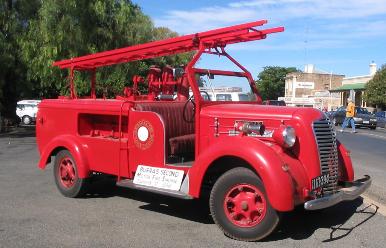
Burra’s second motor fire engine a 1936 Diamond T.
The Fire Station - 1922
As early as 1877 after fire destroyed Mr. Dunstan’s house in Redruth and later in 1878 and 1879 after the loss of the Miners Arms Hotel and the Aberdeen Hotel in separate fires, there were calls for a town fire station. The Mine fire engine had been called out to these incidents but because it had a considerable distance to travel, arrived too late to be of much use. In 1877, Captain Sanders had offered the mine engine with horses and harness, but wanted the town to provide proper uniforms for volunteers and a small sum annually to maintain the engine and hoses. These calls went unheeded despite the destruction of the Pig and Whistle Inn by fire, a fire at the Aberdeen Hotel, and serious fires in Market Square in 1883, 1910 and again in 1915.
Tenders were eventually called by the Town Council for the erection of a fire station in 1921, and again in 1922, only to see both tenders being rejected because, at a cost just over £300, they were considered to be too expensive. In 1922 after much debate, the Town Council did borrow the money to build this fire station with the fire bell from the Police Station being transferred to this site. The premises were rented by the Metropolitan Fire Brigade at a cost of £18 per annum. The fire engine was a second hand one that had previously been used by them in Adelaide.
References:
The Story of the Monster Mine Ian Auhl
The Burra Record
The Northern Mail
Compiled by Julian Ratcliffe
Burra History Group Inc.
2008