BURRA’S HOTELS
BURRA
SOUTH AUSTRALIA
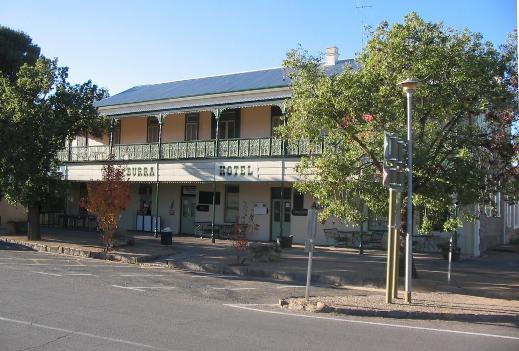
© Burra History Group Inc.
2008
BURRA’S HOTELS
With a six day working week, there was a great temptation for Burra Mine workers to spend their seventh day in their favourite inn. To be found drunk on the Sabbath was a special offence with proper observance of the Lord’s Day rigorously enforced until 1851. The court cases of the day point to the reality of Cornish mining life with ‘deplorable looking nymphs’ being drunk and disorderly on the Sabbath, sly grogging, wife-beating, and miners unable to work on ‘Maze Mondays’. Little wonder meetings of the Burra Total Abstinence Society were often held on a Monday with bouts of pledge-signing by remorseful miners. One Cornish housewife, after an orgy of furniture smashing by her drunken husband, rather than referring to the courts, took her own action. On the following day when he opened his Cornish pasty below ground, found it to contain pieces of broken furniture, ‘nicely arranged.’ Apparently this had the desired effect.
By 1851 the population of the Burra Townships was approaching 5000 and crime was on the increase. The commonest offences were drunkenness, petty larceny and disorderly conduct. Of the 358 arrests in the March quarter of 1851, 114 were for drunkenness, 61 for theft and 30 for disorderly conduct.
The First Burra Hotel - 1846
Designed by George Strickland Kingston and built on the outskirts of the town near the road from Adelaide, the Burra Hotel was Burra’s first hotel. At the time of its completion in September 1846 it was supplied with beer from the adjacent brewery run by Mr. Crawford of the Hindmarsh Brewery in Adelaide. It put an end to the illicit trade in alcoholic drink. At one time described as ‘a pile of buildings’, it boasted fourteen spacious rooms and a large assembly room that was used for many public meetings. Owned by William Paxton, a Mining Company Director and built by the Mining Company, it was the inn chosen by the Mine Directors when they visited Burra. In its heyday in 1851, it was described glowingly as ‘a fine spacious building furnishing every accommodation to visitors and unsurpassed by any house of the kind either in the province or in New South Wales’ (Sydney Morning Herald).
In 1876 it closed as a hotel and was converted into the Burra Hospital. The contractor was Sara and Dunstan.
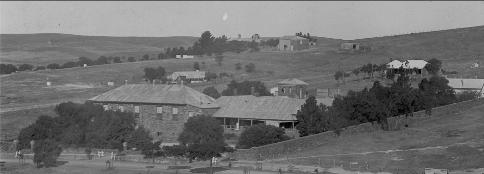
The Burra Hospital in the 1890s which was formerly the Burra Hotel
The Burra Hotel formerly The Miners’ Arms Hotel - 1847
The Miners’ Arms hotel in Market Square started out as a single-storey building and was the scene of much gaming and drunkenness in its early years. By 1855 this hotel was owned by William Paxton, who also owned the Burra and the Pig and Whistle hotels in Kooringa as well as the Burra Brewery and the Smelters’ Home in Aberdeen. In 1878 it was destroyed by fire that had started in the cellars and was rebuilt soon after with additions. In 1880 the name was changed to the Burra Hotel.
George Lord bought the hotel in 1907 and planned to extend it by adding a second storey of fourteen rooms that was completed late in 1911. It became known locally as the George Lord Hotel until 1918, when it once again became the Burra Hotel.
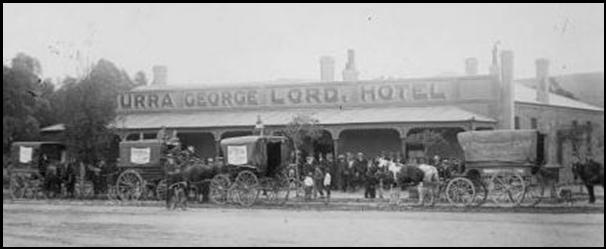
The Burra Hotel formerly the Miners’ Arms
shortly before George Lord added the second storey in 1911
The Smelter’s Home Hotel - 1850
Originally owned by William Paxton, this hotel was established, in Aberdeen, in 1850. In 1861 it was bought by Nicholas Opie and became known as Opie’s Hotel. From here he ran the mail and passenger service to Kapunda in direct opposition to Rounsevells who had previously had a monopoly on this business. It is now a private residence.
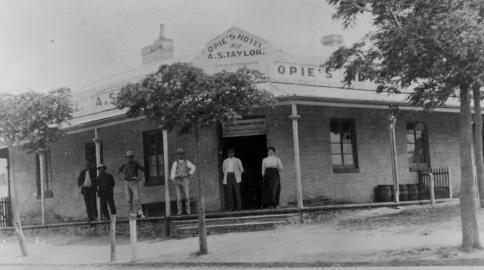
Opie’s Hotel
c1900
The Courthouse Hotel - 1858 – 1921
This building opposite the Redruth Methodist Church, was one of Redruth’s original hotels. It was the meeting place for the Forrester’s Lodge from 1859, the licensee being a foundation member of the lodge. After its sale in 1921 it became a maternity nursing home where many of the local children were born between then and 1938. It has been a wood yard, a garage and taxi service headquarters and tearooms.
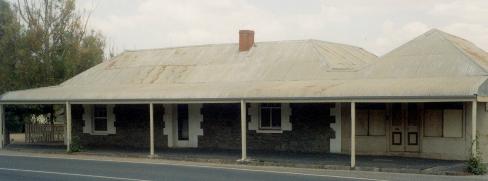
The Former Bon Accord Hotel – 1874
Built in 1874 this imposing two-storey hotel, with its balcony, in New Aberdeen, was named after the nearby Bon Accord Mine and was to serve the newly completed railway station and the saleyards. The character of this building changed significantly with the removal of its balcony. It traded until 2010 when it became a private residence.
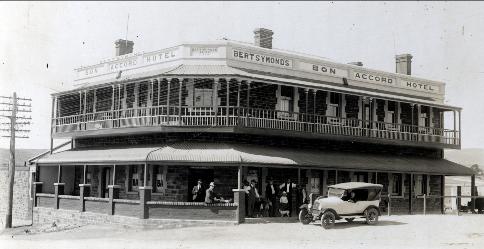
The Bon Accord Hotel c1920s
The Royal Exchange Hotel - 1879
This hotel came into existence after fire destroyed the Aberdeen Hotel in 1879, which was on a site on Best Place Aberdeen. Its owner William .R. Ridway who owned an existing building, on the corner opposite Sara’s, converted it into the Exchange Hotel, enlarging the accommodation space with additions to the south of the premises.
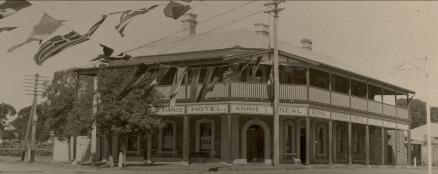
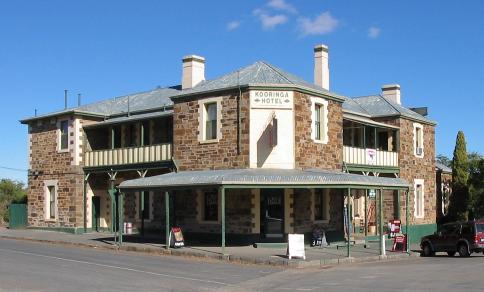
The Former Kooringa Hotel – 1884
This building on the corner of Welsh Place and Kingston Street was built by the owner of the Unicorn Brewery, Edward Lockyer. It is built on the site of the Church of England Grammar School from 1864 to 1873, which took over what had formerly been the Welsh Chapel, built in the 1850s. The old Welsh Chapel was demolished in 1884 to make way for the hotel.
The exterior of the building, as seen today, has changed little since its completion in 1884 and it is a fine example of the architecture of that time. It closed its doors as a hotel in 2013.
The Vanished Hotels of Burra
The Aberdeen Hotel - 1850
This hotel built in 1850 was destroyed by fire October 1879 and although it was not replaced, its owner purchased a building nearby in Best Place and established the Royal Exchange Hotel.
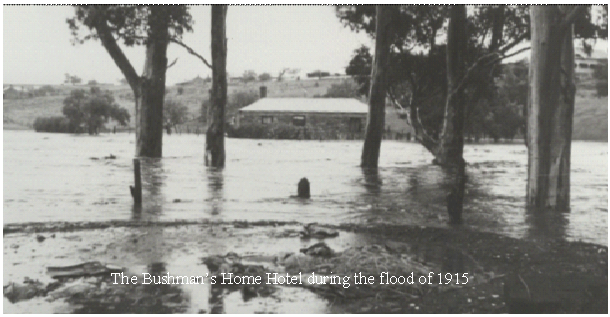
The Bushman’s’ Home
This hotel in Redruth, next to the Redruth Wesleyan Church, was owned by Nicholas Opie from 1857 to 1861.
The Kooringa Hotel
2006
The Racecourse Hotel 1859 - 1896
This hotel in Lostwithiel, one of the small townships to the west of the Burra Mine, was as the name suggests close to the racecourse.
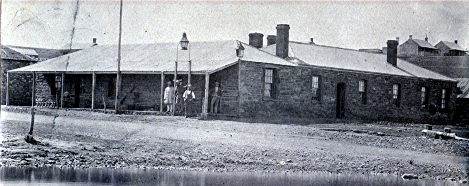
The White Hart Hotel – 1851
This hotel, in Aberdeen on the eastern bank of the Burra Creek, was built in 1851. It comprised 22 rooms and was a booking office for the North Eastern Coach Line for several years around 1876. It became the Temperance Hotel in 1887 and was a boarding house in 1891. In 1916 when it was destroyed by fire, it was owned by James Reed, used as the home of Mrs. A. Sara, who had allowed the Boy Scouts to use some of its rooms for their meetings. It has since been demolished.
The White Hart Hotel after the flood of 1910
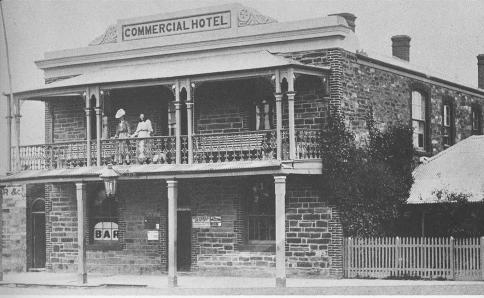
The Commercial Hotel – 1876
The Commercial Inn opened on this site in 1859, but it closed in 1863 and was demolished. The present two storey building, with its balcony overlooking Commercial Street, was erected in 1876. During its history it has seen a few alterations, but its façade remains as it always has.
The Commercial Hotel in 1910
The Pig and Whistle Inn - 1851
This hotel on the corner of Thames and Stocks Streets was one of the first buildings in Kooringa. At the time of its erection in 1851, it was described as a ‘triumph of architecture’ and it served the burgeoning population of mine workers who lived in dugouts along the Burra Creek. It was originally owned by William Paxton one of the Mining Company Directors, who also owned the Burra Hotel and the Miners’ Arms.
It was destroyed by fire February 1883 and was not rebuilt. It continued trading for a while in the remaining undamaged rooms of the original building. Its dilapidated state led one correspondent to the local newspaper welcoming a large flood down the Burra Creek, which had been subject to flooding in the past, to carry it away. The only sign of its existence today is a depression in the ground that was probably the cellar.
The Unicorn Brewery c1890
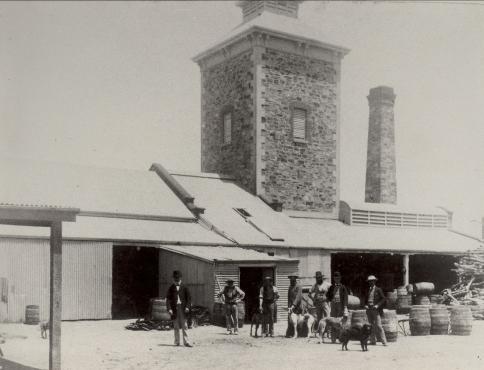
Mr. Edward Catchlove Lockyer, manager is on the far left of the picture.
The Unicorn Brewery 1873 - 1902
This brewery supplied many of the hotels of the townships of Burra and places as far away as broken Hill with Unicorn Ale during its operation. It was the second brewery of the town being established by Willaim Henry Banks in opposition to the brewery adjoining the original Burra Hotel on Limestone Hill run by W.H. Williams. After its closure in 1902, because of changes to government regulations controlling breweries, it stood idle until April 1905, when it was put up for sale together with all the hotels owned by Messrs. Lockyer and Co. The Burra hotels listed were the Bon Accord, Kooringa, Burra, formerly the Miners’ Arms, Commercial, Opie’s, Royal Exchange, and the Courthouse. Whilst there were buyers for the hotels, there was no offer made for the brewery.
The brewery was demolished in 1911 after it was purchased by the Education Department of South Australia and its stone used for cottages built on the site.
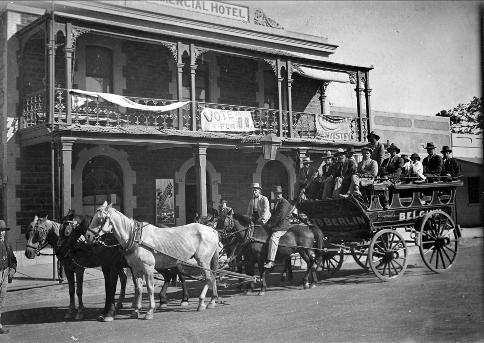
The Commercial Hotel 1915
Hotels as Meeting Places
The hotels of the townships of Burra were always important meeting places. The picture above shows the Commercial Hotel during the World War I when elections for the State House of Assembly were shortly to be held. The local candidates often gave election speeches in the hotels, following the lead of George Strickland Kingston, who in 1851 held a public meeting at the Burra Hotel seeking votes for his election as the Burra District’s representative in the first State Parliament. The Burra Hotel was the polling place for the election, and after a bitter struggle, Kingston was elected.
As well as the usual celebrations and fund-raising events held by community organizations and sporting clubs, ratepayer meetings and protest meetings were commonly held on hotel premises. One important function of some hotels was the holding of court inquests into many of Burra’s disasters, like fires. Welcoming weary travelers, the hotels of Burra have been hosts to business presentations, sales promotions, wrestling, boxing, gaming and in time of war, recruitment.
The photograph above also shows that a dentist W.E. Thomas who came to Burra on a regular basis, practiced in the Commercial Hotel.
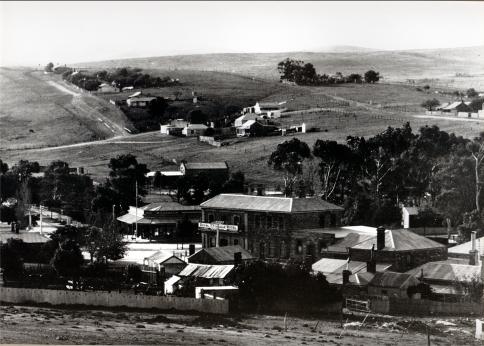
A view of the two-storey Royal Exchange Hotel from the Mine site looking into the township of Aberdeen. The additions to the original building are clearly visible on the right and the balcony is yet to be added.
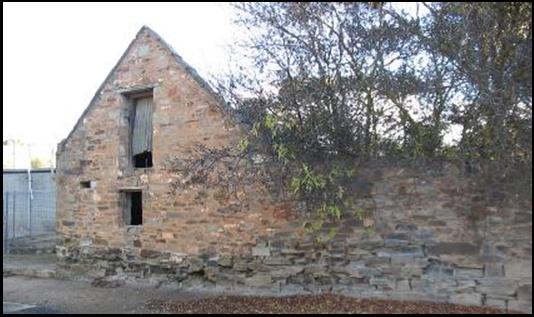
Until the arrival of the motorcar and for sometime after every hotel provided stables for its clients. This is a view of the stables at the rear of the Royal Exchange Hotel in 2006
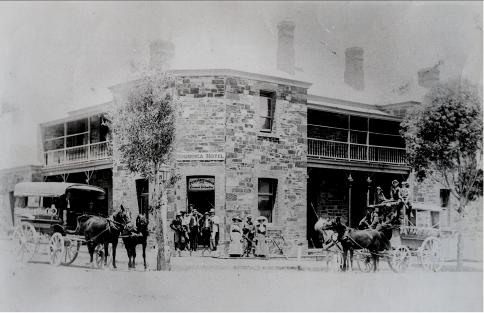
The Kooringa Hotel in 1911
Percy Gottschalck Proprietor
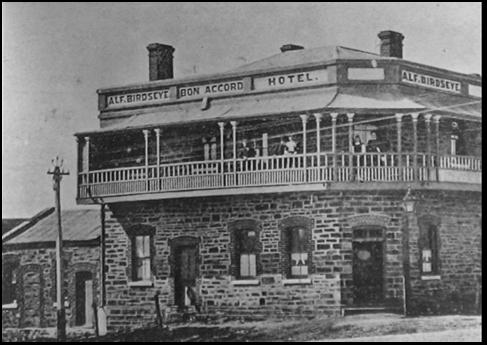
The Bon Accord Hotel in 1909, Alf Birdseye Proprietor
Compiled by Julian Ratcliffe
The Burra History Group Inc.
2008