
Atmospheric Beam Engines
A beam engine is a steam engine with a vertically moving steam piston pushing or pulling on one end of a beam, pivoted near its centre. At the other end of this beam a pump or other mechanical device is attached, the rising and falling of the beam powering such devices. At mine sites, beam engines were used for pumping, winding and crushing.
Atmospheric engines worked on the principle that when steam condensed it contracted causing a low pressure inside the cylinder of the engine. When steam was admitted to the cylinder, slightly above atmospheric pressure an injection of cold water into the cylinder caused the steam to condense, lowering the pressure in the cylinder. Atmospheric pressure then forced the piston down to the bottom of its stroke, drawing the beam down. This was the working stroke of the engine, which raised the pump rod connected to the other end of the beam. Because the pump rod was heavier than the piston, it would then drop under gravity, causing the piston to rise to its original position in the recovery stroke. This resulted in steam entering the cylinder again. The beam was usually made of cast iron and weighed from 16 to 30 tons. The cylinder was also an iron casting encased in a steam jacket. A system of valves enabled an operator to control the number of strokes per minute the engine made.
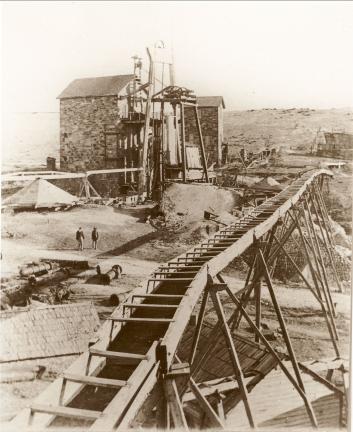
This 50-inch engine erected at the Burra Mine in 1849 was the first and last Cornish beam pumping engine erected in South Australia, having been transferred to the Bon Accord Mine in 1859 and finally to the Bird in Hand Mine, Woodside in 1886.
This pumping engine was a replacement for Roach’s engine. It was a larger 80-inch engine, Built in Cornwall by the Perran Foundry Co. and served by three Cornish boilers. At one time it was planned to reinstall this engine in Graves’s engine house but this was shelved when the mine went to an open-cut operation.
Peacock’s Engine
Morphett’s 250-horse power, 80-engine manufactured in 1857, by Perran and served by six Cornish boilers in the adjacent boiler house, commenced operation in March 1860. Pumping water from a depth of up to 600 feet, it had a 32.5-foot beam weighing 30 tons with a pump stroke of 10 feet. Working at eight strokes per minute, this engine pumped more than two million gallons of water per day, considerably more than Schneider’s Engine and kept the water in fork at the 60-fathom level. Water pumped from the shaft flowed along a launder to the dressing tower or to the engine pool, for use in the boilers. .The engine remained in its house after ceasing operation in November 1877 until it was removed for scrap in 1916. In 1925 a fire gutted the engine house and the upper part of the shaft timbers.
One early reminiscence of the Burra Mine described the pumping engines.
“The most important machine on the mine was the pumping engine. When I was only a small boy I was taken in the boiler-house of Schneider’s engine and was awe-stricken to see the three great boilers with their terrible fires into which they were cramming still more wood. But I got a proper scare when the firemen suddenly turned on the steam and water taps, they made such a noise. Morphett’s engine was erected later and I was older when I was shown over it. The mighty balance ‘bob’ seemed to have irresistible force behind it and the big cylinder encased in wood and packing impressed one as being wonderfully powerful. I liked seeing the bright ironwork with moving rods, up and down movements of handles, the turning of other parts which I cannot name, all seemed perfect in their rhythm and time. And I was told all these movements were necessary to control the valves for steam or control the ingress or egress of steam to the cylinder. It was a marvel of ingenuity and force. Then we went upstairs and here we saw the top of the encased cylinder with the immense piston rod being forced up and moving the great bob up and down. The bearings and axles on which the bob moved were of great size and strength. Watched from outside the bob came down steadily but rose more rapidly bringing up a great quantity of water, which ran through wooden flumes or launders as they were called, into the engine pool, filling it up during the night and by a sluice gate it was run out during the day for dressing purposes. During the summer this pool was used for swimming, but the water was very cold. Nevertheless I have seen many bathers there on a hot evening. I did not like this pool as much as I did the smaller one near the engineer’s workshop. This was a warm pool from the engine condensing water. This warm pool was not so deep either and it swarmed with boys who played about for hours with planks and rafts floating therein.”
Solomon Williams
Morphett’s Winding Engine
This 30hp rotative beam engine was installed in its stone half-house adjacent to Morphett’s pumping house to be powered by steam from its boilers. It commenced operating in October 1861 and hauled ore from Hector’s shaft until 1868 when it was no longer needed for the open-cut operations that continued until the closure of the mine in 1877.
Morphett’s engine house was reconstructed in 1986 as part of South Australia’s Jubilee 150 celebrations and is the only reconstructed Cornish engine house in the Southern Hemisphere. The balconies were restored in 2006.
References:
Cornish Beam Engines in South Australian Mines G.J. Drew and J.E. Connell
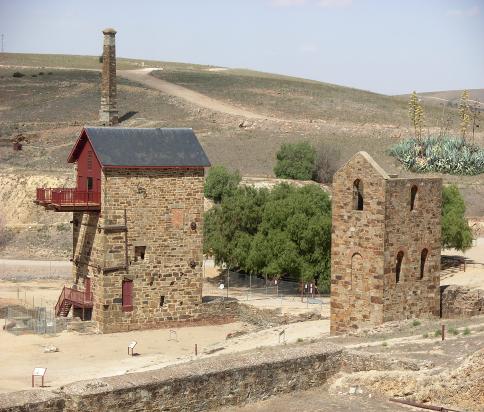
Morphett’s Pumping house, on the left, showing the restored balconies and
Morphett’s Winding house, on the right, with Morphett’s Pool in the foreground.
February 2007
Compiled by Julian Ratcliffe
The Burra History Group Inc.
2007