JOHNNY GREEN
BURRA
SOUTH AUSTRALIA
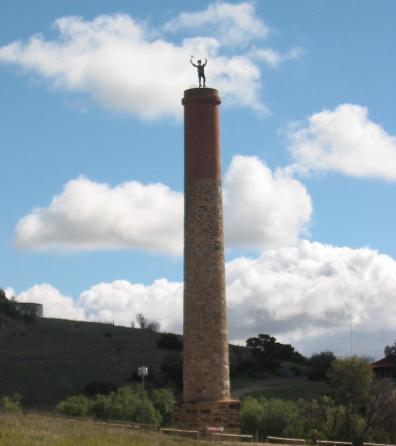
Johnny Green as he is today on Peacock’s Chimney
© The Burra History Group Inc.
2008
JOHNNY GREEN
S.T. Gill’s painting entitled the Surface Operations of the Burra Mine painted in 1850, shows a figure mounted on the shears in front of Roach’s Engine house. This figure was a life-size effigy of a Cornish miner, holding a miner’s pick and gad aloft. It appears that this figure was placed there as part of the celebration of the erection of the mine’s first engine house. Whilst such a celebration was common in Cornwall, this figure seems to have been an original idea. In Cornwall there was a tradition of hoisting a small tree to the highest point of a pump-house in celebration of its completion but there is no record of a Johnny Green in Cornish engine-houses. Known as ‘Johnny Green’ he became the mine mascot and a legend among the children of the Burra Mine townships. Various claims have been made as to the originator and creator of ‘Johnny Green’, one such claim being the Green family of Narrogin W.A. The family claims that the effigy is of Henry (‘Johnny’) Green a Cornish stonemason who helped build the first engine house. The miner’s pick and gad in Johnny Green’s hands suggests he was a miner. He was, after all, the mascot of the miners.
In March 1855 a visitor to the Burra Mine, writing in the Adelaide Observer noted: ‘The shears above Roach’s shaft are standing although the engine has been removed and the figure with its pick and gad still occupies its old place.’
‘Johnny Green’ was shifted to the shears of each new engine house on its completion. The first figure being made of wood was short-lived.
The second ‘Johnny Green’ was made of sheet-iron and proved more enduring having been fashioned by a Burra Mine blacksmith. This new Johnny Green took up his position high up on the ‘bob platform’ of Schneider’s Engine-house soon after its 80 inch beam engine imported from Cornwall had been installed in 1852. William Bentley’s painting of 1857 shows him there. ‘On approaching the mine, the first object that strikes the eye is Schneider’s Engine-house with its immense beam displaying its giant strength from the summit of the building. The engine works at 7 strokes a minute raising each time 136 gallons of water,’ a visitor wrote.
Celebrations for the completion of an engine-house sometimes involved a ‘christening’ with the drinking of a barrel of ale atop the structure. Schneider’s Engine-house was certainly ‘christened’ with the breaking of a bottle of Champagne over the beam by one of the Directors of the Company.
In 1858 the miners shifted their mascot for the last time. It was set atop the shears of Morphett’s Engine-house on its completion in 1858, where it stayed for the next 67 years, well beyond the closure of the Mine in 1877.
During the ‘Back to Burra’ celebrations in 1925 an old miner, John Beal came back to see Johnny. He had been a ‘roper’ and used to stand by the iron figure on the high platform of Morphett’s shaft.
The Legend of Johnny Green
Old Burraites, like John Beal, always retained an affection for the miners’ mascot, with him achieving legendary status particularly among the young children of Burra. Every small boy knew that at midnight when their house clock struck twelve Johnny came down from his tower and ran around the town checking on children to see if they were asleep. Time, then, to hide under the blankets before he peeped in at the window. Small girls it seems were more sceptical of the little man’s ability.
In 1936, Elizabeth Ward wrote: I remember him in all his glory standing erect upon the big engine-house, pick and gad in hand, a representative of ‘that theere Cornish Miner’. It is said that a blacksmith working on the mine made him and placed him in position. I have never heard him named. He was always referred to as ‘that there Man up to mine’ and was a personality in those days. Mothers trying to get a flock of unwilling children to bed would say ‘you’m childer best be going to bed or else you’m be having that there Man up along to Mine peeking in the window at ‘ee’. To which a saucy maiden would reply ‘Aw, us wodden keer would us? Tis a’ better, Meary, if we could only see him. Ded ‘ee ever see ‘im yerself, mawther?’
A group of boys returning from carrying ‘feythers’ crib would gather round the big engine house. One little chap stands, legs wide apart, mouth open, eyes staring at ‘That theere Man’. ‘Whatever be matter wi’ ‘ee Tommy, what be ‘ee glaring up along like that for? Alec replies ‘Tommy, if he du come down, however du ‘ee get up again?’ Whatever be ‘ee talking about?’ asks Billy. ‘Why when that there man du here the clock strike twelve he du come down and run all round town. However du he get up along again?’
Jan’s reply is crushing – ‘Gose along home with ‘ee thu gurt buffle head, whenever ded that theere Man heer clock strike?’
The Fall of Johnny Green
A spectacular fire in December 1925 resulted in the fall of Johnny Green. At about 11am on Saturday the twelfth smoke was seen issuing from Morphett’s Winding house and later residents beat out a small grass fire around Morphett’s shaft. However the fire proved to be more serious than was realised and they tried to put it out themselves, before raising the alarm. By 2pm the fire was out of control and fighting the fire became out of the question as both of Morphett’s engine houses were in flames. The woodwork of enormous dimensions burned like matches and as there was an immense amount, it took some time to burn. Towards midnight quite a crowd had collected to watch the blazing poppets fall, which supported the platform on which the big pulley wheel was fixed, used when the mine was working drawing stuff up and down the shaft.
On this platform 50 feet high stood a life-sized figure of a miner holding a pick and miner’s gad that always attracted much attention and was looked upon with feelings amounting to veneration from Burraites. Many sincere regrets were expressed when in company with the white-hot 5ft. diameter wheel it crashed to the ground. The wheel broke but the figure was not badly damaged.
Morphett’s shaft, which is almost under the large engine house, is 600 feet deep and heavily timbered was burning fiercely. The sight at night of the flames leaping to a great height was very beautiful.
‘The next day with columns of smoke ascending one could hear the heavy timbers falling away and crashing to the water below. It has been alleged that the fire was caused by lads smoking out rabbits that lived in these old buildings. Old miners believe that it will take many weeks for the fire to burn itself out. The only thing left intact is the famed echo, which is as clear as ever’, reported the local newspaper.
The Resurrection of Johnny Green
One of Johnny’s champions Frank Treloar wrote a letter to the local newspaper in 1933 urging the Council to bring him back to life by erecting his figure somewhere suitable at the mine. Johnny Green had been rescued from the ashes of the fire, one that had destroyed the timbers of Morphett’s Engine-house and shaft and eventually he was raised up on a pole at the entrance to the disused mine. Here he stood until 1967 when vandals cut him down. He was too badly damaged by now and he was put into storage.
In the 1970s when Samin Ltd. began its modern open-cut mining operations at the mine, it became necessary to demolish Peacock’s Engine-house and its smoke stack. It was decided to dismantle the stack stone by stone and resite it at the mine entrance. The engine-house was dynamited and its stone put to further use. A third Johnny Green was made and now he stands proud, silhouetted against the sky, atop Peacock’s resited chimney at the entrance to the Burra Burra Mine.
So who was Johnny Green? The best we can say is that he was the Burra Mine mascot that made the miners’ chests swell with pride.
References:
The Story of the Monster Mine Ian Auhl
Glimpses of the Past Ian Auhl
The Burra Record
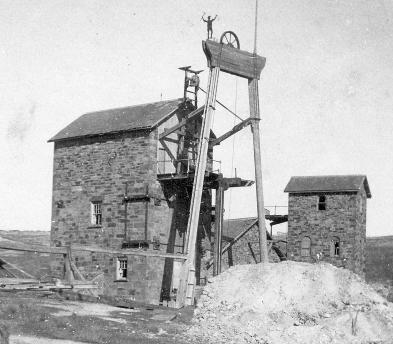
Johnny Green atop the shears of Morphett’s Engine house
Compiled by Julian Ratcliffe for
The Burra History Group Inc.
2008