MARKET SQUARE
HERITAGE WALK
BURRA
SOUTH AUSTRALIA
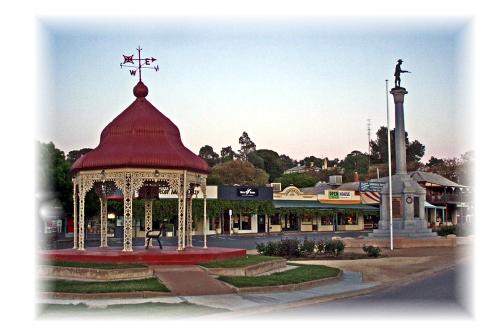
Market Square
2008
© The Burra History Group Inc.
2008
1
Introduction
This publication is designed to lead visitors on a leisurely walk back into Burra’s past. On this walk you will see many of the important buildings that are so much a part of the town’s character and history. Dating from as early as 1846 when Kooringa was a mining town, continuing through the Victorian and Georgian eras the history unfolds before you.
Starting at the Visitors’ Information Centre in Market Square, you will be guided northward along Market Street as far as the Art Gallery. You will then return to Market Square and then along Commercial Street as far as Elder’s Building and return to the Visitors’ Centre. The sites are:
The Visitors’ Centre and Market Square
Schneider’s Engine house Bed-stone
The Town Pump
The Rotunda and War Memorial
Wilkinson’s Chemist
The Gaslight Café
The National Bank
2, Market Street
Dr. Brummit’s Residence
The Burra Town Hall
The Art Gallery (Old Telegraph Office)
The Jinker
The Fire Station
Market Square Museum
The Burra Hotel
The Council Chambers
Kooringa Bridge
1, Thames Street
The Primitive Methodist Church
Thames Street Cottages
Fool’s Corner
The Doctor’s Surgery
The Commercial Hotel
Pearce’s Building
The Bank of Australasia
The Record Office
Drew and Crewes Store
2
THE MARKET SQUARE
HERITAGE WALK
Compiled by Julian Ratcliffe
© The Burra History Group Inc. 2008
3
MARKET SQUARE
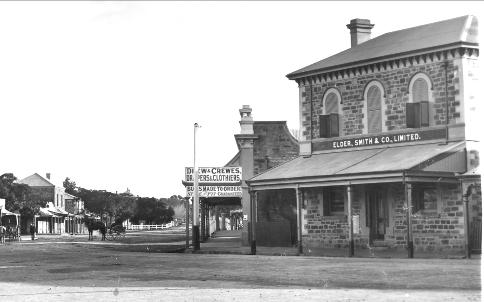
1. The Visitors’ Information Centre - 1890
Originally built in 1890 by Sara and Dunstan as the office of Elder, Smith and Co. Ltd., auctioneers, on a site known locally as “the fruit garden” that boasted trees that were “the best of their kind in the colony” it was a most imposing building. It was acquired by the Burra Council in 1979 and opened as the Tourist Office..
2. Market Square – 1846
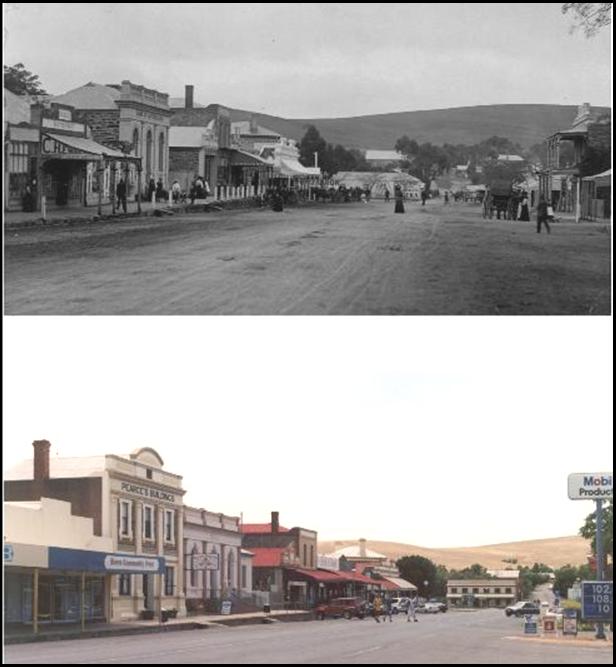
This open area at the end of the road from Adelaide has been the business and commercial centre of Burra since its beginning in 1846 as a part of the original company town of Kooringa. During its history it has seen bullock teams lying down waiting their turn to load. Some historical features displayed in Market Square are:
3. The Bedstone – 1852
This huge sandstone block was one of the two bedstones for Schneider’s 80 inch beam engine erected at the mine in 1852. These stones held the large bolts that secured the beam engine in place. Bedstones like this were often reused when new engine houses were constructed at other sites. It is now presented to you lying on its edge, not as it was originally positioned.
4
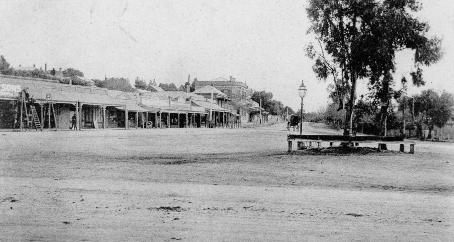
A view of Market Square c1900
4. The Market Square Pump – 1881
A tube well drilled to a depth of 220 feet provided water that rose to within 20 feet of the surface. In December 1881 the hand pump was erected to supply water for a public horse trough and to fight fires. One hundred years later it was restored as an historical feature.
5. The Rotunda – 1911
Erected in January 1911 by the inhabitants of the town and district of Burra as a memorial to King Edward VII, the rotunda has been a focal point for the town on public occasions.
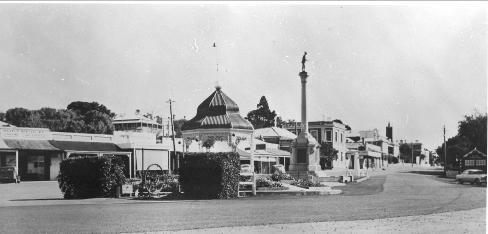
Market Square 1940s
5
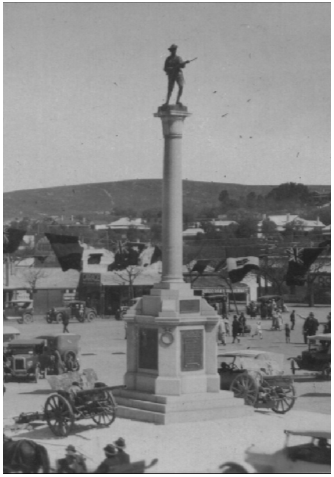
6. The War Memorial – 1922
The bronze figure of a soldier mounted on a marble column was erected as the result of donations from the people of the Burra town and district. It was unveiled by the then Prime Minister W. M. (Billy) Hughes in March 1922.
7. Wilkinson’s Chemist - 1855
As early as 1855 James Parker, a chemist and druggist, was trading on this site. In 1872 T.W. Wilkinson bought this shop from a chemist Percy William Dyer and remodelled the façade of the building that has endured to this day (2008).
8. Gaslight Café – 1848
Built in 1848 and possibly the first two-storey building in Market Square, in 1858 it was leased from the South Australian Mining Association and was known as the Gas Light Café where local miners found themselves a welcome meal
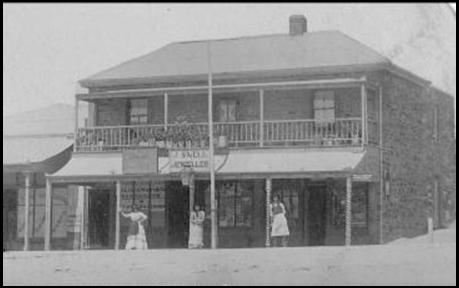
Gaslight Café
in 1878
6
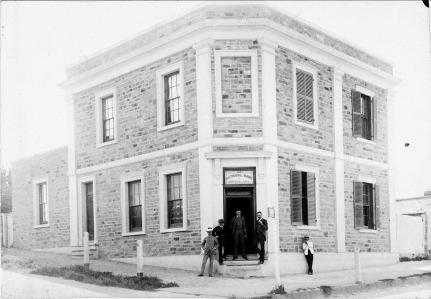
9. The National Bank – 1861
The first bank in Burra, a branch of the National Bank of Australasia, was opened at another site in 1859. At that time, so much money, mainly as promissory notes, and other valuables such as silver, gold and precious ore was stored by miners in their dugouts that the banks of the Burra Creek were referred to as the ‘Savings Bank.’ Solomon Williams who at age 6 months arrived in Burra in 1847, recalled a ‘safe’ in his parents’ dugout. ‘There was a hole high up in the side of the chimney breast….that was plastered up with clay and lime washed over so as to appear the same as the rest of the wall and would be hard to find by any burglar.’
Kooringa 1851.
The trade of this place is conducted with a private circulating medium of local promise notes. The Burra Company issues notes; the Copper Company does the same; those of £1 or higher distinguished by colour. The tradesmen, of course follow the same system and Boord Brothers and Hutchens, shopkeepers, issue their respective notes. All are payable in cash in Adelaide. Little other money is current and silver is scarce; but as storekeepers’ notes are as small as ten shillings and seven shillings and sixpence, the want of change is remedied.
(From ‘The South Australian Register’ - July 1851)
The building that stands here today was built in 1861 and has served Burra as the National Bank continuously since then.
7
10. Number 2 Market Street
Originally a general store, the business premises of David Bayne from before 1851, it was eventually burnt down and then rebuilt. Later Thomas Bath, described as one of the oldest established businessmen in the town who had gone into partnership with William Pearce in 1878, as Bath and Pearce, acquired this site for their business as general importers of drapery, groceries, wines and spirits, it was shown in a calendar produced in 1894. It has been the site of the Pearce Brothers’ business, until 1907, Seabury’s, until 1909, J Allen’s store selling refreshments, until 1933, Arberg’s Butchers, until 1947 when it became the Burra Cold Stores run by E.G. Franklin and C.H. Cummins. It is now McPhee’s butchers shop.
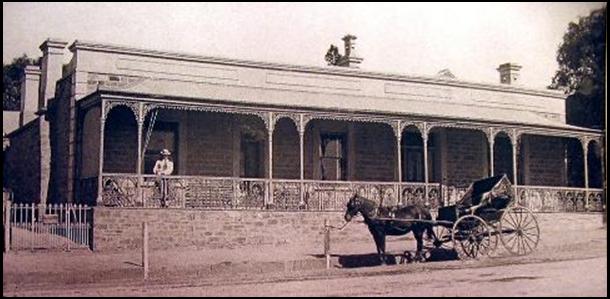
11. Dr. Brummitt’s Residence - 1882
The original building on this site was a three-roomed cottage dating from the 1860s. It became the residence of Dr. Robert Brummitt 2 years after his arrival in Burra in 1877 to join Dr. Nesbit. Dr. Brummitt served as the local doctor for 23 years and also as the medical officer of the Redruth Gaol for 17 years. During his time here he was twice elected as the town mayor and was one of those responsible for developing the Burra Hospital. The residence as seen today was built in 1882, incorporating the original cottage and provided a little room that served as his surgery up until his departure in 1900.
8
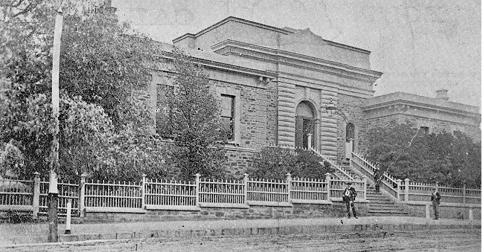
12. The Burra Institute (1857)
This historic building situated in Market Street and listed in the National Heritage Register began life as a much more modest building, serving as the Miners’ and Mechanics’ Institute. Built by a committee of civic-minded members of the town on land granted on a 99-year lease at ‘peppercorn rent’ by the Mining Company, it was opened in August 1857. It was given to the people of the town “for the purpose of improving their minds and advancing their social position by acquirement of that information which shall prove most useful to them and which by the help of such Institutes is brought within reach of every man however humble his lot.” This was to be achieved by providing a library with a reading room and by holding lectures monthly.
A New Institute (1875)
Rolland Rees, an Adelaide architect and the member for Burra in the House of Assembly redesigned the institute in 1874. This much more imposing building, which was built by John Pearce of Burra on the same site, consisted of a main building with two wings. The entrance hall, which was designed to act as a museum had sliding doors that allowed it to extend into the lecture hall with a library and reading room in one wing and a committee room and classroom in the other. The Grand Opening was held on the 14th October 1875, with the hope that it would provide the town with “a well stored library, an instructive museum, educational classes, popular lectures and agencies in every direction whereby the mind might be cultivated and the feelings refined.”
9
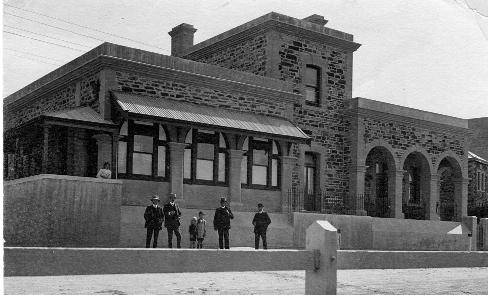
13. The Kooringa Telegraph Office (Burra Regional Art Gallery)
The original Telegraph Station on this site, designed by the architect Edward Hamilton and built by Mr. Francis of Adelaide at a cost of £653 went into service in September 1860. At the time it was described as having ‘a very possessing appearance…and a model (of workmanship) for our local tradesmen.’ Since then its appearance has changed considerably, being altered in 1890, with an addition incorporating arches on its southern side, to house a postmaster and again in 1911 when after demolition of part of the original building followed by additions, with arches on the northern side of the building made way for a telephone exchange.
It gained a place in history, in December 1862, when an emaciated, John McDouall Stuart returning from his crossing of the Australian continent from south to north and back, sent his historic telegram informing the Governor-in-Chief of the success of his expedition and the immanent return of his party to Adelaide.
This post and telegraph office served its community for 100 years until its closure in 1960. After the Burra Council purchased the property from the Commonwealth Government in 1994, the building was restored and it was opened as the Burra Regional Art Gallery in October 1996. It houses the historically important Samuel Gill collection of paintings of Burra that were commissioned by SAMA between 1847 and 1850
10
14. The Jinker – 1851
This 40 foot long jinker, constructed in 1851, built of Blue gum and Ironbark, is a relic of colonial transport. It was purpose-built, for bullock teams, to haul the pumping machinery imported from Cornwall for the purpose of dewatering the Mine the distance of over 100 miles from Port Adelaide. It was first used by bullocky Bell Freeman in 1852 to move the 17 ton cylinder case for Schneider’s 80 inch atmospheric steam engine with a team of 72 bullocks and in 1858 William Woollacott transported the engine for Morphett’s pump house, the return trip taking two months. The Industrial Revolution literally came to Burra riding on a jinker.
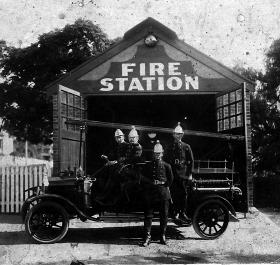
15. The Former Fire Station - 1922
As early as 1877 after fire destroyed Mr. Dunstan’s house in Redruth and later in 1878 and 1879 after the loss of the Miners Arms Hotel and the Aberdeen Hotel in separate fires, there were calls for a town fire station. The Mine fire engine had been called out to these incidents but because it had a considerable distance to travel, arrived too late to be of much use. In 1877, Captain Sanders had offered the mine engine with horses and harness, but wanted the town to provide proper uniforms for volunteers and a small sum annually to maintain the engine and hoses.
These calls went unheeded despite the destruction of the Pig and Whistle Inn by fire in 1883, a fire at the Record Offices in 1910, and serious fires in Market Square in 1883 and again in 1915.
Tenders were eventually called by the Town Council for the erection of a fire station in 1921, and again in 1922, only to see both tenders being rejected because, at a cost just over £300, they were considered to be too expensive. In 1922 after much debate, the Town Council did borrow the money to build this fire station with the fire bell from the Police Station being transferred to this site. The premises were rented by the Metropolitan Fire Brigade at a cost of £18 per annum.
11
16. The Market Square Museum - 1880
Built in 1880, this building was originally the shop and residence of the tailor Andrew Wade. It was acquired by the Burra Branch of the National Trust of South Australia and opened as a museum in 1966. On display in the museum are a large number of artefacts and furnishings from the period 1880 to 1920 donated by members of the district. The shop at the front of the building is now a sweets shop.
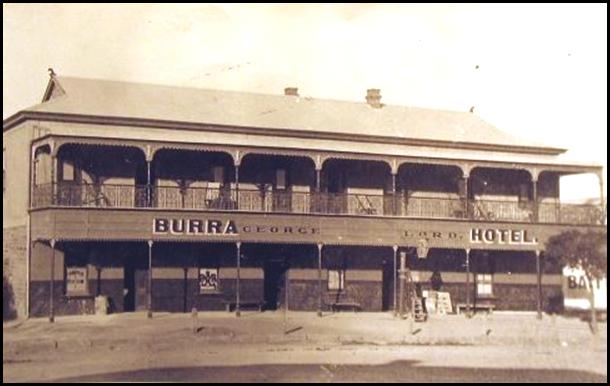
17. The Burra Hotel - 1847
Built in 1847 and named ‘The Miners’ Arms’ it was first licensed to H. Chandler. Early in its history it was owned by William Paxton a director of the mining company who also owned the ‘Burra’ and ‘Pig and Whistle’ Hotels. These hotels were supplied by The Burra Brewery.
In 1877 it was renamed the ‘Burra Hotel’ and after it was gutted by fire in 1878, it was rebuilt. It became the ‘Burra Lord George Hotel’ in 1906 and in 1912 the second storey was added. In 1918 its name reverted to the ‘Burra Hotel’.
This building is not to be confused with the original Burra Hotel on Limestone Hill, the first hotel in the town that eventually became the Burra Hospital.
12
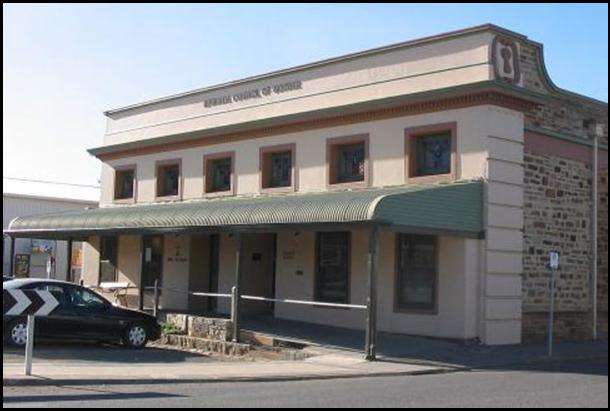
18. The Goyder Council Chambers
The first District Council of Burra Burra was formed in 1872 and they met in the Miners’ and Mechanics’ Institute building and in 1876 it became the Corporation of the Town of Burra.
This building was originally built in 1924 as the Farmers’ Cooperative Union store. The Farmers’ Union monogram is still visible in the old leadlight windows and embossed on the outside façade. After World War II it was used as the RSL Hall and as the District Council offices and chambers since 1979. It is now the offices of the Regional Council of Goyder.
19. The Kooringa Bridge (1879) The Kingston Street Bridge
This cast iron bridge was completed in 1879 and replaced the Bridge Street Bridge, which was washed away by a flood in 1877.
Built a little further upstream from Bridge Street, it consists of two 18metere spans supported on two cylinders sunk into the creek bed.
A concrete deck was added in 1933.
The bridge was reinforced with steel girders and concrete columns in 2004.
13
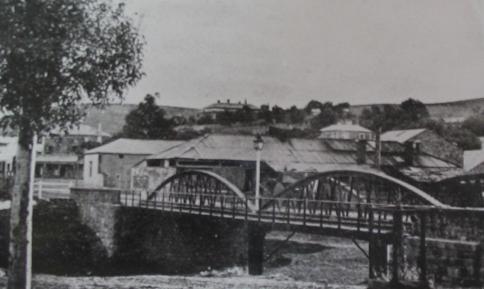
The Kooringa Bridge Kingston Street
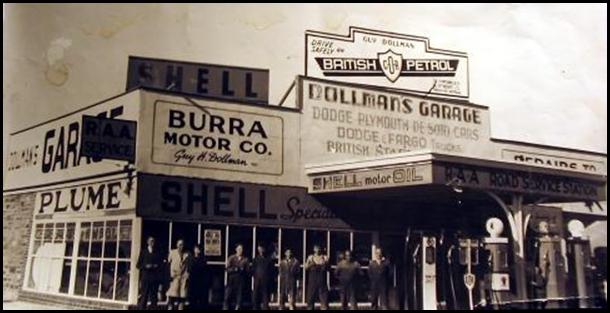
The Burra Motor Company in the 1950s
14
20. Wright Motors – 1928
This property, originally the ford across the Burra Creek became 1, Thames Street, after construction of the Kooringa Bridge. In 1894 it was reported as being held by Luke Day grocer, fruiterer and general dealer. He was a local market gardener who traded here until 1928 when he sold the property to Wright Motors. They erected a motor garage, showroom and service station, trading here until it was taken over by Guy Dollman in the 1930s, who renamed it the Burra Motor Co. Dollman traded here until 1998 when it was bought by the Webster bothers. Trading as a BP service station they added a cold store supplying frozen small goods.
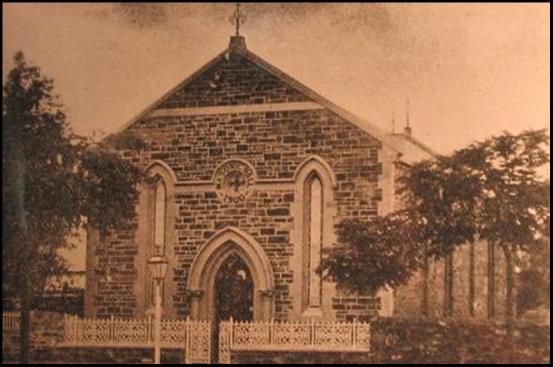
21. The Primitive Methodist Church (1879) - Masonic Hall
Originally this hall was the Primitive Methodist Church. Whilst the original Primitive Methodist Church was erected in 1849, extensive modifications in 1879 gave us the present structure. The church manse attached, on the northern side of this building has been demolished.
It became the Masonic Hall in 1900 when the three branches of Methodism combined, (Bible Christians, Primitive Methodists, Wesleyan Church).
It is now a private residence at number 9, Thames Street.
15
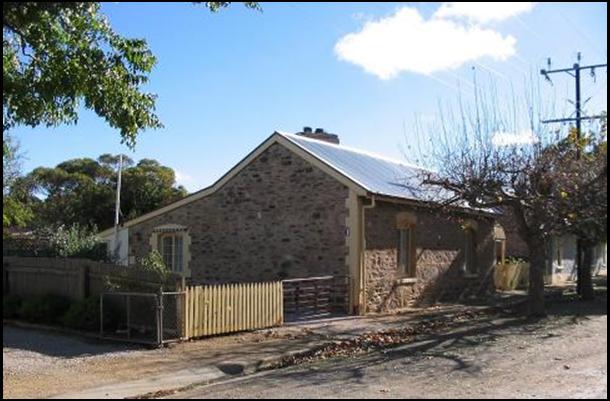
21. Thames Street Cottages – 1846
The Thames Street Cottages were the first cottages built in Kooringa, a company owned township. Built in 1846, soon after the laying out of the town, the first eight of these double cottages were designed by the architect George Strickland Kingston, a director of the S.A. Mining Association, for mine employees.
Constructed of bluestone and originally having floors of local slate, they were designed to house two families, being separated by a solid dividing wall. To cut costs, after the first cottage was completed, the slate floors were dispensed with in future cottages. One prominent feature of these cottages is the massive four-way chimney in the centre of the building serving fireplaces in each of the four rooms. Each family had a bedroom at the front of the cottage which is entered from the side of the cottage with a kitchen behind having a doorway to the backyard. The cottages’ earthen floors, canvas or calico ceilings and stone walls were whitewashed; the roofs were made of split timber shingles. These shingles are still in place under the galvanised iron roofs that were first erected in 1872. The cottages were rented to miners until at least the 1870s when freehold title was offered by the company as they gradually began selling off their holdings. They are probably amongst the earliest domestic buildings in South Australia still in occupation.
16
20. Fool’s Corner (Cnr. Commercial and Thames Streets)
On this site, the first cottage for mine employees was erected by the Mining Company in 1846. As early as 1878 Mr. Ford had a shop on this corner of Market Square, presumably in the original cottage. During a storm, in November 1878, the verandah of this shop was torn away and deposited on Mr. Wilkinson’s residence.
In March 1887 it was reported in the Burra Record that E.A. Moore opened a private Labour and Registry Office at ‘Ford’s Corner’.
A report in the paper in September reported that E.J. Harris had purchased this shop now known as ‘Fool’s Corner’ and is turning it into a general grocery store. An entrance was made through the division wall of the cottage, to provide more display room and a large cellar was excavated, to store butter. It would seem that it became ‘Fool’s Corner’ after several bouts of larrikinism there.
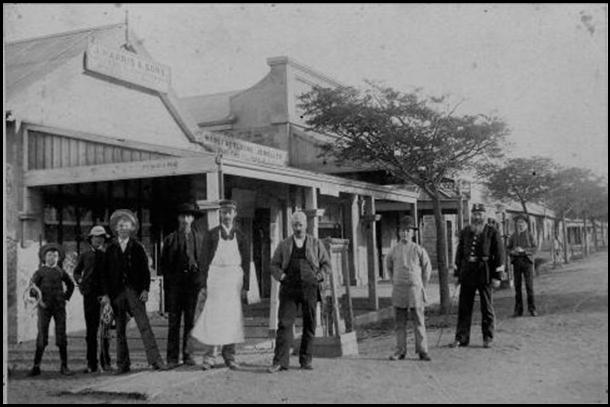
The general store of J. Harris and Sons at Fool’s Corner
c1890s
17
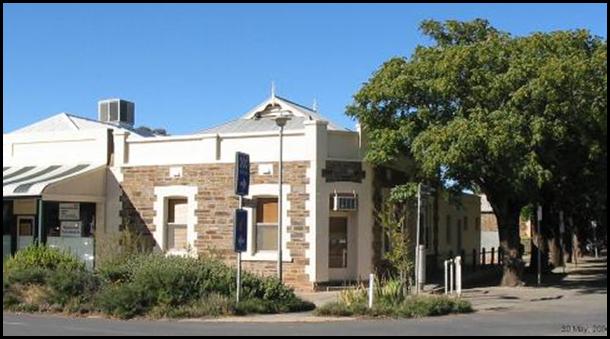
24. The Doctor’s Surgery - 1908
This building, dating from 1908, was built as the offices of Dalgety and Co. They demolished some old cottages known as ‘Tobins’ to make way for the new building. In 1911 it became the Kooringa branch of the Commercial Bank of Australia. Between 1969 and 1979 it was the offices of the District Council of Burra before transferring to their present site in the old Farmers’ Union building. Since 1979 it has been the doctor’s Surgery.
18
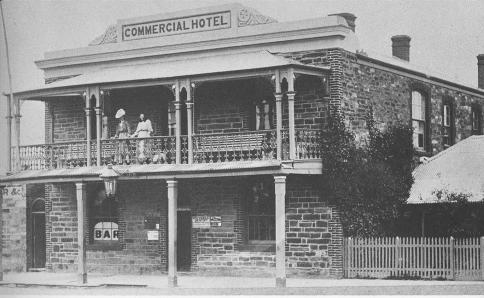
25. The Commercial Hotel – 1876
The original building on this site was the Commercial Inn which was opened in 1859, was closed in 1863 and demolished. This building was erected in 1876 and opened for business as the Commercial Hotel, providing food, drink and accommodation with an ostler and stables. It is still trading as the Commercial Hotel today. The photograph on the page opposite shows the hotel in 1910.
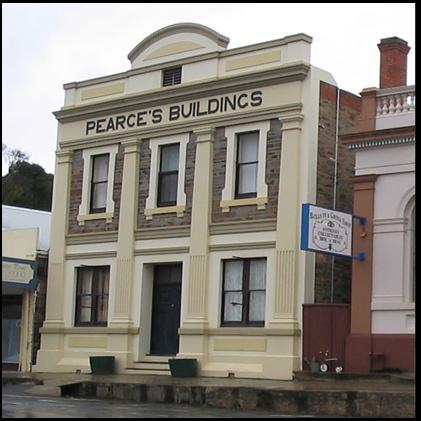
26. Pearce’s Building – 1914
The Burra builder John Pearce bought this site next to the bank of Australasia and erected this building as his office. Consisting of two suites on the ground floor with a large hall at the rear, which was hired out for meetings, entertainment and private parties and two suites of offices upstairs, it was used by many different businesses over the years, including a Naturopath, a hairdresser, two different dental surgeries and the Electoral Office.
During World War I the Cheerup Society used the hall as their meeting room and tea rooms run by the League of Loyal Women.
19
27. Former ANZ Bank – 1878
The original branch of the Bank of Australasia opened in Kooringa in 1860 at a site in Market Street adjacent to the Institute. They moved to the present site in Commercial Street into a new building designed by the architect G. F. McLagan of Melbourne, was built for the bank by the local builders Sara and Dunstan at a cost of £1620. Whilst work on the building commenced in December 1878 it was not occupied until May 1879.
This building served as the Bank of Australasia for many years, eventually becoming the Burra branch of the ANZ Bank, until it closed in 1997. It is a good example of the architecture of its day.
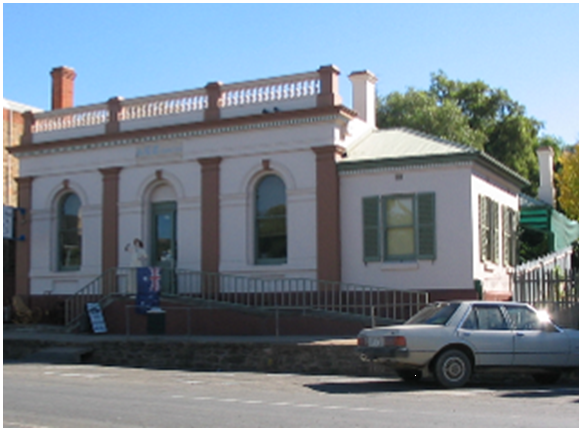
28. The Former Burra Record Office Commercial Street
The Burra Record, the local newspaper was published at these premises from 1921 and was destroyed by fire in 1935.
The first newspaper published in Burra started life in 1876 as the ‘The Burra News and Northern Mail’, later in 1878 becoming the ‘Burra Record.’
20
Its first editor Frederick William Holder a school teacher at the time rose to become the Premier of South Australia and the first speaker of the Federal Parliament in Melbourne. Its offices were originally in Market Square and were destroyed by fire in 1910 and after a period of 3 months continued publications on that site. The ‘Record’ ceased publication in 1977, after 100 years of service to the town and district.
29. Drew and Crewes Store – 1880
This building in Market Square was built in 1880 for the Company of Drew and Crewes as its general store in Kooringa. It was one of the first businesses in the town to have a telephone which connected it to its bulk store in Aberdeen. The firm was originally established by Samuel Drew in 1848 and after going into partnership with E. Crewes continued trading until 1938. This building preserves the character of Burra’s late 19th Century businesses.
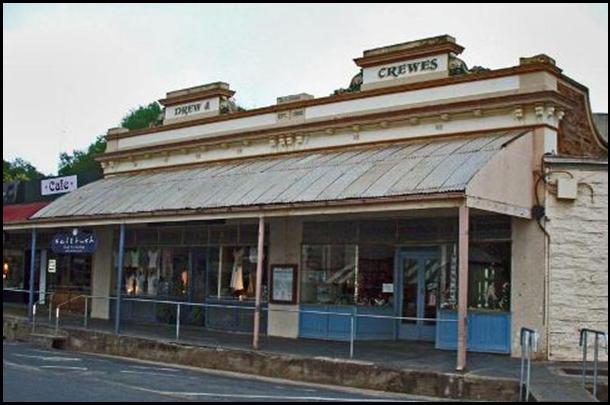
Drew and Crewes’ Store in 2008 displaying three separate shops
21
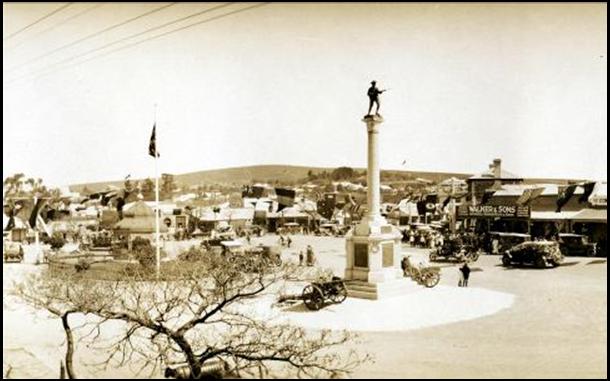
Market Square c1925
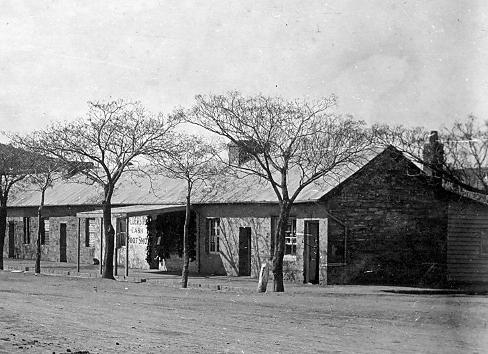
Miners’ Cottages in Market Square
22
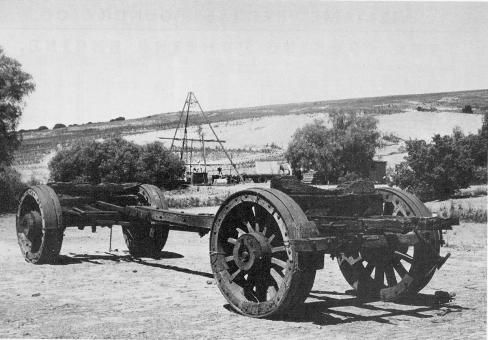
The jinker now on display in Market Street that was used to haul atmospheric beam engines used to dewater the mine from Port Adelaide to Burra
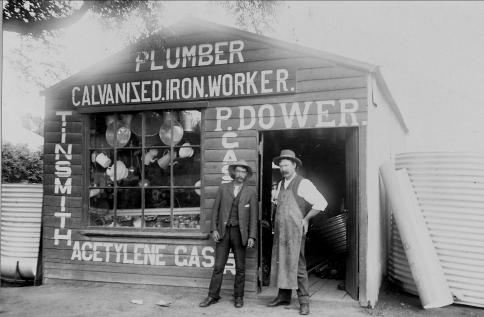
23
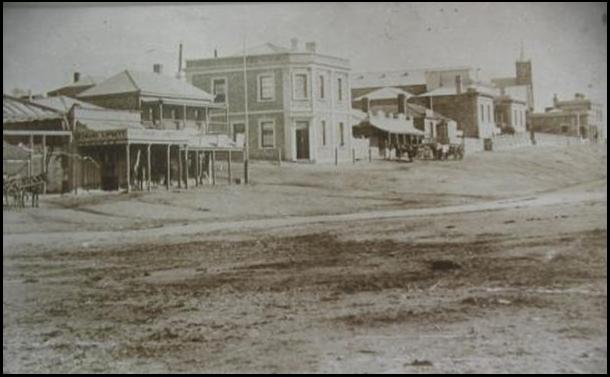
Market Street in 1890s
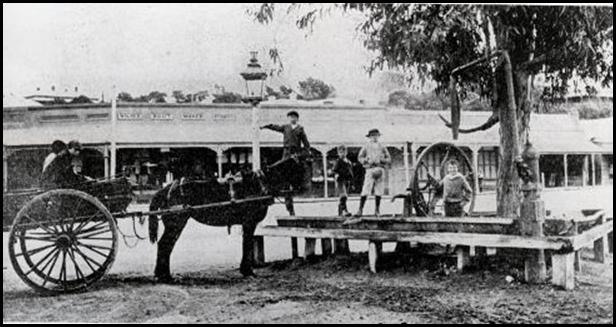
The town pump in Market Square
Compiled by Julian Ratcliffe
The Burra History Group Inc.
2008
24