

1
2
3
Recording this extraordinary sight
On the two occasions, 1847 and 1850, when the artist S.T. Gill was sent to document the Burra Burra Mine, rather remarkably, he left out the details of the dugouts from his paintings of Kooringa.
Rather fortunately, however, in 1850, William Cawthorne did make a drawing of the dugouts, which now hangs in the Mitchell Library, Sydney. This is perhaps the only existing record of the extraordinary sight of so many of the inhabitants of the mining township of Kooringa living in dugouts along the banks of the creek from which the mine and its surrounding townships would ultimately take their name.
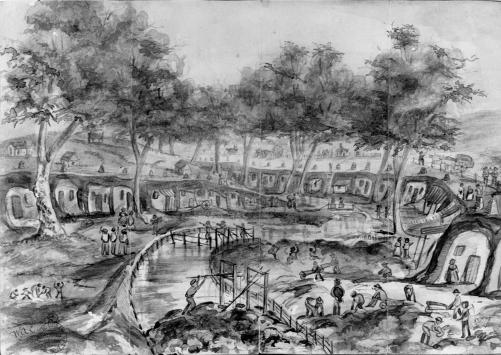
W A Cawthorne’s sketch of the Burra Creek in 1850.
It shows what was known as ‘Creek Street’ with its many miners’ dwellings dug into the clay banks of the creek. Dotted along the creek banks you can see the dugouts’ chimneys made from beer barrels or palings. In the foreground there is also the activity of miners handling piles of ore and erecting makeshift bridges crossing the flow of water in the creek.
4
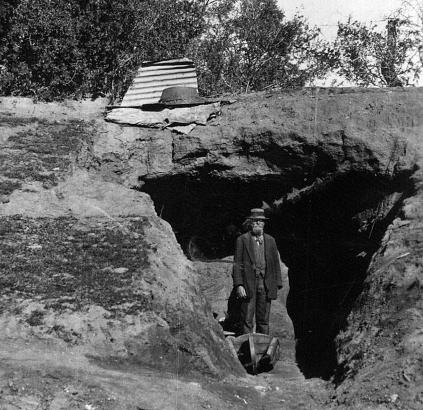
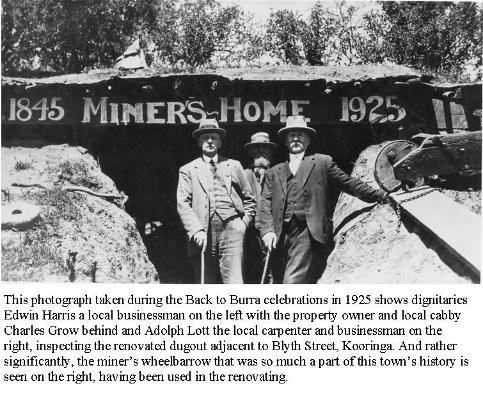
During the Back to Burra celebration in 1925, three remaining dugouts adjacent to Blyth Street were renovated and displayed to the public. The dugout here had survived the flooding that had destroyed most of the other dugouts because they are situated on a tributary of the Burra Creek rather than along the main water course. Since then they have become a regular feature for visitors interested in Burra’s history to see.
Eventually after fund raising for the project, these dugouts were completely rebuilt between 1970 and 1974 by the Burra Council and The National Trust as a present day tourist attraction.
5
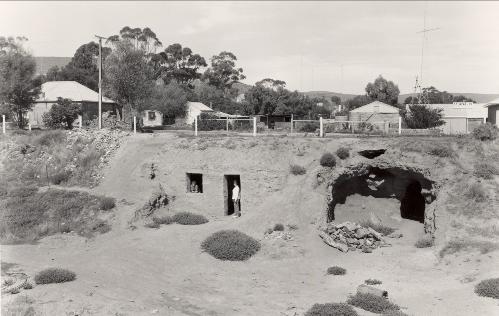
Burra’s Miners’ Cottages 1970s
This shows the restoration of the remaining miners’ dugouts on a tributary of the Burra Creek alongside Blyth Street that was carried out between 1970 and 1974.
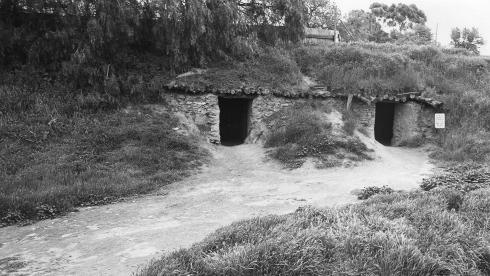
The same dugouts after the restoration and renovations of the 1970s.
6
“Burra Creek Dwellers’ Dugout Conservation Study”
Austral Archaeology Pty Ltd.
“Whitewash and Red Clay” - Peter Birt, Flinders University
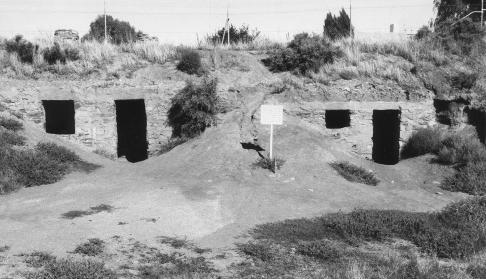
The miners’ dugouts sometime after their major renovation in the 1970s.
7
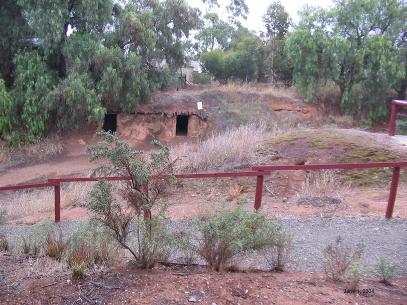
Former Miners’ Dugouts
Blyth Street
Kooringa, Burra SA
Contact the Burra Visitor Centre for entrance with a
“Burra Passport Key”
Compiled by Julian Ratcliffe
The Burra History Group Inc.
2015
8