BURRA
RAILWAY STATION
BURRA
SOUTH AUSTRALIA
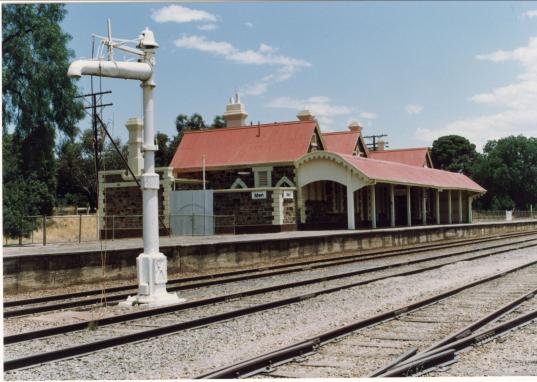
Burra Railway Station 1993
© The Burra History Group Inc
2014
Burra Railway Station
A Much Awaited Event (1870)
The first train steamed into the Burra Railway station at 12.45pm on Monday August 29th 1870, welcomed by a crowd of some 3000 onlookers from the townships and surrounding district.
This historic event had been heralded in the following way: ‘NOTICE is hereby given that the NORTHERN EXTENSION LINE of RAILWAY will be OPENED for TRAFFIC to the BURRA STATION on MONDAY next, the 29th instant. A train will leave Adelaide Station on that day at 7am, carrying First and Second Class Passengers, calling at all Intermediate Stations and arriving at the Burra Station at 12.30. A return train will leave the Burra Station at 4pm.’
In fact two trains made the journey that day, the public train and the vice-regal train carrying the Governor, Sir James Fergusson, and the official party, following a half an hour later. It was a day of great celebration with a luncheon held in the goods shed and toasts and speeches aplenty.
A Terrible Accident
Unfortunately the day was marred by the railway’s first fatal accident. On the return trip the train carrying the official party just after Farrell’s Flat struck a flag man who had fallen across the line and he was killed instantly. Although the engine driver saw the danger, sounded the whistle and applied the brakes he was unable to stop in time. The victim was identified as Thomas Attenborough, who had a history of suffering fits and falling unconscious. He was survived by a wife and six children.
A Regular Passenger Service
It was further announced by order of the Hon. Commissioner of Railways, Chas. Bonney, Superintendent of Railways1, that: ‘A passenger Train will run each way daily (Sundays excepted), leaving Adelaide at 7am, and Burra at 8.15am.’ First and Second Class Passengers only will be conveyed between Gawler and Burra by these trains. Third-Class Passengers will be conveyed by Goods Trains, leaving Gawler at 1pm. and Burra at 5am.
A few years later passengers were forbidden to ride on Goods Trains.
Choosing a Site
Several different sites had been suggested for the proposed Burra Railway Station. Paxton Square in Kooringa; the Court House allotment in Redruth; an allotment outside the Burra Survey on Smelting Works Hill, Redruth; and the Bon Accord Mine, Aberdeen. The objections to the Redruth and Kooringa sites were the extra expense of building rail bridges over the creeks and the excavation of a cutting through a hard
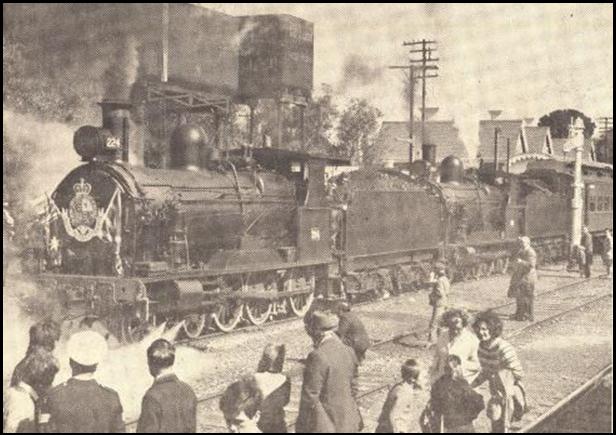
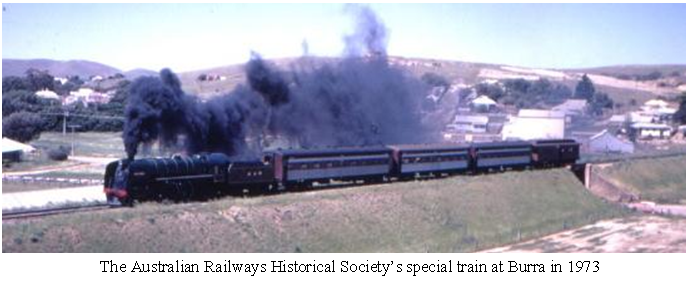
The Special Train that celebrated the Centenary of the events of 1870
Saturday 29th August 1970.
rocky hill, so the Aberdeen site prevailed. The proximity of this site to the Burra Mine, being central to the townships of Copperhouse, Redruth and Hampton, and an abundance of splendid water for the locos were also seen as advantages. In fact the railways were the first to use the water from the disused Bon Accord Mine2, water that later became the town’s water supply. The choice of this site would be a boon to the township of Aberdeen and many businesses would be established there as a result.
1South Australian Railways (SAR)
2With the permission of the owners, the Yorke Peninsula Mining Company.
The Benefits of the Railway
When the railway reached Burra in 1870, the Adelaide-Burra line was more than half the total rail line laid in South Australia. This broad gauge line that had been extended north of Riverton now stretched a distance of 101 miles and reached an altitude of 1,555 feet above sea level. Its construction had been achieved in stages with the costs decreasing from
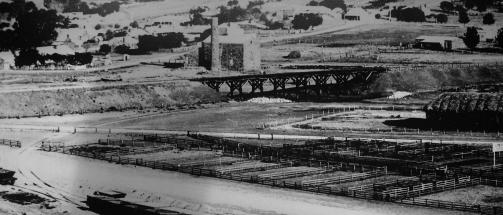
The rail embankments and original wooden bridge across the Burra Creek for the Burra-Hallett railway line. The stockyards of New Aberdeen are in the foreground with the flourmill in the background. This bridge was replaced with a steel one in 1909.
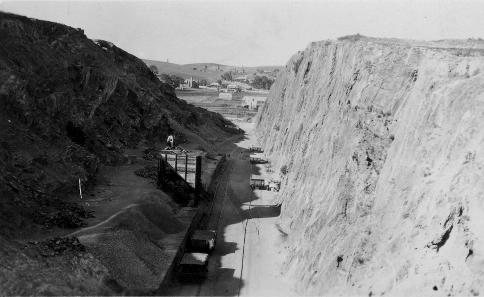
The Aberdeen ballast quarry in the 1920s. The township of Aberdeen and the Bon Accord Hotel are in the background.
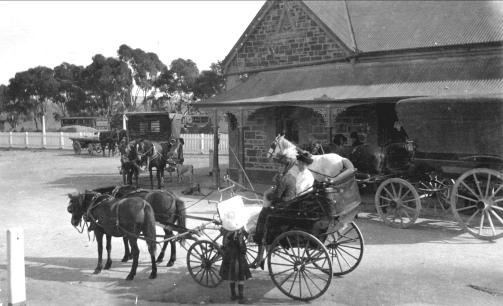
A lineup of cabs at the Burra Railway Station in 1906.
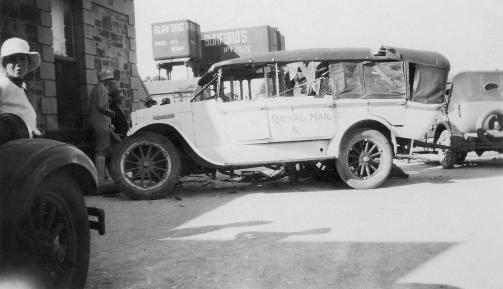
The Royal Mail has a slight disagreement with the Railway Station. Claude Attril’s charabanc which carried passengers and the mail between the station and Kooringa shortly after colliding with the station wall. Nov. 1928.
£14,500 per mile to £4,945 per mile. The costs had always been a deterrent to the development of the South Australian Railways.
In 1874 it took five hours for the 160 kilometre journey to Adelaide and the weatherboard, skillion roofed station building provided few amenities for passengers. This railway station was then known as the Aberdeen Railway Station, by the locals and around it grew the new businesses of Aberdeen and the stockyards with easy access to the railway.
In its early years, Burra was the terminus of the line, there was a turntable for the steam locomotives and water was supplied at first from a bore and later from the old Bon Accord Mine site for their boilers. It was this water, pumped from a disused shaft, that eventually became the town’s water supply.
The businessmen of Kooringa, who were relying on the rail to provide them with their stock from Adelaide, were very unhappy that they then had the problem of transporting these wares to their shops, a good mile away.
The true beneficiaries of the arrival of the rail line in Burra were the Burra Mine that was now able to load its ore and the growing local rural industry, sending grain, wool and livestock to markets in Adelaide. All of this enabled Burra to grow as an important rural centre and survive as a town. However, it was the passenger service that made newspaper reports. As early as 1877 there were calls for a new railway station, one as least as good as the one at Riverton or Terowie.
A New Railway Station (1883)
The present station was erected in 1883 by Sara and Dunstan, replacing the 1870 wooden structure with the platform being extended by an extra 30 feet. Even after this, there were frequent references to the platform being too short or the service provided in the refreshment rooms being inadequate. Nevertheless this stone building of ‘Gothic style’ has been described as one of the most attractive and impressive in the state and did in fact resemble that of Terowie. Burra became noted for its cabbies that lined up at the station on the arrival of a train and were only too keen to take passengers, for a fee, into Kooringa. A feature of the station until 1935 was a large, ornate arched roof which covered two of the tracks and the platforms. In 1884 the locomotive workshops were transferred to Burra from Riverton. Burra eventually became an important station on the line north to Broken Hill where steam locos took on fuel and water and served the needs of an expanding rural community. It survived beyond the steam era to that of diesel locomotives, but by now road transport was replacing rail around the country. Rail services to Burra discontinued in 1985 and the line closed in 1998.
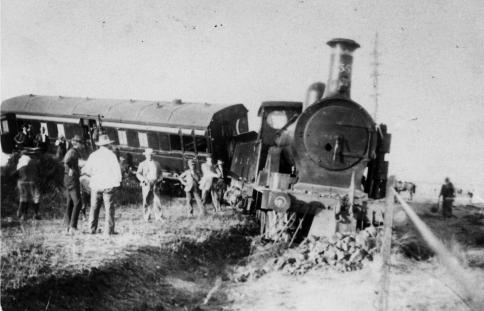
This railway accident occurred just 1½ miles south of Burra at Dew’s Crossing when the locomotive struck a bull, causing a derailment. (January 1912.)
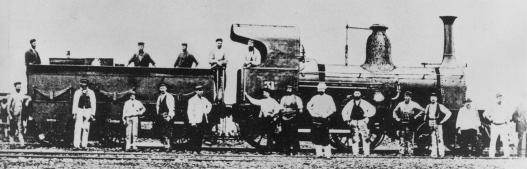
An H Class locomotive with tender was the type used on the railway line to Burra shortly after its opening in 1870. It was obviously a labour intensive exercise back then.
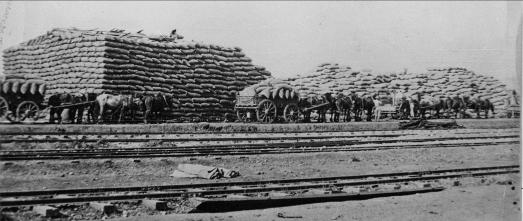
The wheat stack of 15,000 bags at the Burra Railway Station in 1873.
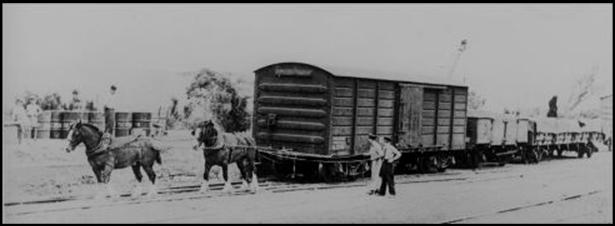
The Railways apparently sent a new horse from Adelaide to replace steady old ‘Brit’ who had done the job for some months of shunting trucks around the quarry. The new animal ‘Joey’ looked impressive until he got to the end of the rope and had to take the weight of the truck: he then stopped. It seems likely ‘Brit’ will soon be back plodding on in his reliable style. Burra Record Feb. 1894
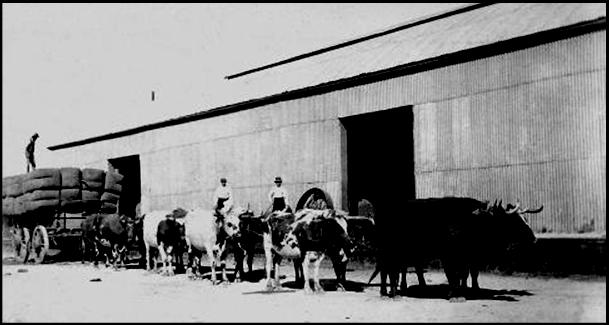
Bales of wool arriving at the Burra Railway Station drawn by a bullock team in 1874.
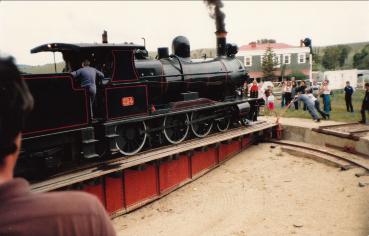
One of the Rx class engines of the Centenary Train on the turntable at the Bon Accord Crossing in 1970.
Restoration of the Railway Station 2010—2014
In 2006 the Burra Regional Art Gallery secured a lease on the building with the intention of restoring it. Whilst the stonework was sound, the roofing and timberwork through out were in need of replacement and the funding for such an undertaking was not yet available.
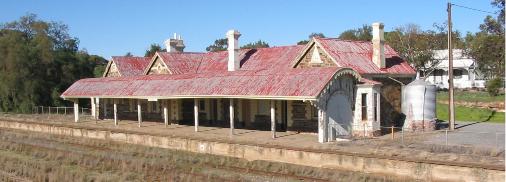
The Burra Railway Station in August 2004
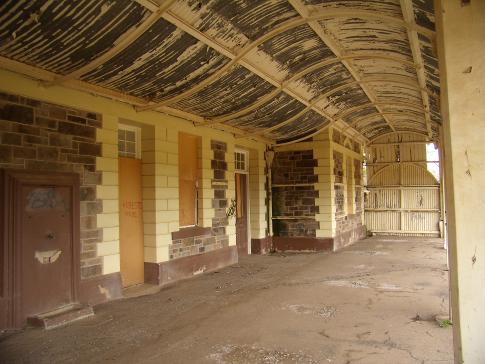
The railway station platform prior to restoration
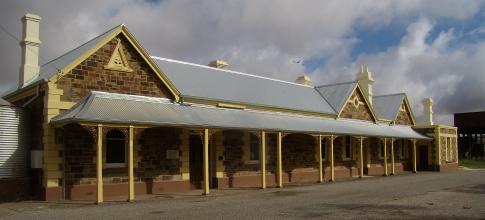
The railway station in 2014 after completion of the restoration work
A Government Grant
After the Premier of South Australia, Mike Rann visited Burra in 2009 and met with the ‘Friends of the Burra Railway Station’ he expressed interest in the conservation of this important historical building. The success of the project would rely on government funding and volunteer labour.
This was followed up by an announcement in March 2010 by The Minster for Conservation and Environment, Jay Wetherill of a government grant of $200,000 to begin this important project.
A volunteer, Roy Taplin was made the project manager and carried out the painting of the gables, replacement of the flooring, and the painting of the interior and some of the exterior of the building. A local builder replaced the roofing and another contractor repaired the salt damp damage.
Burra’s Heritage Hero
In May 2013, after being nominated by the Premier Jay Weatherill, Roy Taplin was recognised for his efforts in managing the project and his meticulous restoration of the building with an SA Heritage Hero’s Award.
References:
The South Australian Register
The Burra Record
The Story of the Monster Mine Ian Auhl
Rails to Burra John Wilson
Compiled by Julian Ratcliffe
For The Burra History Group Inc..
2014
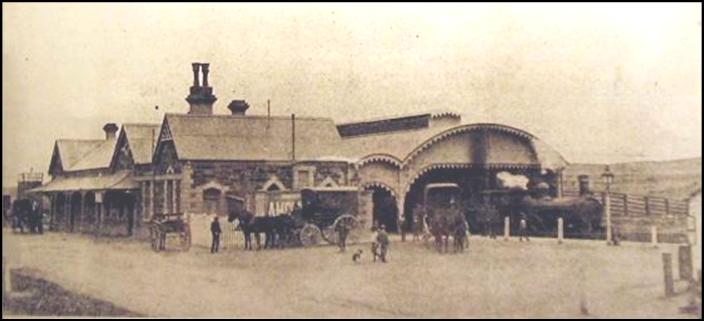
Burra Railway Station 1900
‘This snapshot was taken as the Terowie train pulled up at the Burra station. The station is about a mile from the Kooringa township and because Burra does not yet have a tramway, the distance is done by means of cabs, whose owners are very ‘pushing Jehus.’ One of these enterprising cabbies has named his conveyance “The May Flower”. The railway station is a well-built premises and is not without some attractiveness’.
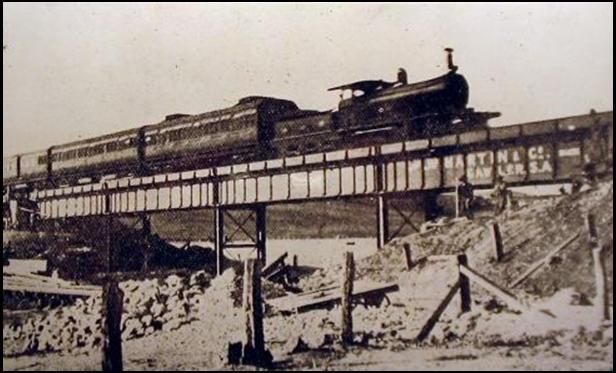
The first train across the new steel rail bridge which replaced the wooden one across the Burra Creek in May 1909. It was erected over the weekend without disrupting the next passenger service to Broken Hill on Monday.