THE BON ACCORD MINE
BURRA
SOUTH AUSTRALIA
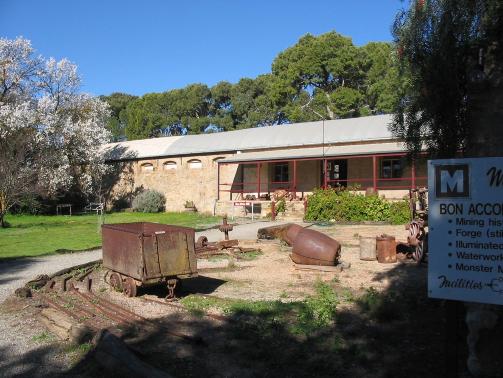
The Bon Accord Mine Museum
Formerly the Mine Office, workshops and store.
©The Burra History Group Inc.
2008
The Bon Accord Mine
A Company Partnership (1845)
The story of the Bon Accord Mine starts in 1845, with the formation of a partnership between two investment companies, the Scottish Australian Investment Co. (with a two third share) and the North British Australasian Co. (one third share), which became known as the ‘Sydney Company’ as it was based there.
The mining operations were to be the responsibility of Robert Morehead, the Manager and Matthew Young, the Accountant. It was a speculative venture that was mounted on the possibility of the ore body of the adjacent Burra Burra Mine extending northward across the boundary of the Special Survey of 1845. At this early stage in the life of the Burra Burra Mine, high grade copper ore was being recovered near the surface in rich pockets.
The Exploitation Begins (1847)
In typical Scottish manner, an exploration of a possible mining site was undertaken, in 1847, with the help of Captain Spargo from the Burra Burra Mine with the sinking of shafts at the site before purchase. The results whilst, not particularly encouraging, were good enough for the purchase of 347 acres of land for £5,500. Thomas Burr thought that good quality ore would be found deeper at 30 to 40 fathoms.
The Bon Accord Mine (1849)
John Dalley, an experienced miner, of the Burra Burra Mine was hired to organise mining operations. Three lodes were traced to the water level of 19 fathoms. In 1850, the southern-most and deepest workings at the Main shaft where a cross cut was driven to intersect different lodes, found ‘one 8 foot wide of good gossen and spar*, with blue and green copper carbonate.’ It would not, however, pay for the workings.
*gossen - iron oxide in quartz spar – quartz (silicon dioxide)
A New Township
In 1849 the Company surveyed the new township of Aberdeen and subdivided land considered least likely to yield ore. In September 1849 land in this proposed township was offered for sale. This was a hedge by the Company to raise funds for the coming mining operations. There were few takers.
In 1849 Roach’s Engine had begun pumping water at the Burra Burra Mine, discovered at 22 fathoms, lowering it to about 40 fathoms, where it was unable to cope with the water entering the mine. Replaced by Schneider’s Engine in 1852, the water was to be kept ‘in fork’ below 50 fathoms. It was therefore thought that the Bon Accord could operate without its own pumps.
A New Company (1857)
After a period of inactivity at the Bon Accord Mine, in 1857, the founding investment companies decided to sell their shares to the Bon Accord Mining Company, selling at double their purchase price and retaining the rights to a royalty of 5% on all ore raised.
Bon Accord Operations Recommence
The Bon Accord Mining Company appointed Captain Jeffrey the Mine Supervisor on a salary of £240 p.a. and work recommenced in March 1858 with 18 miners and mechanics, setting up a blacksmith’s forge, tool house, storeroom, and carpenter’s shop. They also purchased a 25h.p. portable pumping engine, rather than building a permanent pump house until a rich lode was found. To meet the Mine’s needs for transport the Company acquired 124 acres to accommodate the cattle for the teamsters.
New Work
The new work commenced in 1858 saw the sinking of four new shafts intending to intersect Beck’s workings in the Burra Mine. A flood had laid bare a ‘blend creek’ and was thought to be a promising site. Killicoat’s shaft was sunk in a fork between a blind creek and the Burra Creek and Grainger’s shaft in the body of the creek to the east of previous workings. Dickson’s shaft was sunk in what is now Linkson Street and the Engine shaft or main shaft, between Elder’s and Grainger’s shafts. Elder’s shaft was a reworking of an old shaft with drives north and south. An old shaft west of the whim shaft was named Jeffrey’s shaft sending drives to the west of previous workings.
By June 1858, there were six shafts with no water encountered until September, when water was intersected at 16 fathoms, requiring the installation of a pump engine in November 1858.
Although Elder’s shaft had reached 22 fathoms and a winze* to the west of it found ore, none of it was of dressable quality.
When the Engine shaft reached 30 fathoms, a new more powerful engine became urgent as the amount of water increased dramatically. It was clear that the pumping from the adjacent Burra Mine was not affecting water levels in the Bon Accord, despite the fact that these operations had sent wells in Aberdeen and Kooringa dry.
*a shaft between two levels of a mine
A Permanent Pump Engine House (1859)
So in May 1859 a 50 inch pump engine and two Cornish boilers were purchased from the Burra Mine for £2000. This was Roach’s old engine, the first engine installed at the Burra Mine that had been kept in storage. Throughout 1859 a stone engine house and boiler house were constructed together with a 60 foot chimney at a cost of £7,000. Pumping from the Engine shaft at the 30 fathom level commenced in January 1860, the wa
ter being discharged into a reservoir in the Burra Creek between Aberdeen and Redruth. This dam was subsequently washed away during a flood of the creek. It was discovered in April 1860 after a sudden inrush of water at the 30 fathom level that pumping from the Bon Accord Mine was draining wells to the north and east in Redruth. This promising crosscut had to be sealed to prevent any further flooding of the mine.
By the end of 1860 a promising looking 8 foot wide lode assaying at 9.75% copper, had been discovered at 40 fathoms, but by now money was running out. A call of 2/6 on all shares rectified this and shafts were sunk to 50 fathoms, with drives to the north and south. No rich ore was recovered.
Advice Sought
In October 1861, Captain Jeffrey asked to be relieved of his duties, calling for the intervention of overseas experts. So the pumping was halted in November 1861 and Captain Dalley’s advice was sought. He was critical of operations believing that the only hope of success was in yellow clay near the western boundary of the mine property.
The Search Continues
In 1862, first with Elijah Whitford and later Captain Simmons supervising, shafts were sunk to depths of 5, 7 and even 29 fathoms to the west; keeping above the water level, but no payable ore was found. Mining operations ceased in November1863.
In May 1864 the Bon Accord Mining Company was dissolved and later became the Yorke Peninsula Mining Company with a mine at Kurilla about 5miles from Wallaroo.
The story of the Bon Accord Mine is one of frustration. It highlights the difficulties inherent in mining exploration in an era when there was only one way to prove a mine and that was by digging. It required informed guesswork. It also highlights how fortunate the share holders of the Burra Burra Mine were. It was their fortune to find ore close to the surface and be able to follow it to greater depths in a relatively well defined area. How fortunate that the boundary of the Special Survey conducted by Frome in 1845 included the whole ore body. The frustration of continually dealing with underground water was not tempered by recovery of high grade copper ore and just added to the frustration limiting the operations of the adjacent Bon Accord Mine.
The Water Resource of the Bon Accord Mine 1878 - 1884
During the operation of the Burra Mine the townships had relied on the water pumped from the mine that kept the Burra creek flowing. When the Burra Mine closed in 1877 this water was no longer available for water
ing livestock and in particular the large number of teams that came to the railway station.
The wells in Burra had been pumped dry and the townships relied on rain water stored in underground tanks. On the arrival of the railway to Burra in 1870 the railway station required water for its steam locomotives and had sunk a well for this purpose. Later in the early 1870s the Railways Department was pumping water from the Engine shaft of the Bon Accord Mine with the permission of the York Peninsula Mining Co.
A Water Supply for Aberdeen
In 1878 after agitation from locals and the urging of the local Member of the House of Assembly, Mr. Rees, a 4 inch main was laid from the Aberdeen Waterworks (Bon Accord Mine) down Morehead Street to a public trough and standpipe opposite Ridgway & Co’s store. Five private residences in Aberdeen were also connected.
It seems that other public troughs were erected because in 1879 it was reported that although 395,000 gallons had been pumped the previous year the operation was running at a loss because the townspeople were taking their water for free from the public troughs. In 1880 the hydraulic engineer demanded that the local authorities pay for this water taken from the public troughs.
The township of Kooringa was in dire need of a water supply. In early 1881, a pipe bore with a standpipe was provided in Market Square and by 1883 the Burra Creek was little more than a sewer with poor flows and only wastes entering it.
A Water Supply for Kooringa
In March 1884 the Aberdeen Waterworks was leased, after complicated negotiations regarding payment and ownership, with the Railways, to the Burra Corporation.
New plant was installed to pump from a shaft in Linkson Street, with R. Bartle chosen as the engine driver in October 1884. Because of disagreement over the initial plans there was a delay to the completion of the engine house till March 1886 and a temporary engine, an old locomotive engine, was installed. However, by December 1884 water was delivered to Commercial Street Kooringa with other water mains extending to Kangaroo St., Queen St. and Chapel St. The town’s water was stored in a covered 31,000 gallon reservoir.
This event transformed Burra, enabling the planting of gardens, reducing reliance on fruit and vegetables imported into the town. Street trees were planted after a public fund raising campaign. By March 1886 when the system was handed over to Bartle, the total cost of the scheme was £8,500.
In 1886 the atmospheric beam pump engine at the Engine Shaft of the Bon Accord Mine was transferred to Bird in Hand Mine Woodside.
Despite the obvious advantages of a water supply to the Burra townships, people still believed in getting free water, with many residences disconnected their meters. So in 1888 the Council moved to close this loophole and retrieve these unpaid rates.
The Burra Pumping Station 1884 - 1908
The first Burra Pumping Station for the supply of water to the Township of Kooringa was constructed on the Bon Accord Mine site in 1884. It was run by the Burra Corporation. The engine shed was located just off Linkson Street and pumped from Dickson’s Shaft. By June 1885, Burra was consuming around 6,000 gallons of water per day, an annual consumption of over one million gallons and by 1908 when these pumping operations ceased, the consumption had trebled and there were over 8 miles of water mains throughout the town.
In 1892 a Cornish Boiler was added to increase the pumping capacity of the plant and in 1904 a Crossley Gas Engine was installed. On both occasions, the pumping station was altered to house these new installations.
The original old locomotive boiler, installed in 1884, required large amounts of coal for its operation. It needed constant maintenance and at one stage it was shut down to repair a serious leak. It continued to leak even after these repairs. The installation of the Cornish boiler, requiring considerable additions to the site, increased the pumping capacity from 1892. The installation, in 1904, of the Crossley Gas Engine which was fired with carbon monoxide gas produced from coke or charcoal, improved the efficiency of operations greatly and reduced costs.
A New Site for the Pump House (1908)
In 1908 the timbers of Dickson’s Shaft were reported to be in a bad state and this site was abandoned. The pumping machinery was shifted to its present site, over the Engine Shaft. The old engine shed was taken down to be erected over the new shaft and Dickson’s Shaft was covered over. The Engine Shaft had been the source of water supplied to the Railways and some properties in Aberdeen from 1878. This was originally the site of the stone Engine house of the Bon Accord Mine constructed in 1859.
Duplicating the Pump Equipment (1923)
In 1923 the sheds were enlarged for the installation of a new 44hp Crossley Gas Engine, duplicating the existing facilities with a room to house the gas producer.
A New Gas Engine (mid 1930s)
With water consumption increasing and rising pumping costs, a new 58hp Hornsby Gas Engine and Crossley Gas Producer were installed, in an attempt to increase the efficiency of the plant. Repairs were also made to
the timbering of the Engine Shaft. Most of the existing machinery was retained.
The Arrival of Electricity at the Plant
In 1947, a Pomona Pump driven by a 40hp Cromton Parkinson Electric Motor was installed without alterations to the pump sheds. In 1958 the motor was replaced by a 60hp Pope Electric Motor that continued operating until 1966 when pumping from this site ceased and Burra was supplied with water from the Morgan-Whyalla Pipeline.
The Significance of the Bon Accord Mine (1878 – 1966)
The Bon Accord Mine was a failed mine but the water that had frustrated mining operation became vitally important to the survival of the townships of Burra. Water for livestock that was freely available from the Burra Creek during the operation of the Burra Burra Mine soon dried up after the closure of the mine and the water from wells was not enough to adequately supply the town. The water that was first used by the Railways became the water supply for the townships of Burra up until 1966, when Murray River water was supplied to the town.
References:
Bon Accord Mine Conservation Survey A. Bannear
The Burra Record
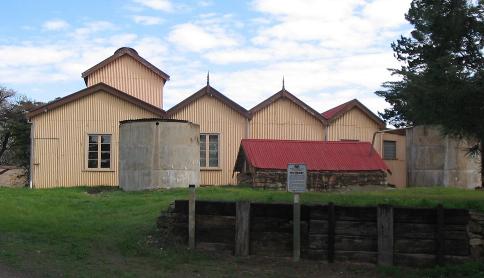
The Bon Accord Pump-house
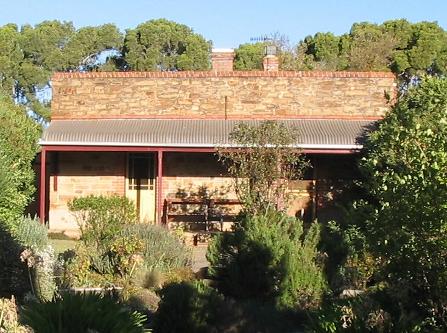
Bon Accord Cottage, formerly the Manager’s residence
Compiled by Julian Ratcliffe
The Burra History Group Inc. 2008