THE
THAMES STREET COTTAGES
BURRA
SOUTH AUSTRALIA
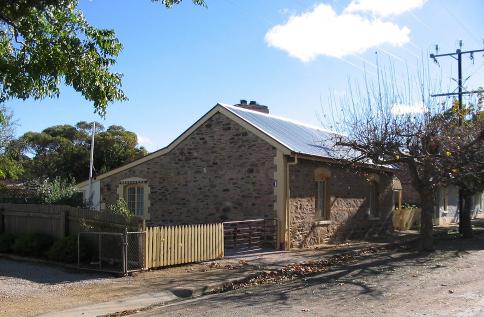
One of the remaining Thames Street Cottages
2006
© The Burra History Group Inc.
2007
The Thames Street Cottages (1846)
The First Cottages
The Thames Street Cottages were the first cottages built in Kooringa, a company owned township. Built in 1846, soon after the laying out of the town, the first eight of these double cottages were designed by the architect George Strickland Kingston, a director of the S.A. Mining Association, for mine employees. Whether the masons followed Kingston’s instructions to the letter is doubtful as there are variations evident in each one of them, but the basic plan is the same.
The Cottages Described
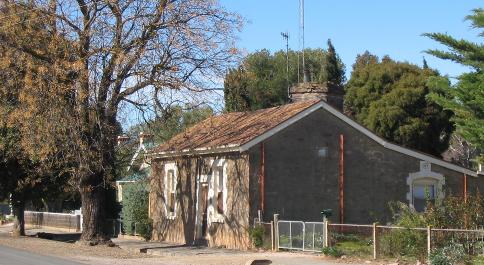
Built of bluestone and originally having floors of local slate, they were designed to house two families, being separated by a solid dividing wall. To cut costs, after the first cottage was completed, the slate floors were dispensed with in future cottages. One prominent feature of these cottages is the massive four-way chimney in the centre of the building serving fireplaces in each of the four rooms. Each family had a bedroom at the front of the cottage which is entered from the side of the cottage with a kitchen behind having a doorway to the backyard. The cottages’ earthen floors, canvas or calico ceilings and stone walls were whitewashed; the roofs were made of split timber shingles. These shingles are still in place under the galvanised iron roofs that were first added in 1872. These cottages were rented to miners at least until the 1870s when freehold title was offered by the company, as they gradually began selling off their holdings. They are probably amongst the earliest domestic buildings in South Australia still in occupation.
Other Company Accommodation
During the years 1846 to 1850, over 100 smaller cottages were built in Kooringa for miners, but unfortunately most of them have been demolished, the most notable exception being thirty three cottages in Kingston Street, known as Paxton Square.
An Early Reference to the Thames Street Cottages
In The Burra Record of 13th Dec. 1893 in a biography of councillor John Sampson was the following; ‘Arriving in the town in 1847 he took up his abode in a tent, no house except the big cottages fronting the Primitive Methodist Church, Kooringa being erected, and Redruth was simply a patch of grass. Huts ranging from one to eight rooms were excavated into the banks of the creek, between Kooringa and Redruth and families lived
happily in them until such time as they were declared unfit for habitation. In 1857 there were 12,000 in the town’.
Who lived in these Cottages?
‘A Directory of Early Folk’ compiled by Jennifer Carter records that one John Glanville Williams born in Cornwall in 1819, lived in company cottage number 6 in 1849 with his wife and three children and he was possibly a tributer. An
early map of Kooringa shows that company cottage number 6 was in fact number 6 Thames Street.
The Cottages Today
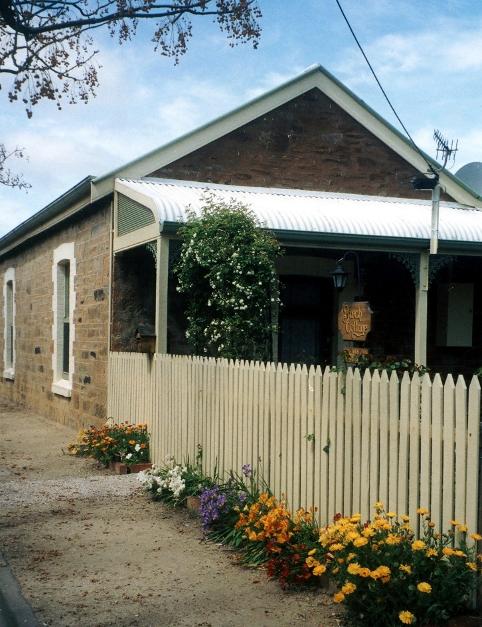
Today only six of the original eight cottages remain. The first cottage which was on the corner of Thames Street and Market Square has been demolished as has one on the corner of Thames and Bridge Streets. The second cottage in the street has been extensively modified with the addition of stone walled rooms at both ends and front doors opening to the street. All of the cottages have lean-tos added at the back and four of them have bull-nosed verandahs protecting their Northern walls. They have a mixture of slate and pine timber floors built over the original *whitewashed earthen floors.
One of these cottages provides bed and breakfast accommodation for visitors to the town.
*This discovery was made when replacing a timber floor at number 6 Thames Street in 2005.
References:
The Burra Record
Compiled by Julian Ratcliffe
The Burra History Group Inc.
2007