THE BURRA BURRA MINE
BURRA
SOUTH AUSTRALIA
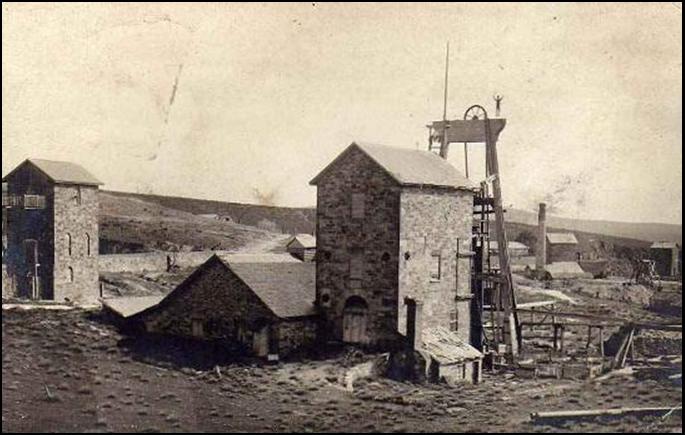
A view of the Mine c1890 showing four of the engine houses.
Morphett’s Winding Engine house on the left, the boiler house adjacent Morphett’s Pump Engine house, Peacock’s Winding Engine house with its flue and on the far right Graves’ Engine house
© The Burra History Group
2008
The Burra Burra Mine
The Discovery
In 1845 two shepherds, William Streair and Thomas Pickert, discovered copper outcrops at two separate sites along the Burra Burra Creek. When this news reached Adelaide, two rival companies immediately showed interest. The Princess Royal Mining Company known locally as the ‘Nobs’, the company working the Kapunda Copper Mine, and the newly formed South Australian Mining Association (SAMA), the ‘Snobs’. They provided the money for a special government survey of an area of 10,000 acres and at a meeting in Adelaide lots were drawn to decide which half of the special survey would go to each party.
Mixed Fortunes
The South Australian Mining Association drawing the half north of Stein Hill and Princess Royal to the south. William Streair had sold the location of his find, the site of the Princess Royal Mine, to James Bunce, an Adelaide shopkeeper for £8. Although this outcrop was very rich, this mine proved to be a failure when the ore ran out and it ceased operations in 1851.
For his find Thomas Pickert was rewarded with £10 by SAMA and died a pauper. His discovery became the ‘Monster Mine’ an operation that made its shareholders very wealthy men.
‘The Monster Mine’
The ore body, consisting of rich deposits of mainly blue azurite and green malachite in dolomite host rock, was 70 metres wide and 55 metres deep in a strip between two fault lines.
At the outset miners were urgently sought and free passage was given by the government of the new colony for experienced workers to emigrate from Cornwall and later Wales, where employment was scarce.
Early Mining Operations
Initially the copper ore in veins, blebs and nodules was mined from near the surface by ‘tributers’, paid a percentage of the value of the ore they recovered from their pitches, with simple implements. Later as shafts were sunk, tutworkers were employed to shore up the mine with timber and remove the mullock. Ton workers, who were paid a fixed rate per ton of ore picked out, separated the ore from the mullock. The ore was transported in drays by bullock teams to Kapunda and then to Adelaide, where it was shipped to Wales for smelting. And when smelting operations commenced in 1849, the ore was carted across the Burra Creek to the smelter and the Gulf Road to Port Henry was opened. The Gulf Road was nothing more than a series of waterholes for the bullock teams that hauled the copper from the Burra Burra Mine to Port Henry, now Port Wakefield.
Of course a mine requires far more than miners. It requires a force of supporting workers like carpenters, blacksmiths, engineers, masons and carters for its efficient operation. The mining operations need to be continuously planned and managed. The erection of buildings, the installation of whims, the harnessing and stabling of horses, the keeping of records and the day to day supervision and organisation of such a large enterprise all require good leadership for a mine to function.
Captain Roach
Samuel Stocks who had been the Resident Director of the Mine resigned that position in 1846 and shortly after arriving at the mining following dismissals of two Superintendents, Henry Roach, an experienced Cornish mine captain, was appointed to the position of General Superintendent of the Mine. Forever known as Captain Roach he was instrumental in the early success of the Mine. He was noted for his mild manner and courtesy and his appreciation of the difficulties of the miners of representing their concerns to the
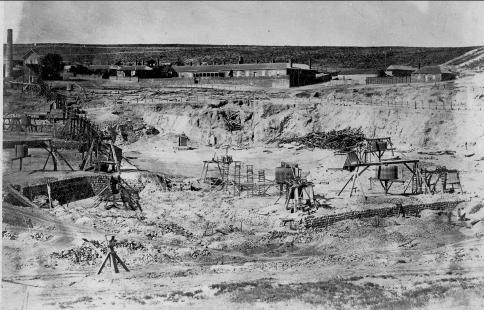
A view of the mine in 1869 immediately prior to changing to an open-cut operation.
Note the idle horse whims atop mine shafts
Mine Board. He was also a good organiser and hard working. He lived on the Mine site and was continually inspecting the workings with his Mine Captains.
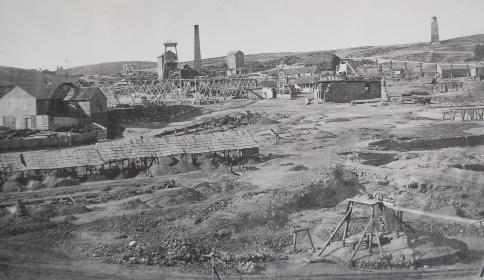
The Mine Site 1869 showing the crusher water wheel, with the partly demolished Schneider’s Engine house in the background to the right
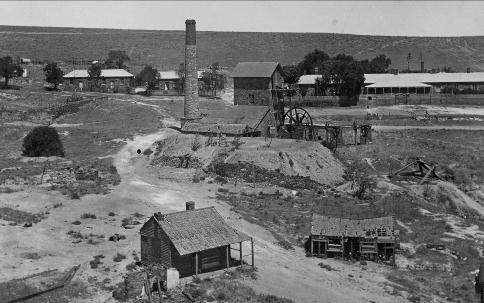
Peacock’s Winding Engine house
When Thomas Fisher of the Sydney Morning Herald visited the mine in May 1851, he was struck by the amount of activity and the orderliness of the operation. ‘You observe an area of from 80 to 100 acres, crowded with stone buildings, covered shafts leading underground, machinery and engine works, engine-houses, store-houses, tanks and dams of water, innumerable sheds of all sizes and countless piles of copper ore of various assorted qualities, in different stages of dressing, lying in almost every direction. If you arrive after six o’clock in the evening, expecting to find all quiet and the business of
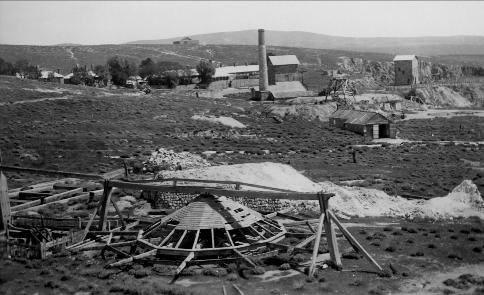
A capstan serving a mine shaft c1890s
the day all over, great will be your surprise at the bustling animated appearance of the place.’ On this occasion he counted 11 shafts.
By 1851, the tributers had moved well below ground level in their pursuit of fresh veins of copper, digging deep shafts, the deepest being Morphett’s shaft reaching 100 fathoms† shortly before the mine closed. The names of these shafts Stocks’, Graham’s, Waterhouse’s, Ayers’, Peacock’s, Roach’s were those of Company Directors or Mine Officials. The ore being hauled to the surface in kibbles* using horse whims or capstans.
A ‘Wet’ Mine
When at the 20 fathom† level ground water began seeping into the mine, Captain Roach ordered the first Atmospheric beam engine to be installed to dewater the mine. It was a 50 inch engine installed in a stone engine house, with its adjacent boiler house, atop Roach’s shaft and began operation in 1849. It was the first and last Cornish beam pumping engine erected in South Australia, having been transferred to the Bon Accord Mine in 1859 and finally to the Bird in Hand Mine in 1886. The water from the mine was sent along wooden launders to a mine pool and used for the steam boilers or to drive a huge 22 foot water wheel that powered a sawmill and an ore crusher. This same water was used to wash the ore in the buddle pits and eventually ran into the Burra Burra Creek.
When Roach’s pumping engine failed to keep pace with the water in the mine, and the engine house began to fall down as its foundations subsided, a new larger engine was ordered.
Schneider’s Pumping Engine
This 80 inch beam engine imported from the Perran Foundry in Cornwall came into operation in 1852. This had been an urgent installation as the water level in the mine was proving difficult to keep in check below the 60 fathom level. Soon after it began operating it was shut down and the mine was flooded when miners deserted Burra to go to the Victorian Goldfields. Eventually it became evident that even this pumping engine was inadequate and by 1857 another 80 inch engine had been ordered. The engine house was demolished during 1867 and its stone was used to build Graves’ Engine house.
The winding engine or “Fire whim” hauled kibbles* containing the ore to the surface from four shafts (Peacock’s main shaft and air shaft, Waterhouse’s, Roach’s shaft.)
Whilst the foundations for Peacock’s Engine house were commenced in June 1851, the work did not progress because of the greater urgency for the erection of Schneider’s Engine house. Peacock’s Engine house was not shown on the 1853 plan of the mine and the tender for it was awarded to Blackler and Hollow in January 1857, and completed early in 1858. The rotative beam engine began operation in April 1858. It was the longest serving engine on this site, being used to haul ore trucks up an incline during the open-cut operations in 1870 and in 1876 it was converted to pumping water assisting Morphett’s Engine. Its engine was removed for scrap in 1916 and the engine house was demolished in 1972 to make way for the modern open-cut operation.
† 1 fathom = 6 feet (1.83m)
*Kibbles: large egg-shaped buckets used to hold the ore. They were made from strong flat sheets of iron riveted together, and were egg-shaped so that their bulging sides would prevent the top rim from catching in the timbering of the shaft or from fouling each other when they passed in the shaft.
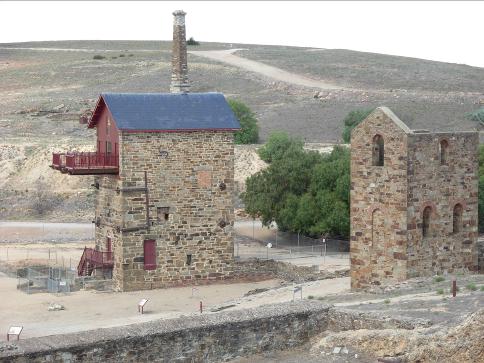
Morphett’s Engine Houses with Morphett’s Pool in the foreground 2007
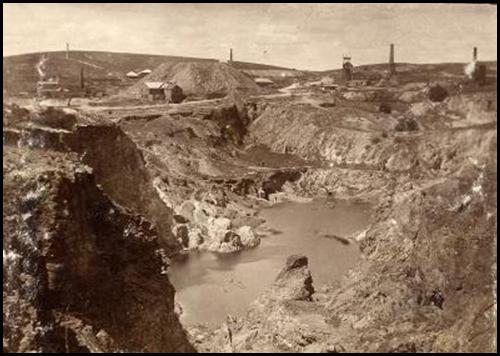
A view of the Mine Pool showing the extent of the 1870-77 open-cut operation.
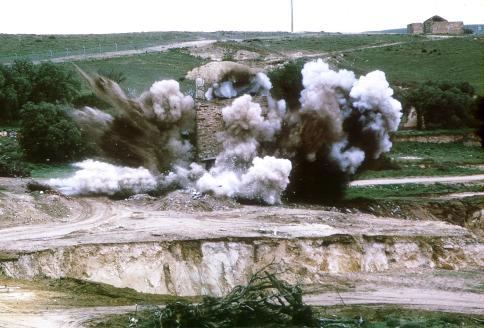
The end of Peacock’s Engine House 1971
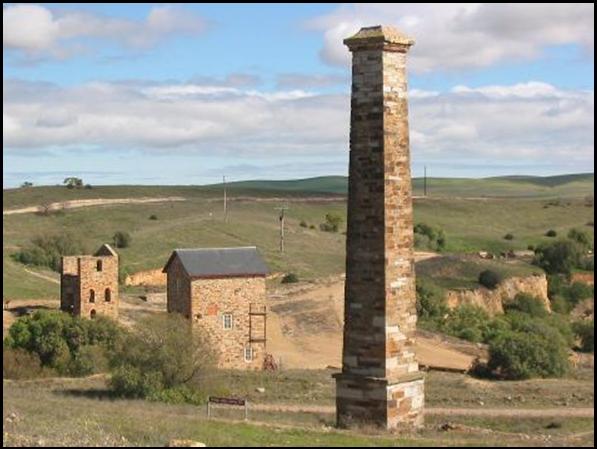
In 1970 a modern open-cut mining operation commenced and this engine house had to be demolished. Peacock’s Chimney had been moved stone by stone to the entrance to the Burra Mine site where it stands today.
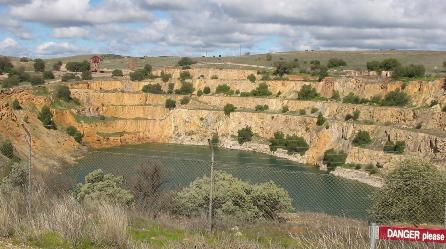
The Mine Pool in 2004 revealing the increased size of the mine by
open-cut operations in the 1970s
A story from the mining days of the 1850s
“One day I witnessed the breaking of a chain when the kibble was nearly up to the surface and its weight as it descended pulled the loose chain so fast that it was entangling itself about the posts and pulleys breaking timbers and making a great clatter. Men were running in every direction except in the line of the posts. Much damage was done to the gearing, but I have wondered whether the men below could find a safe place when they heard the kibble coming down the shaft. They must have realised that the law of gravity was in its worst mood.”
Morphett’s Pump Engine 1858
Although the engine was ordered from the Perran Company in 1858, it was not installed and made operational until 1860. This engine with its six Cornish boilers in an adjacent boiler house was the ‘workhorse’ of the mine. It kept the water ‘in fork’ to the 60 fathom level and below. This huge engine like all of its predecessors had been hauled on a jinker by bullock teams from Port Adelaide to its home in an engine house. The cast iron beam for this pump engine weighed 32 tons. Morphett’s Engine-house still stands in place at the mine site today being the only reconstructed engine-house outside Cornwall.
Grave’s Engine house 1868
This engine house was designed to house the old engine from Schneider’s and assist Morphett’s pump engine with dewatering the mine but was never put into operation because the mine was converted to an open-cut operation in 1870.
The End of the ‘Monster Mine’
‘In the last week of October, following the final inspection of the underground workings by the three mine ‘Captains’, the pumping engines were stopped and the mine fell silent. After almost seventeen years of almost continuous working, the great projecting beam high up on the bob-wall of Morphett’s pump-house lay motionless. No breath of smoke emerged from the chimney stacks on the surrounding hillsides. Silently in the levels and shafts far below, the ground waters rose. With its life-support system withdrawn and its heartbeat stopped, the old mine slowly and quietly drowned,’ wrote Ian Auhl. How strange that silence must have been for the townships of Burra.
Over the history of the mine there had been times of frantic activity with work going on around the clock and at other times the mine lying idle and water flooding the mine, as workers left for other mining ventures or men were laid off because of falling copper prices. Nevertheless it was a most successful enterprise, for over the time of the mine’s operation the total ore recovered was 234,648 tons valued at £4,749,234.
Because of falling copper prices and also because the ore was running out, the South Australian Mining Association’s mining operations in Burra, ceased in October 1877.
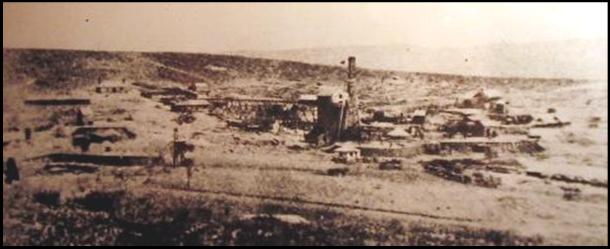
This very early photograph of the Burra Mine shows the first engine house at the site. Roach’s engine was installed in 1849 to pump ground water discovered at the 30 fathom level from the drives so that mining could continue. It soon became obvious that this pump engine could not keep on top of the flow of water into the mine and it was replaced with the more powerful Schneider’s pump engine in 1852.
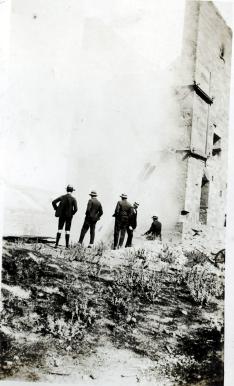
Fire at the Mine site
In December 1925, long after the closure of the ‘Monster Mine’ and the removal of the beam engine in 1916, a fire at the disused mine site destroyed the timbers of Morphett’s Engine house and its shaft. The fire was said to have been started by boys smoking out rabbits from burrows in the vicinity.
In 1986 the top section of Morphett’s shaft and the engine house were re-timbered and the engine house re-roofed with slate. The galleries, that gave engineers access to the heavy beam and pump rod that reached down to the pumps deep in the shaft, were also rebuilt. This is the only reconstructed Cornish engine house outside Cornwall. The engine house was then opened to the public as a tourist attraction and part of an outdoor museum showing some of Burra’s mining history.
Boys in their Sunday best watch the fire at Morphett’s Engine house, in 1925.
Modern open-cut mine operations (1970-1981)
Between the mine closure of 1877 and 1970 many small operations were attempted on the mine site, including miners eking out a living during the depression of the 1930s and a magnetic ore extraction project. Modern mining techniques and rising copper prices led to a modern open-cut mining operation from 1970 to 1981, which left the mine pit as it can be seen today. This gives us an insight into the true extent of the mine except to say that a lot of it is obviously under water, water that was a problem for the Mining Company so many years ago.
References:
Cornish Beam Engines in South Australian Mines
G.J. Drew and J.E. Connell Department of Mines and Energy
The Story of “The Monster Mine” Ian Auhl
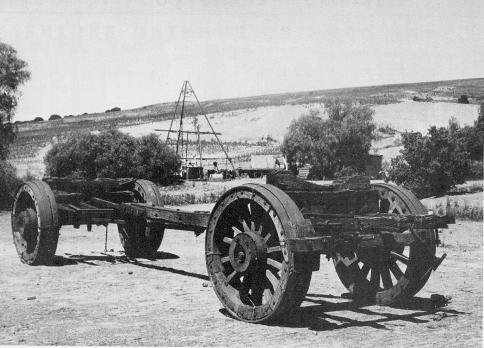
The timber jinker that William Woolacott used to haul the atmospheric beam engine for Morphett’s pump-house by bullock teams over 100 miles from Port Adelaide to Burra in 1858-59 .
It was an event that brought the locals out of their homes and work places in every town along the journey, culminating in great celebrations on its arrival in Burra.
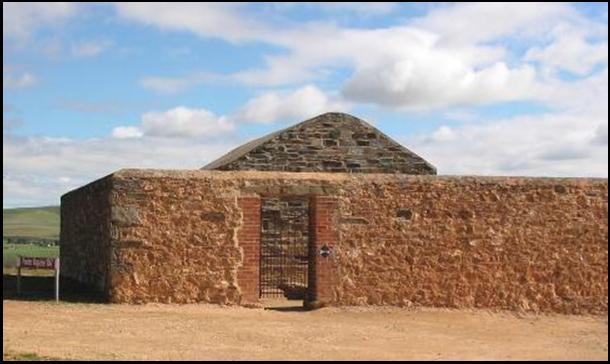
Above is the Powder Magazine of the mine, one of the oldest mining buildings left in Australia
Below is the chimney for the ore crusher that was installed at the mine in the 1870s during the first open-cut mining operation.
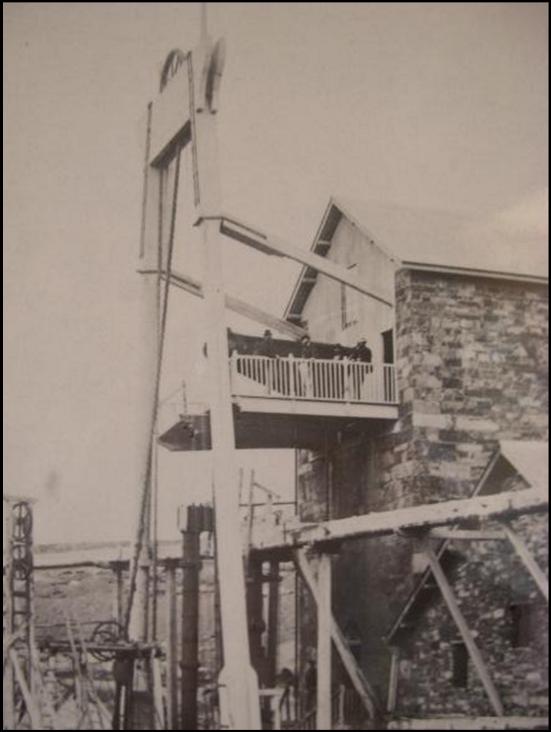
Morphett’s Engine House c1890s showing the shears and 32 ton cast iron beam. The launder that carried water to Morphett’s pool runs from left to right with the adjoining boiler house on the right.
Compiled by Julian Ratcliffe
The Burra History Group Inc.
2008