THE BURRA INSTITUTE
&
TOWN HALL
BURRA
SOUTH AUSTRALIA
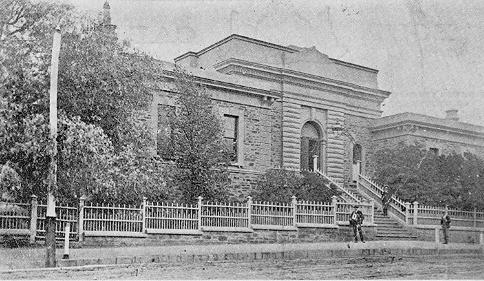
The Miners’ and Mechanics’ Institute 1905
The Burra History Group Incorporated
2007
This historic building situated in Market Street and listed in the National Heritage Register began life as a much more modest building, serving as the Miners’ and Mechanics’ Institute. Built by a committee of civic-minded members of the town on land granted on a 99-year lease at ‘peppercorn rent’ by SAMA, it was opened in August 1857. It was given to the people of the town “for the purpose of improving their minds and advancing their social position by acquirement of that information which shall prove most useful to them and which by the help of such Institutes is brought within reach of every man however humble his lot.” This was to be achieved by providing a library with a reading room and by holding lectures monthly.
The Institute drew much criticism from its subscribers for being too small, poorly lit, having inadequate furniture, too few books, too few lectures and a prison-like appearance.
Rowland Rees, an Adelaide architect and the member for Burra in the House of Assembly redesigned the institute in 1874. This much more imposing building, which was built by John Pearce of Burra on the same site, consisted of a main building with two wings. The entrance hall, which was designed to act as a museum had sliding doors that allowed it to extend into the lecture hall with a library and reading room in one wing and a committee room and classroom in the other. The Grand Opening was held on the 14th October 1875, with the hope that it would provide the town with “a well stored library, an instructive museum, educational classes, popular lectures and agencies in every direction whereby the mind might be cultivated and the feelings refined.”
So successful was it that by 1876 it had 135 subscribers and a library of 1300 volumes and tenders were being called for additional rooms. In January 1877 a lodge room was added and by 1880 the library had grown to 2369 volumes, with tenders being called for alterations to the platform of the institute.
More Improvements
In June 1881 it was reported at a general meeting that the main building included a hall, a large entrance and four other rooms the property has been enclosed with a stone walling and front ornamental railing, a cottage has been erected for the librarian, a large room for Masonic and other lodges has been built, and two rooms have been provided in what was the entrance hall, and one of these entirely fitted with shelves which, are fully occupied with books, is the library.
On the 17th May 1889 The Provincial Elite Roller Skating Rink opened at the Institute to a fair house, though with more observers than skaters.
Mr J. Davey’s Burra Brass Band added to the occasion.
On 12th July 1893 The Burra Record reported that “The building is now composed of the Council Chamber, reference library and amusement room, lodge room, library, ante-room and a fine hall with every convenience, consisting of stage, lights, scenery and two large dressing rooms.” The newspaper acknowledged that the public had greatly assisted the work of the committee by attending concerts, becoming members and donating various sums t the building fund.
It is significant that from 1876 until the amalgamation of the Corporation and the District Council of Burra Burra in 1969, besides nurturing the cultural and social life of the community, the Institute became a focal point of civic life with one room devoted exclusively to the Corporation of the Town of Burra.
The year 1891 saw some significant alterations to the Institute. The back wall of the hall was removed allowing for enlarging the stage and the addition of two dressing rooms. The proscenium had decorative pillars added to it and an escape door from the hall was added. The central hanging chandeliers were replaced with six large bracket paraffin lamps on the walls. A water closet has been provided together with a urinal opposite the Institute
On 26th Feb. 1897, Mr. W. Reeve presented Leimiere’s Wonderful Cinematographe at the Burra Institute. It featured two series of 20 pictures with scenes from life of the sea, the street, labour, military pageants, domestic pictures, Royal Pageants, and comic scenes. It showed The Mel
bourne Cup from start to finish and Episodes in the Czar of Russia’s Coronation.
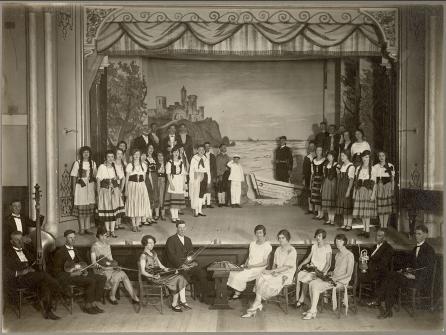
Les Cloches de Cornville
The Opera Society together with the Burra Orchestra presented “Les Cloches de Cornville” at the Burra Institute on 10th July 1901. The proceeds of this successful event went to the Burra Jubilee Benevolent Society.
Acetylene Lighting for the Institute
Mr Mozart installed an acetylene generator, which was capable of supplying gas for 40 lights at the Institute in July 1906.
A New Floor, June 1912
As it was unfit for dancing, the Institute floor was replaced.
“Messiah” at the Burra Institute
A favourable report, in “The Adelaide Mail”, of G.E. Dane’s production of Handel’s “Messiah” on the 10th June 1914, at the Burra Institute, mentioned 71 voices with 7 principals from Adelaide and 26 instrumentalists, as being an artistic and financial success. Apparently every seat was filled and hundreds were turned away.
At the pictures on Saturday night 7th July 1915, someone seems to have deliberately set fire to the scenery. Fortunately it was discovered before doing much damage and the hall was evacuated without panic. This was one of a series of arson attack sin the town at this time.
January 1919: Because of the high cost of carbide, Parson and Robertson were engaged to install a Delco electric lighting plant in an engine-house at the rear of the building.
The Bells of Cornville presented in the Burra Institute in December 1926
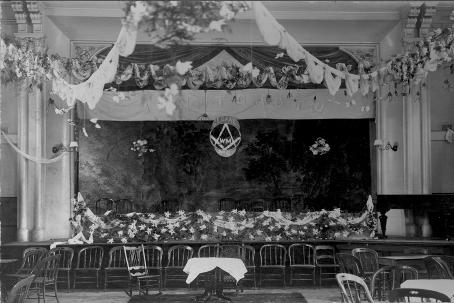
Masonic Lodge Dinner
In March 1921 the Burra Record reported that;
“The considerably enlarged Institute was finally re-opened on Tuesday evening when the Theatregraph Picture Co. presented a first class programme. The audience was large and the takings were given to the Institute. The entire cost of the enlargement with extra lighting and seating etc. amounted to about £2,000. The alterations were as follows
The back wall was moved 10feet out, taking in the present ticket office and portion of what was at one time the library. This added about 100 seats. A gallery seating about 80 was erected above. This increased seating from 338 to 518. A 90 foot awning was erected at the front of the building and a side door was made to give access to the lodge room. The passage was provided with a new ceiling.”
Improvements to the Institute in 1926
Work carried out by contractors T.H. Woollacott and J.E. Pearce at a cost of £2600 made 1926 a most successful year for the Institute. As well as enlarging the stage, dressing rooms with lavatory facilities were added. On the south side of the building, a side entrance to an enclosed kitchen was provided.
Burra Institute is now Burra Town Hall (1945)
History was made at a Burra Town Council meeting held on Monday evening July 2, 1945, when necessary papers were signed for the conveyance of the Burra Institute to the Burra Corporation.
In 1969, the interior of the Town Hall was given a ‘face lift’ with new lighting installed, new carpet on the balcony stairways and a new ceiling above this area. The interior was repainted and the foyer redecorated.
New toilets
New toilets were constructed on the southern side of the hall in 1973
Demolition of the Librarian’s House
In 1977 the District Council of Burra Burra called tenders for the demolition of the house at the rear of the Town Hall.
Major Town Hall Redevelopment
In 2001-2002, under the auspices of the Burra Community Development Programme, the Town Hall underwent an $180,000 redevelopment of its facilities with a view to making it an outstanding venue for conferences and cultural functions. The kitchen was refurbished, a seminar room was fitted out and the stage got a new front of stage curtain. Most of this funding went towards payment of salaries for the management of this development programme. Today the Town Hall, that is open every day of the week, is now managed completely by unpaid volunteers.
Historic Photograph Display
In December 2005, with the support of local businesses a display of historic photographs depicting aspects of Burra’s early history was opened and has continued to evolve and attract visitors since its opening.
Interior Refurbishment of the Town Hall
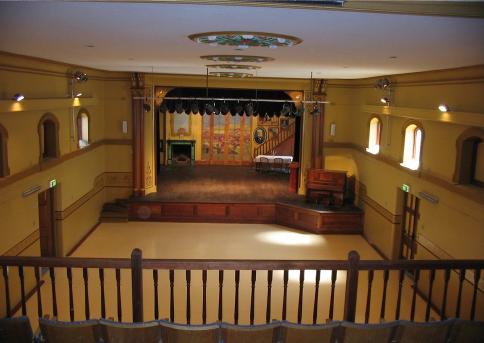
Between May and September 2006, the foyer was enlarged by repositioning the foyer wall and new foyer floor covering was installed. All the walls of the main hall, both foyers and the stage were repainted. The ceiling roses in the auditorium and the proscenium were redecorated in the style of the 1920s and a mural was added to the stage wall. The auditorium floor and woodwork at the front of stage were sanded and painted or stained. Damaged ceilings in the balcony, the stage and projector room were repaired and repainted. The sound and lighting equipment for the auditorium was upgraded and insulation was installed in the auditorium. New curtains were provided for the supper room, the civic room, foyer doors and stage windows. A storage area for auditorium chairs was constructed. For the reopening of the refurbished Town Hall on the weekend of 13th-15th October, the Town Hall Committee of volunteers received the Goyder Council’s Australia Day Award for the Community Event of the Year. As part of this event, an historic display was opened depicting early Burra businesses.
In early 2007 air conditioning was installed in the Supper Room.
References:
The Burra Record
The Burra Broadcaster
The Burra Institute - The First Fifty Years
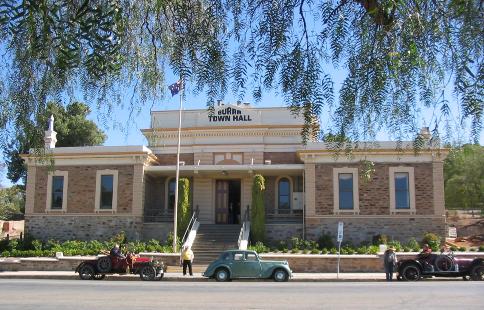
2006
Compiled by Julian Ratcliffe
The Burra History Group Inc. 2007