THE BURRA SCHOOL
BURRA
SOUTH AUSTRALIA
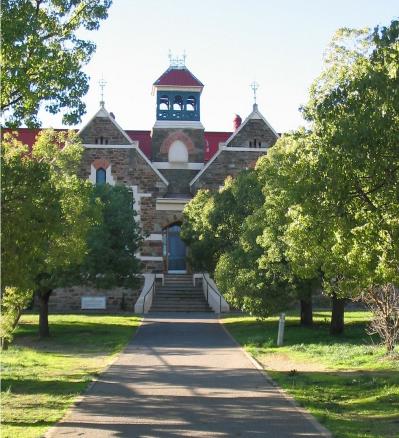
The Burra School
The Early Days
In 1878, education was something of a luxury and was not compulsory in South Australia until 1875 and then only between the ages of seven and thirteen. “Free” education was implemented in 1892. Prior to the opening of the Burra Model School, in January 1878, only the children of parents who could pay the fees, attended various private schools in the Burra townships of Kooringa, Redruth, Aberdeen, Hampton and Copperhouse.
In the year before the new public school was opened, it was estimated that of the 750 children between the ages of 7 and 13, less than 500 were attending a school. Children of working class parents generally left school at the age of ten and after only a year or two of schooling were barely able to read or write. An education census in 1877 revealed that, of the 927 children of school-going age in the District of Burra, most of whom lived in the five Burra townships, 130 could not read or write, 216 could read only and the rest could read and write to a satisfactory standard.
The state assumed full responsibility for the education of children with the passing of the Education Act of 1875 and established a Teachers’ Training College in June 1876. In 1878 when education became compulsory, the government began building its own schools and appointing headmasters and teachers. When the Burra Model School was opened in 1878, school attendance was very poor. In September 1878 the average attendance for that month was 445 of the 641 required to attend.
One reason for this was the poor health of children and a high incidence of infectious diseases like measles, whooping cough, scarlatina, diphtheria, tonsillitis, typhoid and scarlet fever.
Until education became free in 1892, many parents, in those days of large families, were unable to afford the fees, which ranged from fourpence to ninepence per week for each child, no small amount when an average weekly wage was less than £2. In 1881 the School Board granted 80 applications for free instruction. This led to “free” children being branded as paupers through no fault of their own and, in general, no fault of their parents.
The misery and poverty of many Burra Families was reflected in the excuses for absences from school. These included the inability to meet the cost of fees and books, “no boots”, “no clothes fit to send children in”, “the only pair of trousers in the wash”, “gone droving with dad”, “needed for harvest”, and in winter, “feet too bad with chilblains”. August Wittber, the second headmaster of the Model School, was so distressed by the lack of boots among the schoolchildren, in 1886, that he organised a series of musical evenings at the Institute to raise funds for the purchase of 40 pairs of boys’ boots.
Despite the Model School having cheaper fees and trained, certificated teachers, the numbers in the new school rapidly fell during its first year from an average attendance of 326 in term one to 248 in the final term. The school had become unpopular because of too few teachers to the extent that only three out of the twelve rooms were occupied and as a result, several private schools, known as “mushroom schools” opened and ultimately closed during the period from 1878 to 1892, when fees were abolished in government schools. The longest surviving private school was “The Sisters’, St. Joseph’s” School opened in 1857 and closed in 1970.
Where are the Students?
The Burra School remained half empty for about forty years and it took many years and much court action for parents to realise that education was compulsory. The school’s opening in January 1878 was followed by the closure of the mine nine months later and this had a drastic effect on the town population.
In 1878 a headmaster and four teachers were meant to teach 400 students. This resulted in the school becoming unpopular a situation that continued until 1890 when some improvement was noted.
In January 1913 it was announced in the local newspaper The Record “The Education Department has decided to open a High School after the holiday.” Prior to this, only parents who could afford it had sent their children to boarding schools in Adelaide for their secondary education, so most children finished their education at age thirteen. Although secondary education had been made available in some country districts as early as 1907 it was not until 1912 that efforts were made to provide this in Burra.
For some reason very few parents availed themselves of this opportunity and even when, in 1946, the school leaving age rose to 15, enrolments were still less than 50.
In order to continue on to secondary education from 1913 until 1944 students were required to pass the Qualifying Certificate, for many, a rather daunting task.
The concept of a community school incorporating a community library and using the community to assist in the education of students was first mooted in 1974.
In October 1975, The “Record”, announced “The state’s first community school for Burra” It was to be a reception to year12 school serving the whole district. After government acquisition of additional land, the construction of new buildings to replace the transportable buildings that had been added over the years was commenced in 1977. For the school’s centenary celebrations the concept of a community school was put into practice prior to the completion of the buildings.
The Burra Community School and Community Library opened in 1978.
References
The Burra Model School 1878 – 1978 Ian Auhl
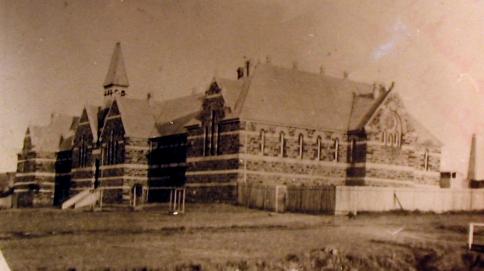
The Burra Model School 1888
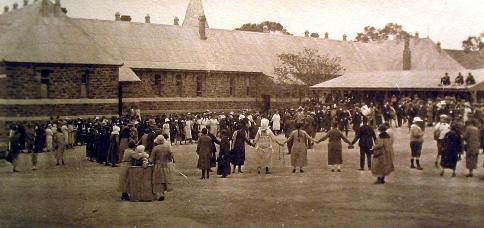
Back to Burra School 1925
Compiled by Julian Ratcliffe
The Burra History Group Inc.
2007