THE
MONGOLATA
GOLDFIELD
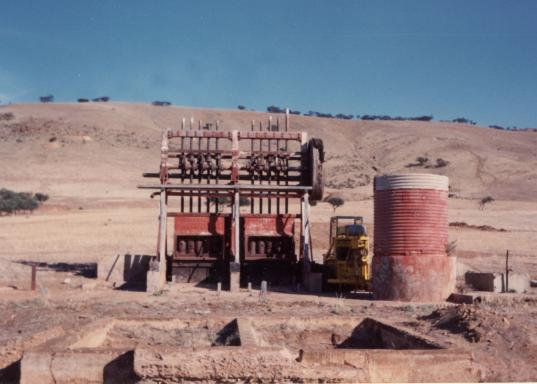
The remains of the Mongolata Government Battery in 1991
Compiled by Julian Ratcliffe
The Burra History Group Inc.
2009
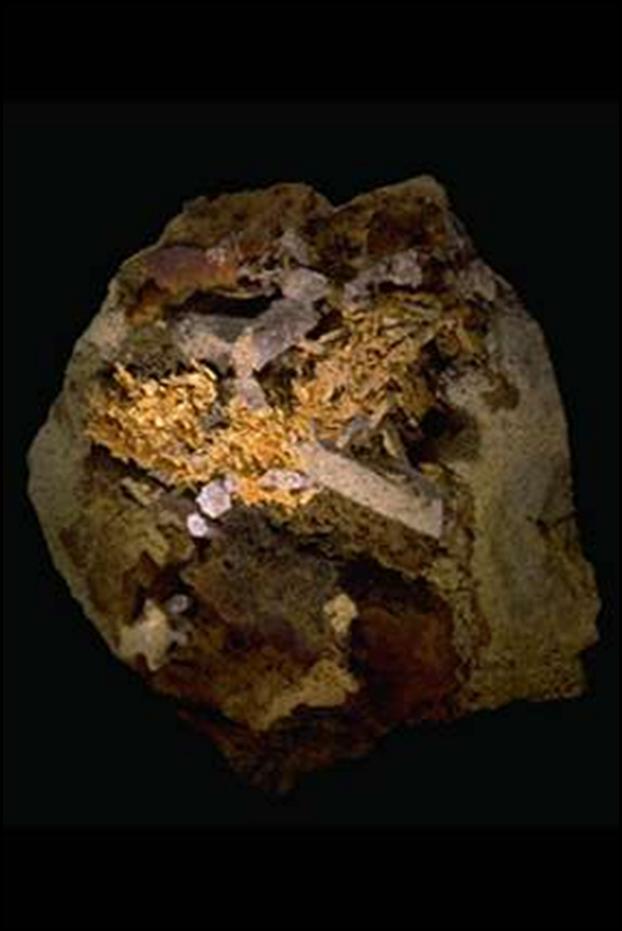
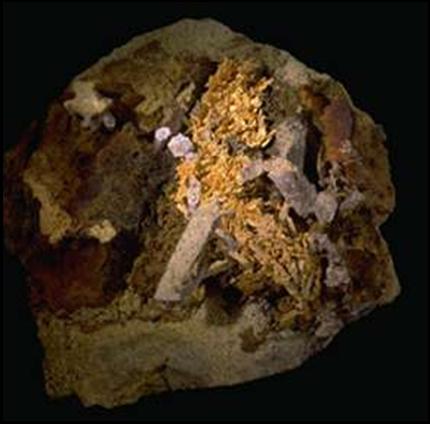
A sample of crystalline gold in a matrix of quartzite and ironstone from the Mongolata Goldfield
Picture courtesy of Greg Drew at PIRSA
2
THE MONGALATA GOLDFIELD
The first mineral discovery in the Hundred of Mongalata was made as early as 1865, when copper was found associated with gold and there were discoveries of small amounts of gold from 1884 onwards.
The Discovery
In November 1930 a drover ,Henry Byles, who was employed by Isaac Warnes discovered a promising gold-bearing reef on section 36W, a property just 16 miles from Burra owned by Mr. George Morgan. A sample found in ironstone and quartz showed good coarse gold as specks as big as a pinhead and in some cases considerably larger. Samples were sent to Adelaide for assaying amid much speculation about a mining venture that could be vital for the Burra District which was suffering from general unemployment. Byles acquired an 18 acre claim at the site and commenced a drive into the hillside, removing 12 tons of ore, which was treated at the Peterborough battery that had been in operation since October that year, returning 73 ounces of gold. The Mongolata Gold Mining Syndicate, with a capital of £500, was formed shortly after this to develop the claim. Others also rushed to the area to stake their claims in section 36W, with leases taken by companies like East View, Block 8, Golden Harp, Hansel Mundy and Curlew.
Byles’ Gold Mine
After extracting 467 ozs. of gold from 76 tons of ore, the Byles Mongalata Gold Mining Company was reformed with a nominal capital of £100,000 in 1932 and it continued until 1945, having recovered 3,531 ozs. of gold from the battery alone. In 1932 the Pexton Brothers opened up a new payable reef on an adjoining site on Section 23, on land owned by Mr. Barker, which became known as Takati and produced rich ore including 154 ozs. of free gold hand picked from the reef. This mine was followed by further discoveries on the same section including Wildildie, Baldina, Mongolata South and Mongolata Central.
Hard Times
All this activity was set against a background of acute unemployment throughout the whole of Australia; the average figure for the first three months of 1930 was 14.6%. Burra was hit by falling wool prices and pastoralists pushing to reduce employees’ wages by 30-50%. The unemployed were seeking help from the Council and there were plans to rework the old Burra Mine with the permission of the owners A.J. and P.A. McBride. The prospect of employing men on a new mine was attractive to the government as it would take them off the list of unemployed.
Ministerial Visit
3
In March 1931 at the invitation of T.H. Woolacott, the Mayor of Burra, the Minister of Mines, Hon. S.R. Richards visited the Mongolata gold prospects. At this stage there were 43 men working out there. The mining camps were mostly ‘bush’ houses with some men in tents and it was considered that the men had ‘made themselves reasonably comfortable.’ The miners requested explosives be provided by the Department of Mines because the rock being worked was so hard. Although a lot of work had been done with drives into the hillsides and there were some beautiful specimens recovered, the miners representative explained that all were on ‘poverty street’ and most of the ore was low grade. Water was in short supply and this needed to be addressed.
Put on Notice
A notice in the Burra Record on 22nd July 1931 warned that any person cutting timber or taking water out of dams on G.B. Morgan’s property would be prosecuted.
Promising Signs
In August of that year, it was stated that 37tons 12cwts of ore treated had yielded 138ozs 3dwt 15gr of bullion valued at £530/17/2.
A Water Supply
In September 1931 the Mayor announced that Mr. Bert James had been hired to supply 500 gallons of water to the gold field at a cost of £4 per week, but in December there were complaints that the water from the Burra Water Works deteriorated out in the sun in small containers and a request for rain water from the disused Redruth Gaol be supplied.
A Request for a Battery on the Mongolata Goldfield
Also a deputation of miners had made a strong case for the provision of a battery at Mongolata. At this time there was a government restriction on motor transport between Burra and Peterborough, forcing all of the ore to travel by rail to the Peterborough Battery. This meant that the ore had to be bagged and handled eight times on its journey to the battery for processing. The bags, which cost 5/- a dozen, wore out on the trip resulting in a considerable amount of wastage. The miners wanted the supply of bags to be free and improvements made to the rough road from Mongolata into Burra. So although there were many new finds being reported throughout the year at places like Rampton and Clarke’s seam and Terry’s claim there were still on-going problems, none the least of which were that the battery was three weeks behind in processing the ore and the inadequate meat rations supplied to the miners on the field.
A New Company
The Mongolata Block 8 Gold Mining Company was registered in January 1932 to work their claim 16 miles from Burra and on the strength of the quality of the ore recovered and the price of gold at £7 per oz. it was
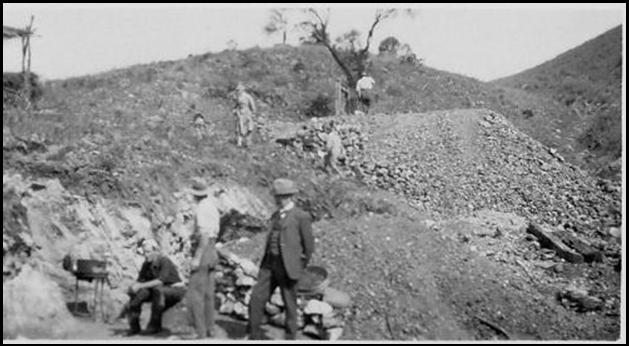
The Mongolata Goldfield 1931
4
speculated that Burra would become ‘one of the biggest places in the State’.
The Battlers
The question of water for a battery was discussed and it was proposed to sink a bore for this purpose. It was estimated the battery would consume 10,000 gallons a day to process the ore. These discussions took place in the field between 16th and 21st January 1932 when the maximum temperatures recorded were 1070F, 113, 117, 112 and 1170F (470C). It was concluded that the battlers out there who lived in huts or tents with little shade needed decent water.
At this time the State Government was spending nearly a million pounds a year on rations for the 23,000 men who were unemployed and it was looking for ways to get men back into work. The provision of a battery at Mongolata would employ 50 men and add to the wealth of the state, but the Government seemed loathe to act as it found money in short supply. It was estimated that such a battery would cost £4000.
In June 1932 it was reported in the local newspaper that a ‘beautiful supply of fresh water’ had been struck at a depth of 310 feet, but unfortunately the bore contractor had got his tool jammed in the bore and as a result the full flow of water could not be calculated, but the purity was confirmed by Messrs T.H. Pearse and I.J. Warnes, foremost outback sheep farmers. It took until August after the completion of 16 hours of testing to establish that this bore could deliver 1000 gallons of water per hour without the slightest reduction. This would be an important
5
consideration in the sighting of a battery in the future. At the same time a rainwater tank for drinking water was nearing completion.
Causes of the Depression
In June 1932 Miss H. Lesley Gebhardt gave an address to the Burra branch of the Liberal Federation on the subject of the Gold Standard and the causes of the depression.
In describing the Gold Standard she pointed out that it was gold that was used to pay international debts. Furthermore it was the reserves of gold held by a country that determined the value of its currency. The Bank of England began losing gold because of a loss of trade and so it raised its interest rates, leading to a reduction in the money supply. This resulted in a check on industry and created unemployment. She also mentioned the fact that with an increase in the amount of gold coming from new mines in South Africa, the Klondike and Western Australia, the price of gold fell on world markets. This effectively devalued all currencies tied to the Gold Standard.
By 1927 with most nations on the Gold Standard, the USA was now the world’s largest holder of gold having gone from a debtor nation to a creditor nation as a result of War debts owed to it by the European combatants. Instead of dropping its trade barriers so that its debtors could still purchase its goods, the USA maintained them and raised interest rates. This resulted in increased debt and a further fall in money supply. Throughout all of this it must be understood that Australia’s economy and currency was tied to England’s.
The Visit of the Premier, June 1932
The Premier announced at a meeting at the Institute that the Unemployment Relief Council had granted £2,500 for a battery at the Mongolata goldfield that would enable the hardworking diggers there to secure a better return for their labour and benefit the State at the same time. ‘The men out there are of the right stuff,’ he said amid applause.
Comments of a Visitor to Mongolata, June 1932
He was full of praise and admiration for the men at Mongolata because instead of preferring the ‘dole’ to work they were prepared to work for rations. He saw them as performing a Herculean task in getting the ironstone ore, in which the gold is found. In amongst the ‘bullock bush’ he discovered a number of miner’s camps that consisted of huts and tents protected from the heat by branches of the local vegetation. He was most taken by the Latagomon Restaurant run by William Carpenter of Aberdeen. Here he and his family were providing beautifully cooked and served meals for the miners. He also mentioned the windbreaks of mallee boughs that surrounded the homestead and protected a garden from cold gully winds that were common in the area. He enjoyed the experience of a
6
campfire in one camp known as the King William St. of Mongolata. Clearly the miners had not lost their sense of humour.
Living Conditions on the Goldfield
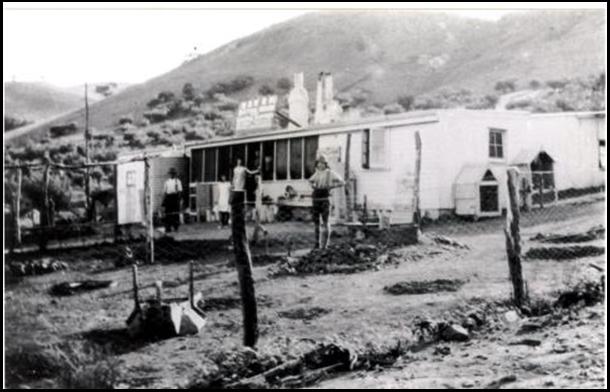
The first miners to come to the goldfield were forced to live in huts which were little more than whirlies constructed of branches stripped from the surrounding scrub. Some men camped in the ‘relative luxury’ of tents, which were draped with branches to provide some extra shade. The miners also built brush windbreaks to protect them from the cold winds that swept the area in winter. As time went by, the miners chose to live in dugouts that were driven into the banks of creeks or into the hillside, providing better protection from the heat in summer and the winter’s chill. Some of these dwellings were whitewashed inside and out. As can be imagined sanitary conditions were a problem and food and particularly water were usually in short supply. These essentials were mainly supplied from the township of Burra from where most of the men came, some with families. Others were single men who had lost work on the surrounding properties and the provision of boarding accommodation and an eating house by Bill Carpenter was very welcome.
An Encouraging Development
Block 8 reported that the main tunnel had been extended 65 ft. and connected to a plat at the 92 ft. level that was being timbered. The total
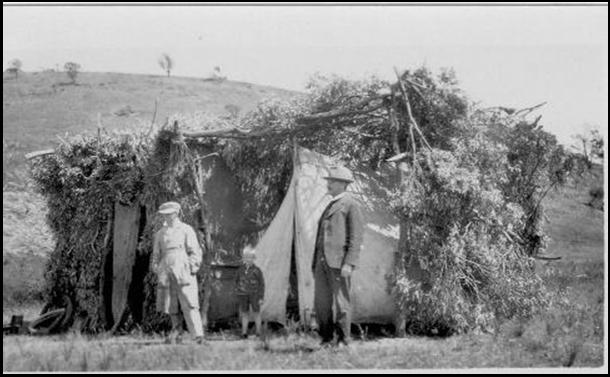
A Miner’s Camp in 1931
7
tunnel was now 345 ft long with rails being installed. The discovery of three separate, well defined, gold-carrying leaders each about 9 inches wide in slate country was an encouraging development.
A Progress Report
October 1932 saw some significant progress being made generally in the goldfields.
At Byles’ Mine, The close timbering of a two compartment shaft to the 77 ft. level with ladders had been completed and two plats had been cut and timbered. Rails had been laid in a cross-cut at the 52 ft. level for handling the ore from the shaft The Main tunnels to the shaft at 92 ft. had been advanced 341 ft. and the mouth of the tunnel had been timbered. Rails had been laid for the full length of the tunnel and trucks put into service. A stone drain to carry flood waters away and a new blacksmith’s shop had been constructed near the tunnel entrance.
A Battery under Construction
The building of the battery and the outbuildings had been commenced with the expectation of it being completed just after Christmas.
With the price of gold now quoted at £8/8/6 an oz. and after twenty members of Parliament in Adelaide had inspected a large slug and other gold from the Takati Mine, Mongolata, it was still proving difficult to convince the Government of the worth of the goldfield.
The Mongolata Lode
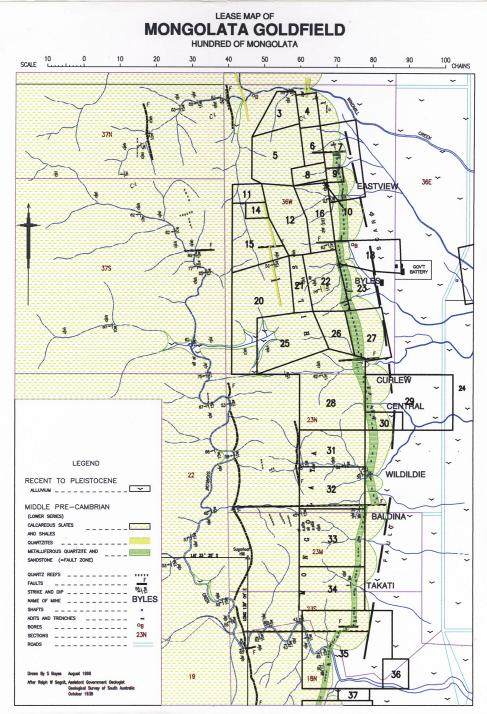
When you look at a modern map of the Mongolata Goldfield which shows the geology of the immediate region, you are struck by the great age of the calcareous slates and shales of the area that date from the middle Pre-Cambrian. These original alluvial sediments were laid down in an ancient sea and over time were compressed under layers of deposits and later after considerable weathering exposed as they are now today. What is also significant are the much more recent alluvial deposits from the Pleistocene Era that border this landscape. The miners were interested in a metalliferous intrusion of quartzite and ironstone lying in a fault zone that runs roughly north to south that had been thrust up through the shaly bedrock. This metamorphic rock is much harder than the surrounding rocks. The miners were able to drive into the upraised lode from the eastern alluvial plain and follow it downwards along the dip angle. Some of the men were experienced prospectors but many were unemployed farmers or labourers with no experience of mining. The gold proved quite elusive at times and much hard work, breaking very hard rock provided little reward. The small claims, many of them completely fruitless, were worked for a time and abandoned, but some grew into small mining operations.
William Carpenter’s Bakery and Eating-house c1932
8
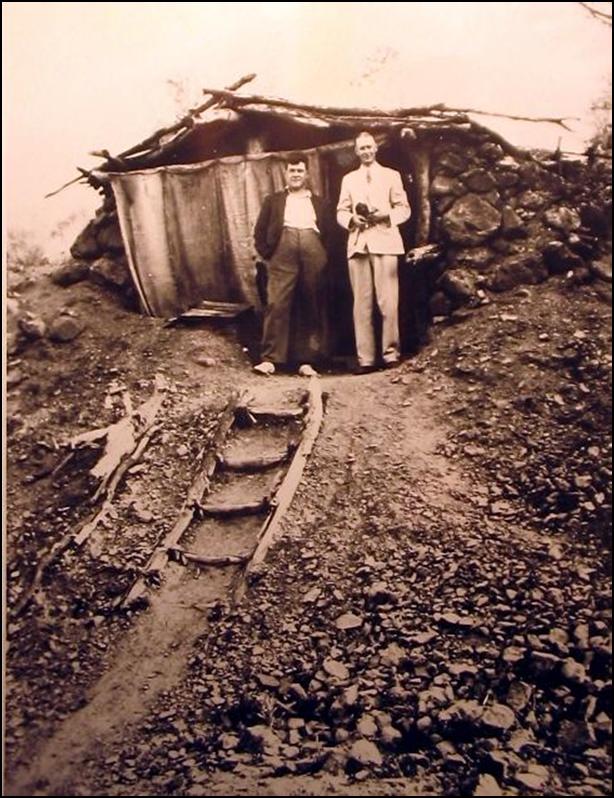
Phil Rule’s dugout in 1933
The miners built dugouts into the sides of the hills in much the same way as miners had done 90 years before in Burra. This was a way of overcoming the summer heat and the winter’s cold.
9
Takati
Great interest and excitement was expressed in January 1933 when Pexton’s mine known as Takati discovered 96 ounces of gold in one afternoon. One piece was just over 3 pounds in weight and another 2 pounds with the balance measured in ounces. The gold that was found in a pocket in a winze at a depth of 80 ft. was described as being beautifully clean. Some experts stated that finding gold in pockets was not a good indication for deeper more valuable deposits. Amongst recent finds was extremely rare crystalline gold of around 24 carat value.
Will History Repeat Itself? - The Burra Record 15th Feb. 1933
Frank Treloar recalled the early days of Burra’s Copper Mine and speculated on the potential of Mongolata Mine in once again bringing wealth to a depressed economy. The Burra Mine had started in a small way in 1845 but by 1847 it paid a dividend of 800 percent. A.L. Walker wrote that just as the Burra mine meant so much to the state in those early days so too Mongolata had the potential to be of similar importance. He believed that other mineral deposits were found along the edge of the same Pre-Cambrian rocks at places like the Adelaide Hills, Ulooloo, Wadnaminga, Teetulpa and Olary.
He advised the miners to follow all stringers as they must eventually lead to the gold deposits. He also suggested there must be plenty of alluvial gold in the area.
After much frustration over delays to the completion of the battery at the mine site a notice appeared in the Burra Record of 22nd February 1933 advertising the official opening of the Mongolata Battery by the Hon. R.S. Richards on March 2nd.
The Opening of the Mongolata Battery – 2nd March 1933
On a rather sultry day, about 300 people made there way out along a dry and dusty road from Burra to Mongolata in company with the State Premier, the Mayor of Burra, the Town Clerk and other dignitaries for the official opening of the Government battery. A trolly was used as a platform from which the speeches were delivered with the old Union Jack and Australian flag fluttering above. Mr. I.J. Warnes the Chairman of the Mt. Bryan District Council presided and welcomed the newly elected Premier Mr. Richards, the Mayor of Burra, Mr. Woolacott, the Members of the District and other prominent gentlemen. He then briefly outlined some of the recent events that led to this day and reported that although this was the official opening the battery had actually already been in operation for a few days. From the commencement of mining two years ago, some 1500 ozs. of gold had been recovered, which at £6 an oz. meant £9000 worth. He predicted that there was probably another 500 ozs. of gold in the 500 tons of ore already mined and that this mine would
10
prove to be another Burra and greatly help pull the State out of its difficulties. He congratulated Mr. Grundy, the manager of the battery and thanked Mr. Morgan, the property owner, for his generous support in the development of the mine.
Mr. Woolacott, the Mayor of Burra, supported Mr. Warnes in his remarks and then outlined the history of the mine’s development. He also mentioned that, just as the Premier had waited a long while to become Premier, they had also waited a long while for the battery. He praised the work of the prospectors who helped to prove the goldfield. He thanked Mr. C.A.S. Hawker and Senators Daly and O’Halloran for their part in supplying military boots, clothes and blankets for the men.
Cr. J. Kellock representing the Burra District Council apologised for the absence of the Chairman, Cr. Pearse and referred to the lack of publicity the mine had received in Adelaide and how impressed he was with the changes that had occurred at the site in the 6 months since last he had visited. He promised to make every effort to get the money for a made road to the mine. He then asked the Premier to declare the battery open.
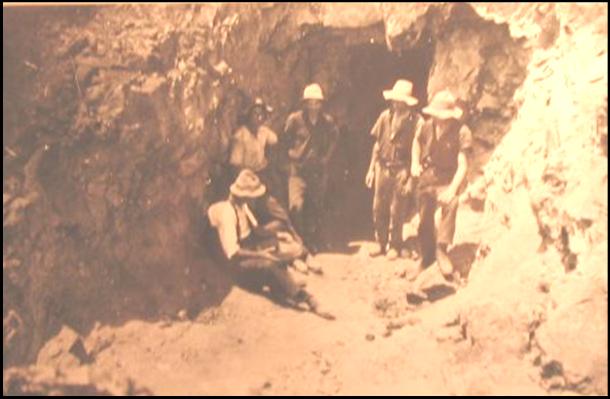
Pexton’s Takati Mine 1933
William Pexton (seated) with his sons Tom, Ron, Bert and William (Jock)
11
The Premier rose and assured people that he would not use the occasion to make a political speech and then proceeded to launch into a long political speech. He was a politician after all.
He warned the miners against striking for extra pay and of the risks of a shortened life as a result of inhaling the fine quartz dust they were working with. He took credit for helping to get an extra meat ration for the men. At this stage he was asked, ‘Did they get it?’ He replied with, ‘If you have set out to annoy me then you couldn’t have a harder job.’ There were obviously some angry men in the gathering who were quite prepared to challenge all of the speakers as well as the Premier.
The Premier then went on to defend the government’s actions in relation to the mine, he briefly defended the cyanide process to be used in extracting the gold from the tailings and assured miners they would receive the premium on gold from the Royal Mint provided Mint certificates could be produced.
He quoted the figures from treatment of their ore at Peterborough as being 863ozs. 10dwt. 13grs. of bullion with a value of £3384/2/8, from 198 tons 11cwts. of ore.
He thanked the State and Federal Governments for their grants and quoted a figure of £3000 in incidental expenditure.
He revealed the results of the first crushings by the battery as 52 ozs. 19dwt. 2grs. of gold from 50 tons 14cwt. from Byles’ Mine and 239ozs. 16dwt. 6grs. of gold from 15 tons 15cwt. from the new Curlew Mine. He urged miners to work on a cooperative basis.
One heckler was seeking a Government diamond drill, obviously like the one that had been used to sink the bore. The Premier thought ‘the country was too broken for that.’ He hoped the mine would turnout to be a second Kalgoorlie.
The Premier then declared the battery open.
Mr McHugh, MLA, thanked the Premier and other speakers followed. The ceremony ended with people being invited to inspect some of the workings.
The official guests were entertained at a dinner in the dining room of the Burra Hotel. There was a civic reception at the Institute at which the Premier again delivered another long speech that also was met with interjections. A thoroughly good time was had by all.
The Government Battery
The ‘stamps’ for the battery were manufactured in Adelaide by Forward Down and Co. of Mile End. Mr. Grundy was appointed as manager of the battery that handled separate parcels of ore from each of the claims as required on the Mongolata goldfield. There were four other government
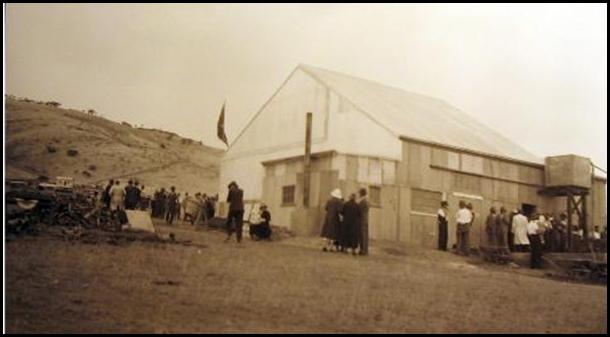
The Official Opening of the Mongolata Government Battery
2nd March 1933
12
batteries throughout the State. They were situated at Peterborough, Tarcoola, Mount Torrens and Glenloth.
The Truth Emerges
At a meeting of the Burra Women’s Branch of the Liberal and Country League the question of why the Mongolata Battery was delayed was put to Mr. C.A.S. Hawker MHR the Federal Member for the electorate. His answer was most illuminating in that he said it was funded by the Federal Government and not from State Government funding as the Premier had led people to believe at the opening ceremony.
A Sense of Injustice
An article in March 15th edition of the Burra Record, made the point that Burra and in particular the Mongolata Mine seemed to be being treated unfairly. Previously reference had been made to the lack of publicity given the mine in Adelaide. This article pointed to the fact that a copper discovery at Wallaroo was given much more prominence in the ‘Advertiser’, Adelaide’s leading newspaper, that a magnificent find of gold at Byles’ Mine. It also goes on to another article in the ‘Advertiser’ furnished by the Minister of Mines (Mr. Richards) and the Director of Mines (Mr. L.K. Ward) under the heading ‘Mineral Output Increases’ that notes the remarkable fact that no copper ore had been sold in the year 1932. By contrast the gold output in the same period was the largest since
13
1919. Of the 3014 ozs. of gold recovered, a very large percentage was from Mongolata. It also was of interest to note that Wallaroo Mines had been granted £10,000 to produce ore that was almost valueless. It also points out that Mr. Richards was at that time the Minister of Mines and is now the Premier and that Wallaroo is in his electorate and of course Burra is not.
Fruits of Their Labours
From the commencement of the Mongolata goldfield samples of the ore had been displayed in Mr. F. Harris’ shop window. On 28th June it was reported that the first police gold escort had brought 171 ounces of battery gold, in the form of a handsome gold bar, from Byles’ Mine into Kooringa and deposited it in the Bank.
Cyanide Extraction of Gold
In discussing the gold produced, there was always a distinction made when it was ‘cyanide gold.’ The reason for this is that the gold extracted in this way always contained slight traces of other metals like zinc or copper and was not as pure as the gold in some nuggets. It might also be of interest to mention that the cyanide extraction of gold, which was common practice, was also an extremely hazardous operation because of the deadly toxicity of cyanide.
Questions in State Parliament
Mr. A.D. McDonald asked the following question on notice in parliament.
What was the amount spent in Wallaroo district by the Hill Government as subsidies to mining during the years 1930-31, 1931-32, 1932-33 from (a) Commonwealth funds, (b) State funds?
What was the value of the copper mined as a result of these subsidies?
What subsidies were paid for gold mining at Mongolata for the same years?
The Hon. R.L. Butler replied:
Wallaroo District:
‘Expenditure in 1930-31: Commonwealth, £5000; State £3,607
Expenditure in 1931-32: Commonwealth, £5000; State £1,204
Expenditure in 1932-33: Commonwealth, £13,494; State £777
The value of the copper mined was approximately £10,090 with work made available on a large tonnage yet to be raised.’[sic]
At Mongolata, £3000, was provided by the Commonwealth for provision of the battery and cyanide works.
It’s little wonder the people of Burra felt aggrieved.
A Curiosity from the Mongolata Mine
As usual Mr. Frank Harris had on display in his shop window an object from the Mongolata Mine It was a wonderful formation of ‘pottery’ in the from of a huge ‘clay’ basin from a shaft at Mongolata. The specimen,
14
formed of sandstone, was thought to have been formed in an ancient river when ever-moving pebbles swirled around by water, ground out this basin in the river bed.
Gold of Richest Quality
On a visit to Burra by the Minister for Mines Hon Geo Richie, he and his party were taken to the Bank of Australasia to inspect some value quartz found at the Byles’ Mine. Half a sugar bag of specimens was brought from the strongroom and samples were shown. At first the Minister was unimpressed until three lage pieces streaked with gold were produced. Mr. C.J. Butler, the Bank Manager, said that 852 ozs. of gold had gone through the bank, the value of which was £5710. The value of the gold passed onto the Melbourne Mint from the Curlew Claim, Mongolata, was of the richest quality that had ever passed through and was valued at £7/6/6 an ounce, whereas the usual rate was about £6/18/5.
A Deputation from the Mongolata Prospectors’ Association
6th September 1933
A deputation of prospectors met with the Minister for Mines Hon. G Richie, MLC at Mongolata with proposals for government subsidies for their work on mine drives and sinking shafts. They also wanted subsidies
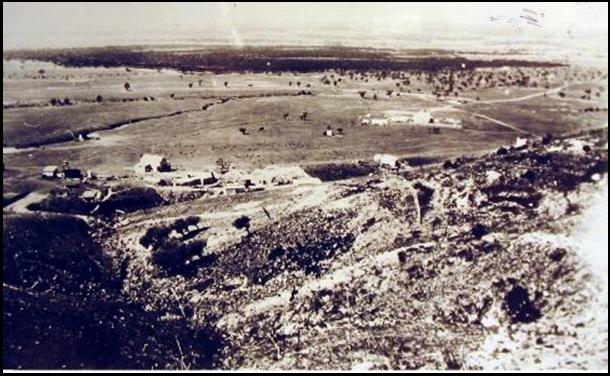
A view of the Mongolata Goldfield in 1933 showing the buildings at the entrances to the Eastview Mine on the left, and Byles’ Mine on the far right. The Battery can be seen on the plain in the distance to the right.
15
on costeening, a process where cuts are made into the rock in an attempt to strike the veins of ore. The nature of the Mongolata Mine required a lot of this exploratory work without realising much ore. They also called for assistance with the provision of mining tools, clothes and supplies of fracture. This was the name given to the lengths of fuse, detonators and explosives required to break up the very hard quartzite rock in which they were working. They supported their claims with facts and figures showing the success of the operations so far.
A Picnic Sports Day Eight Hours Day, Wed. October 11th
The Mongolata Sports Club held its first Sports Day on this public holiday and was most encouraged by the number of people who motored out from Burra to support them. The flat country on Mr. Morgan’s property to the east of the diggings proved to be an excellent venue with fine running courses that were free of stones. The competition began in earnest after picnic lunches were enjoyed. The programme of events included sprinting races, an egg and spoon race, potato races, a wheelbarrow competition, a feather race, sack races, high jumping, a hop step and jump event and a football kicking competition. Events were run for all age groups from ‘tots’ to adults with a surprising degree of participation from all who attended. At the completion of the events the children were all presented with a bag of goodies that included a saveloy in a roll, cake and an orange. The winners’ names in each event were listed in a newspaper report of the day, among them were many names well known in the district.
It was reported that in October a number of new ‘residences’ had appeared particularly in Petticoat Lane and The Strand. There was a large underground tank under construction and a new tennis court. The comment was made that ‘the trend of the whole community out there appears to be any amount of hard work, clean conditions and healthy sport. Apparently some of the tennis players showed quite a bit of form.
A Reply from the Department of Mines
T.H. Woolacott, the Mayor of Burra published the Department’s reply to the requests made by the Prospectors’ Association on 8th October.
A place had been prepared at the Government Battery for prospectors to wash prospects during working hours (7.30am to 5pm.) at no charge.
A pipeline from the bore will be connected to Mr. Carpenter’s boarding house if he pays for the water.
Subsidies on sinking, driving and costeening could not be granted because this would have ‘too wide an application to be economically and financially possible.’
16
As far as explosives were concerned, the Government could not store and sell explosives in competition with private vendors. The Minister recommended direct purchase from Elder Smith and Co.
The Year Draws to a Close
The end of 1933 saw a series of reports of magnificent returns from Byles’ (939 ounces in two weeks), Baldina, Curlew and Pexton’s, Takati Mine. These reports are always careful to differentiate between battery gold and cyanide extracted gold. There is also mention of new claims being pegged out and a find in the vicinity of Chalk Cliffs station.
Mongolata Goldfield Report
In December 1933 in the SA Department of Mines Review, a report on the Mongolata Goldfield from the Chief Inspector of Mines, L.J. Winton appeared. This report lists the following sites; Byles’ Mongolata, Baldina Mongolata Gold Mine, Takati Mine (Pexton’s), Wildildie Mine, Central Mine, Curlew Mine, Rampton’s Eastview Mine, Block 8, Chalk Cliffs and Mongolata Alluvial Gold Mining Co. which was involved in deep alluvial prospecting without any success. These reports were made on a regular basis as a result of inspections made on sites and included the bullion production figures from the batteries at Peterborough and Mongolata.
The New Year 1934
The new mining operation at Chalk Cliffs became known as Anderson’s Reward and was reported as having about a ton of ore at grass.
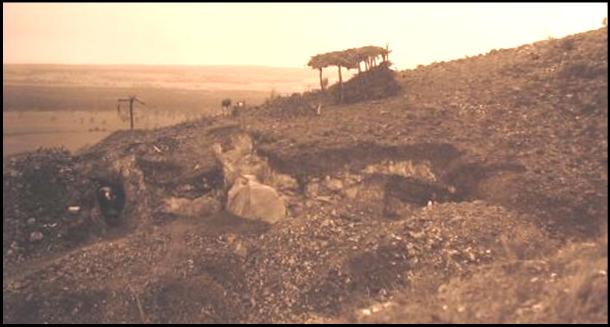
The Byles’ Open-cut Mine
17
Dancing at the Wildildie Woolshed
About seventy people attended a dance in aid of the Mongolata Sports Club on Saturday night 27th January which included elocution items, a step dance demonstration and raised £1/1/10. Once again there were visitors from Kooringa, Aberdeen and Hallett and a good time was had by all.
Results from the Mongolata Battery February 1934
After one year of operation, gold bullion worth approximately £19,700 had been recovered from 1,691tons 7cwt. of ore. It was acknowledged that the total value of production was greater than expected because of an increase in the value of gold in London and an improvement in the exchange rate. It was thought that this result vindicated the erection of the battery.
Mongolata Produces 39.8% of South Australia’s Gold
It was revealed in the April 1934 report from the Minister for Mines that gold production in the State had doubled from 1932 to 1933; the value now exceeding £1million for the first time since 1930. The Mongolata battery had produced 39.8%, well above any other producer.
Rain Delays Operations
April rains caused a lot of damage on a number of the claims with washaways and flooding of drives under several feet of water and it was expected that this would delay progress on the goldfield. It was estimated that about 80 men were employed here at this stage.
Your Obedient Servant S. Harvey, Secretary for the Commissioner of Public Works
In replying to complaints from the miners about the discolouration of the drinking water collected in the government tank, the Secretary assured miners that a bacteriological examination showed the water posed no danger to their health. Nevertheless it had ‘a slight taste of tar and bagging’ according to those who relied on it. The editor of the ‘Burra Record’ commented that the sample he was given seemed worse and in any case no one wanted even a slight taste of tar and bagging in their drinking water. The big tank was being cleaned out this week. It was hoped that this would solve the problem.
In July 1932, bitumen sheets had been laid as a water catchment funnelling water into a 35,000 gallon tank for domestic water. By September, this tank, which was lined with tar, was full after heavy rain.
By July 1934 the water supply was described as being ‘the colour of tea and tasting of rubberoid and tar’ and that the renovations in June, involving new rubberoid, still meant the water remained tainted. In March disgust with the water quality had been expressed, it being ‘yellow-black in colour and unfit for drinking’. There were calls for galvanised iron sheets to be used in the catchment as had been done with the Burra
18
Electric Supply Co.
Bill Carpenter Opens a General Store at Mongolata
Another milestone has been reached with the opening of Bill Carpenter’s local store that will be greatly welcomed by the miners of this growing village. This new venture of his adds to his much praised café and boarding house.
Water Shortage July 1934
Eventually the Waterworks Department saw reason and agreed to clean out the water tank that been contaminated by water collected on a faulty portion of the catchment sheeting. The deteriorating sheeting was also being replaced. As a result, the whole of Mongolata was facing water shortages and resorting to storing water in whatever container came to hand.
Sporting Events at Mongolata
By August there were several sporting events of interest in the small community; a tennis tournament that resulted in a win for the Pexton brothers, a cricket match between a team from Bore Creek and The Rest posting an outright win for Bore Creek and athletes in training with phantom-like figures speeding across alluvial fans for the upcoming Sports Day. It would seem that the boys from the Mongolata Cricket Club were keen to spread their wings and they played their first match against the Aberdeen Colts with the limitation that fast bowling was taboo because of the dangers of the rising ball. The scores indicate that fast bowling or not, the bowlers were on top and so was Mongolata, winning outright.
Wintry Weather - August 1934
The wintry weather in Mongolata though common to other places as well was a mixed blessing producing 98 points of rain and another 20 points within the same week. This was the best rain since April and would provide much needed water.
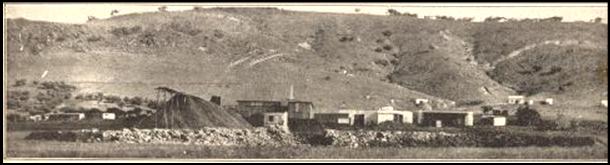
A photograph published in the Adelaide Chronicle in November 1933 showing the amount of activity around the Mongolata Battery. Note the considerable heap of tailings resulting from the operation of the battery since March.
19
Paying Dividends
By September 1934 Byles Mongolata Goldmining Co NL had paid three dividends of six pence a share to shareholders. In direct contrast Chief Judge Dethridge told the Arbitration Court this month that of all of the gold mines registered on the Stock Exchange in Victoria, only one had paid a dividend. It turns out that Byles’ was the only goldminer doing so in South Australia.
Cricket Notes October 1934
The Mongolata Cricket Club conducted a very successful cribbage tournament with four rounds, semi finals and a grand final.
Mongolata Sports Day Eight Hours Day Wednesday 8th Oct. 1934
It was a cool, cloudy, but fine day that greeted participants and visitors that saw a punctual start to events. The Waybacks Grub House was busy at lunchtime serving saveloys, rolls and tea as was a refreshment booth with fruit and sweets. The Mongolata Devil was on hand to entertain the kids. It would seem that the event was growing each year with the inclusion of cycling events. The cycle race for boys was described as them ‘going for the police’ and in the old boys race one old boy by the name of Robinson showed he hadn’t lost much. The Burra Sporting and Athletics Club assisted as officials with the foot races. New events included a tug of war, tossing the caber, bowling at a stump and a book race for the ladies. You could even try yourself out at guessing the weight of a sheep, which wasn’t won by a shearer but by Miss V. Garrard. The day concluded with a dance at the Oddfellows Hall in Aberdeen.
An Aladdin’s Cave
The Chronicle, Adelaide.
“Yesterday I found myself in a veritable Aladdin’s Cave. Mr. Pexton took me down to the safe deposit and brought out a small tea canister from which he extracted big nuggets of gold and gold studded ore the like of which I have never seen before. These riches were won from a goldfield near Burra. I picked up one piece of ore shaped like a small cabbage. It contains 183 oz. of gold and experts assess its worth at £1000. [It became known as Pexton’s Nugget.] Mr. Pexton told me that the Duke of Gloucester inspected, with interest, these samples at Government House during his stay here. ‘His Royal Highness graciously consented to select a beautiful specimen of crystalline gold as a gift from me to Princess Elizabeth, daughter of the Duke and Duchess of York. I know Yorkshire well as I rode to hounds there in my younger days,’ Mr. Pexton said.”
A Mining Lease Goes into Liquidation October 1934
‘Notice is hereby given that the creditors of the Mongolata Block 8 Gold Mining Co NL are required before 30th day of November 1934 to send their names and addresses and particulars of their debts or claims and the
20
names and addresses of their solicitors to Maurice William Bednall of Pearce’s Building Commercial Street, Kooringa in writing etc…’
Despite the enthusiasm and confidence shown for this goldfield there were some losers along the way. The Byles Gold Mining Company took over the Block 8 workings in November, adding it to its original holding and Golden Harp. 1934 ended with more good crushings recorded at the battery and carols sung in celebration of Christmas.
That Man Carpenter Again
Bill Carpenter has agreed to take on the position of Postmaster to Mongolata for the princely sum of 5/- a week. He commented that he was only doing it to help the folk out there.
Off to a Promising Start
January 1935 opened with good rainfall throughout the region so water reserves on the field were replenished. Of even greater importance was the State Government’s decision to furnish cash advances to accelerate mining development throughout the State. All applications were to be made to the Director of Mines.
An Appeal for Reading Matter at the Mines
An appeal by miners for magazines and books for the men on the gold field was swiftly answered and collected at the office of the ‘Burra Record’. Tragically these contributions, mainly from the people of Burra, were destroyed in a fire that took hold at the ‘Burra Record’ Office. Another appeal immediately went out and was also generously answered by the township.
Gold Price Rise
Between February 22nd and March 2nd 1935 the international price of gold rose from £7/3/6½ to £7/6/10½ representing the fifteenth record for the markets since last August.
Low Water Supply March 1935
With no rain falling since January, the surrounding country was very dry and the level of water in the tank was very low. The water quality since cleaning the tank had been good but a little dark. Soon after the men had been warned that bore water may have to be used, 50 points of rain fell. Eventually after another inch of rain, the big tank was full.
Church Services on a Tuesday Night
Throughout 1935 the Reverend Redding from St. Mary’s Anglican Church in Burra conducted church services for the people of Mongolata. These services were generally followed by community singing, which proved to be very popular.
Cricket Matches ‘Mongolata Style’ - April 1935
Mongolata invited World’s end to a cricket match on Saturday 27th April and all roads led to the Mongolata cricket ground. A cavalcade of
21
motorcars bearing cricketers and their supporters, often female, descended on the ground. Afternoon tea was served at the ground and an evening meal of sausage rolls, sandwiches and mountains of cake, was provided at the boarding house, with Bill Carpenter in charge of proceedings. After this everyone made their way to the Wildildie woolshed that was all decked out with clusters of gum tips, coloured balloons and streamers, for an evening of singing and dancing. This came to be a regular event throughout the year.
Visit of the Governor June 1935
Sir Winston Dugan and Lady Dugan visited Mongolata on a bitterly cold day. They were welcomed by Mr. I.J. Warnes and Mr. E.J. Harris and were shown over the workings. It was announced that £50,000 of gold had gone through ‘the stamps’ since the establishment of the battery. The Governor and his wife were presented with a gift of a gold nugget and after a brief speech of thanks, driven back to Burra for an official reception in the evening as guests of the Mayor of Burra, where they graciously accepted a gift of some polished malachite from the Burra Mine.
Sporting Events
Cricket matches seemed to be great events and Morgan’s woolshed hosted the dance on some occasions.
Table tennis tournaments became a regular sporting fixture that proved to be very popular.
At the Annual General Meeting of the Sports Association in September it was announced that the population of the gold field had fallen from 120 a few months ago to 80. People were urged not to ‘drop their bundles.’
A very successful tennis tournament was held in September.
Sports Day
The Eight Hours Sports Day on Wednesday October 9th was a very successful event once again, drawing people from as far as Robertstown and included a relay running race, a nail driving event for the ladies, and a cotton winding competition.
The Vexed Water Supply November 1935
Mr Lacy, the Leader of the Opposition in Parliament raised the question of the water supply for Mongolata. The water catchment that was originally installed was of a temporary nature, consisting of rubberoid nailed to timber. The year before the rubberoid became frayed, due to exposure to the weather and frayed portions entered the drinking water tank, causing an epidemic of sickness on the goldfield, many men becoming seriously ill. The Government had been approached to replace the rubberoid with galvanised iron, but this has not been done. Although £150 had been voted for a water supply, only £11 was spent and this year
22
£25 has been provided. During the time when there is heavy rain the water keeps clear because the 30,000 gallon tank is being flushed out, but during summer sickness is caused by the rubberoid entering the tank. It would seem that the attitude of the Government was that there was no permanency to the field.
30th June Figures for Mongolata Mine 1935
On 30th June each year the Mines Department issued figures for the total ore treated at the Mongolata State battery and cyanide works. These figures were published in the ‘Burra Record’ on 3rd December 1935 and showed that 5887 ounces of bullion had been produced from 3646 tons 7cwt. of ore recovered at 34 claims with a value of approximately £40,000 on present prices. Whilst some of the claims were only small, bringing around a ton of ore each to the battery, Byles Mongolata with 1,862 tons 17cwt. of ore was the biggest. However Curlew and Takati both exceeded a value of £3000 worth of the bullion produced, with Byles being next with £1,618 worth. This was old news to the Mines Department but heartening for the people of the Burra district.
More Telling Figures
In January 1936 the Adelaide newspaper, the ‘Advertiser’ published figures comparing the Mongolata Goldfield with other State batteries, stating that the figures ‘speak for themselves.’
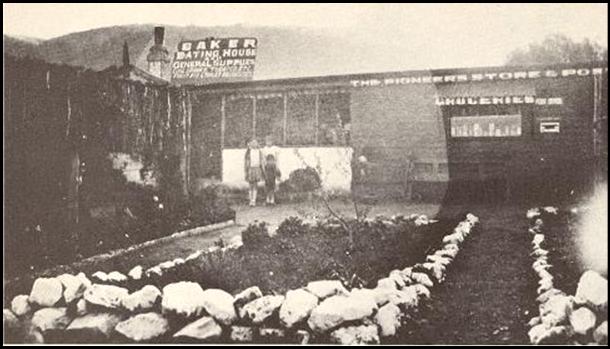
Carpenter’s Pioneers Store, which ran for the nine years of the life of the goldfield became a post office in August 1934
23
The figures showed the December 1935 yields in pennyweights per ton (dwt/ton).
1 oz. = 20 dwt. (pennyweight)
Tons Ozs. Average Yield (dwt./ton) Mongolata Battery 98.15 259.3 52.8 Mount Torrens Battery 108.1 70.5 13.0 Peterborough Battery 12.8 6.6 10.3 Tarcoola Battery 129.1 78.7 12.2 Glenloth Battery 89.0 28.3 6.3
Tons
Ozs.
Average Yield
(dwt./ton)
Mongolata Battery
98.15
259.3
52.8
Mount Torrens Battery
108.1
70.5
13.0
Peterborough Battery
12.8
6.6
10.3
Tarcoola Battery
129.1
78.7
12.2
Glenloth Battery
89.0
28.3
6.3
What is significant is that Mongolata was far above the other batteries in the total amount of gold produced as well as the yield.
The figures also listed some of the Mongolata claims separately. Baldina Mongolata topped all claims with a yield of 111.9 dwt./ton rivalled only by Sullivan’s Section 726, Tarcoola at 58.8, then Takati, Mongolata 45.4 and East View, Mongolata 43.0.
‘The Economic Traders Gazette’ followed up this article with the claim that Mongolata has sent approximately £60,000 worth of ‘some of the best gold that ever went through to the Australian Mint.’ It also refers to the fact that ‘the officers [of the Department for Mines] who are kept by taxpayers and miners, write columns of public information every month and the best field in the State, they never mention.’
The Salvation Army Visits February 1936
It would seem that church services were a Wednesday night affair and the first service for the year saw two ladies Captain Cresswell and Lieutenant Smith accompanied by Mr. and Mrs. Betterman of the Salvation Army bring out their harmonium and cornet for the service which few attended. During 1935 there had been similar services held by the ‘Army’ and it was set to continue on a regular basis. It would appear the next service had a better attendance. Did the harmonium do the trick?
January Operations 1936
The Department of Mines reported that there were about 60 men engaged in mining and prospecting on the field where the battery had been in continuous operation with bookings for 250 tons. All work in progress is with lode mining as prospecting for alluvial gold has been abandoned.
An Important Announcement by the Prime Minister
The Prime Minister Mr. Lyons announced the provision of financial assistance of £210,000 for metalliferous mining over three years. This
24
was for assistance for prospecting, provision of plant and their operation, metallurgical investigations, water supplies, transport, roads and the education of miners. The advances will be on a pound for pound basis with the State Governments. This initiative was intended to assist with relieving the unemployment situation. At this time it was estimated that 45% of the industry’s costs were in labour and that it took three men employed in other industries to keep three miners employed.
A Thunderstorm in February 1936
135 points of rain fell in less than half an hour when a heavy thunderstorm passed over the district. Water poured down from the hills for a considerable time after the rain ceased. All road crossings were washed out and vehicles were forced to proceed very slowly. Bore Creek looked impressive with water flowing down between two ranges of hills turned into a raging torrent abut 100 yards wide at the dugouts. In front of the boarding house was just one big sheet of water with waves of water around the tennis court. At the height of the deluge, the Government Battery was barely visible. Two men working at Byles’ Mine had a remarkable escape. Water coming down the hill flooded one of the air shafts and cascaded into the drive in which they were working. As the water rose they were just able to keep their heads above water as they waded about 150 feet to the exit shaft. Had the water risen any further, nothing could have saved them. The storm eventually passed to the South East where ‘wonderful fireworks were seen at about dusk.’ The total rainfall for the week was 170 points, but Wildildie reported 188 points.
Another Disappointment April 1936
The Education Department had promised that a school would be established on the goldfield to begin the new school year. They had identified an unused school building that would be shifted to the site and the men stood ready to erect it. There had been 13 school age children, but four have left to be educated elsewhere and now the Department claims with only nine students, a school is not required.
Support from the Burra District
Throughout the year, besides the regular visits of the Salvation Army and the Rev. Don Redding, the Church of England minister from Burra, the locals of the district regularly collected books, magazines and comics to send to the adults and children of the mines. There were also gifts of clothing and a successful collection of discarded children’s toys.
Leaner Times 1937, 1938 and 1939
During these years it is clear that some of the smaller claims fell idle. The finds had always been described by experienced prospectors as not reef gold but rather veins and stringers that had to be followed wherever they
25
led. The biggest operation was Byles Mongolata Gold Mining Co. which worked three claims. It had extended shafts and drives deep into the gold bearing quartzite and had found it necessary to make calls on its shareholders to continue its operations. It had also struck water in its main shaft and was not able to continue with this until suitable pumping equipment was installed. Whilst Byles’ had not closed down, there had been times of little activity and after Mr. I..J. Warnes was appointed manager the profitability picked up for a while. It would seem that he had adopted a policy of not sending all of the ore through the battery. In December 1938 he said that it would be extremely serious for the welfare of the goldfield if Byles’ Mine closed down because of lack of funds. The Company owed £92 to the Government and £34 to sundry creditors. It would seem that the management of the Company was reverting to the previous policy of putting all ore through the battery, a method that had not been a success. As usual, the mine closed over the Christmas and New Year period. In February 1939 it reopened with Mr. Phil Schweir as manager. It seems that the Company now had a new directorship which included Mr. Warnes, as chairman of the Board. He was confident of moving ahead with a profitable operation.
Other mines like Curlew on the field had experienced times of idleness but the Baldina Syndicate was continuing on quite well extending drives and regular reports featured this group throughout the year of 1939, but by November it was finding very little gold. In fact most of the earlier encouraging signs across the whole field had started drying up.
1940
In the first few months of 1940, there was a lot of talk about reopening the old Burra Copper Mine. Since the beginning of the depression there had been tributers working on the site attempting to make a living, but the demand for copper had fallen dramatically until now, when there seemed to be a world shortage. [This sudden change in demand was probably the result of the outbreak of World War II.]
In April, East View was finding some gold in its South Drive, Curlew was still successful, whilst Baldina was reporting very little gold.
Through June and July, Baldina showed more promise with some relatively good finds and East View was still reporting finds. This situation continued till the end of the year. From June to November Byles’, working at the 90ft. level, had recovered 106 oz. 5dwt. 8gr. of bullion from 43tons 3cwt. of ore, but only three men were employed. However in November, a nugget weighing 17ozs. was banked.
From February through to April 1941, the Burra Record reported the activities of the Baldina Gold Mining Syndicate at Farden’s Hill and East View where there was little gold recovered. At Lean’s Shaft an underlie
26
winze was being cut but by June this operation ceased as they failed to pick up the leader as expected.
In July at Farden’s Hill they were cutting a drive from Rigg’s Open cut with some gold recovered and ore being put through the battery. Generally, the claims that were being worked showed low values for the rest of the year. At this stage the battery had not been in continuous operation, as it was for the first eighteen months after its completion in February 1933. Progressively less ore was being processed and there were few men on the field.
A Report by an Inspector of Mines, 1943
The Mongolata Field is ‘a gougers proposition only and will no doubt attract this kind of miner and more rich pockets will probably be encountered.’
In 1947 there was a report that, over the course of the year, Byles’ Mine had produced 100 ozs. of gold.
Closure of the Battery
The battery on the Mongolata Goldfield had crushed ore from its installation in 1933 when it worked almost continuously for the first eighteen months. It then operated as required to crush packages of ore
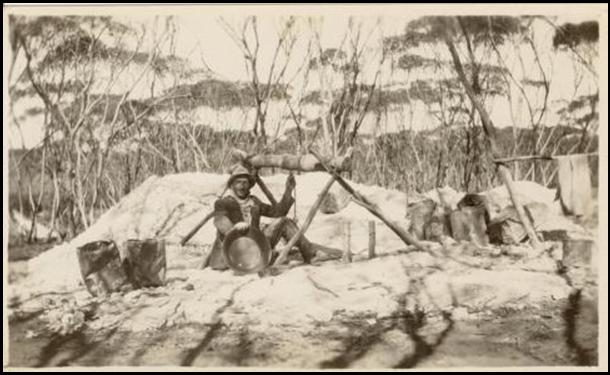
A miner trying his luck by sinking a shaft following leads and panning all of the samples raised. There were numerous small diggings like this throughout the goldfield.
27
from the remaining operations as required. Its operations had been scaled down considerably after the out break of WWII and in 1954 the battery was closed.
Mineral Resources Review S.A. - 1978
The Mongolata Goldfield B.J. Morris, Geologist
‘From 1930 till about 1954 the Mongolata Goldfield produced some 346,112 grams of gold from 7,684 tonnes of ore. The gold was found in ironstone (manganiferous iron oxide) and ferruginous quartz veins filling fractures within a north-south trending fault zone about ten metres wide. The occurrence of the gold is patchy, of a secondary nature and has been enriched in the oxidation zone by supergene processes. It is considered that rich patches of gold still remain within un-worked areas of the fault zone but the patchy habit of the gold renders prospecting difficult and rewards from any mining operation uncertain.’
The area lies on the eastern margin of the Adelaide Geosyncline and comprises relatively unaltered Pre-Cambrian sediments crossed by a belt of folding extending northwards from the Mount lofty ranges. The eastern margin of the syncline is marked by a fault scarp resulting from the Tertiary uplift of the ranges. The alluvium of the plains to the east consists of unconsolidated clays and gravels of the Recent to Pleistocene age. A prospecting shaft in search of alluvial gold passed through 57m of alluvium before entering westerly dipping banded slates.
The gold occurs within ironstone veins and to a lesser extent quartz veins. These veins have all intruded along a 10-15 metre wide north-south fault zone. In the Takati Mine the oxide zone was observed to be at least 45m deep.
The main fault zone contains, besides ironstone veins, quartz veins about 10cm wide. These veins contain reddish yellow patches of iron oxide probably replacing pyrite. [The pyrite, which is iron sulphide, has been oxidised to iron oxide.]
SA Gold Production 1931 to 1947
28
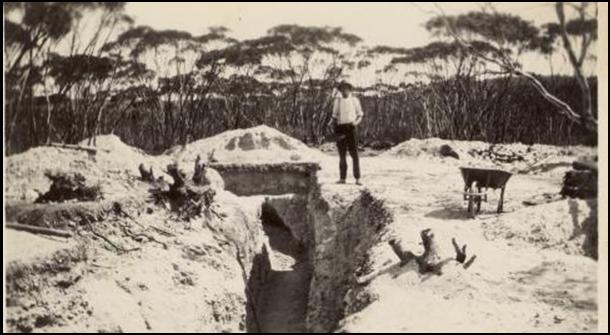
An early example of a costeening operation by prospectors searching for the veins of gold. This operation may have been at Mongolata Alluvial on the alluvial plain to the east of the Curlew Mine
29
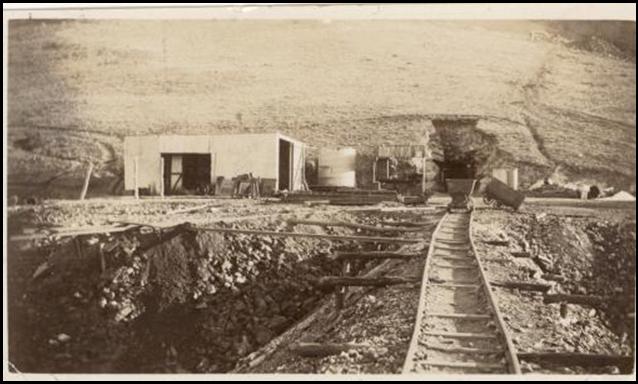
The entrance to Byles’ Mine in 1933.
30
31
32
| Year | SA Total Ounces | Mongolata Ounces | Mongolata Percent of SA |
|---|---|---|---|
| 1931 | 2,782 | 346 | 12.4 |
| 1932 | 3,014 | 477 | 15.8 |
| 1933 | 6,361 | 2,490 | 39.1 |
| 1934 | 6,870 | 2,038 | 29.7 |
| 1935 | 7,333 | 1,264 | 17.2 |
| 1936 | 7,681 | 1,082 | 14.1 |
| 1937 | 6,962 | 840 | 12.1 |
| 1938 | 5,292 | 1,156 | 21.8 |
| 1939 | 3,930 | 112 | 2.8 |
| 1940 | 3,270 | 370 | 11.3 |
| 1941 | 1,679 | 293 | 17.5 |
| 1942 | 1,333 | 135 | 10.1 |
| 1943 | 519 | 86 | 16.6 |
| 1944 | 539 | 55 | 10.2 |
| 1945 | 277 | 33 | 11.9 |
| 1946 | 628 | 35 | 5.6 |
| 1947 | 629 | 91 | 14.5 |
Mongolata Gold Production
From the table on the previous page it can be seen that over the period recorded, the Mongolata Goldfield produced a total of 10,903 ozs. of gold representing 18.4% of the total amount produced in the State.
After 1947, whilst the amount of bullion recovered in S.A. dramatically increased to about 2,000 ozs. a year, this goldfield became a site for fossickers where the amount of gold recovered was not accurately recorded. As with all of the early goldfields, some miners did not declare all of their finds preferring to sell small nuggets to interested buyers for undisclosed sums of money.
A Note on the Units Used
The distances are measured in miles and feet.
1 mile = 1.584 km.
1 foot (1ft.) = 30 cm (0.3m)
The weight of gold is measured in ounces (ozs.) and pennyweights (dwt.) and grains (grs.)
1 oz. = 20 pennyweight (20 dwt.)
16 ozs. = 1pound (1lb.)
1 dwt. = 24 grs.
The weight of the ore was measured in tons and hundredweight (cwt.)
1 ton = 20 cwt.
1 ton = 1020kg. (1.02 tonnes)
1 cwt = 112 lbs.
The yield of bullion per ton of ore is quoted in pennyweights per ton (dwt./ton).
References:
The Burra Record
The Advertiser, Adelaide
The South Australian Department of Mines Review Reports
The Chronicle, Adelaide
Acknowledgements:
Thanks to Steven Boyes for his painstaking work in collecting all of the information for this publication.
33
APPENDIX
Mongolata Goldfield Lease Names
The reference numbers allotted to the leases below apply to the Lease Map of the Mongolata Goldfield. (See adjoining page)
Ref. No. Ref. No. 3 Riley and Reynolds 22 Orinda Byles 4 King Francis 23 Byles Mongolata GM Co. 5 Hansel Mundy 25 Golden Harp 6 Mongolata North 28 Golden Harp 8 Caller Brae 27 Rising Sun 9 J. Smith 28 Curlew 10 H. James 29 Mongolata Alluvial 11 G. Hambour 30 Reid’s Claim 12 Block 8 31 Central Mongolata 14 A. Marshall 32 Wildildie 15 P. Flaherty 33 Baldina 16 East View (Rampton’s) 34 Takati (Pexton’s) 18 Mongolata G M Syndicate 35 Mongolata South 19 Scammell’s Alluvial 36 G. Dunning 20 F. Lewis 37 A. Threadgold 21 J. H. Schweir
Ref. No.
Ref. No.
3
Riley and Reynolds
22
Orinda Byles
4
King Francis
23
Byles Mongolata GM Co.
5
Hansel Mundy
25
Golden Harp
6
Mongolata North
28
Golden Harp
8
Caller Brae
27
Rising Sun
9
J. Smith
28
Curlew
10
H. James
29
Mongolata Alluvial
11
G. Hambour
30
Reid’s Claim
12
Block 8
31
Central Mongolata
14
A. Marshall
32
Wildildie
15
P. Flaherty
33
Baldina
16
East View (Rampton’s)
34
Takati (Pexton’s)
18
Mongolata G M
Syndicate
35
Mongolata South
19
Scammell’s Alluvial
36
G. Dunning
20
F. Lewis
37
A. Threadgold
21
J. H. Schweir
There were other leases outside the area covered by this map with names like Gaghen’s Show, Anderson’s Reward, Golden Eagle, Golden Speck and Feltus’ Claim. The Dope, Duffer and Phar Lap were worked by G. Evans who had a sense of humour.
34
35
Compiled by Julian Ratcliffe
The Burra History Group
2009
36