THE
TELEGRAPH OFFICE
BURRA
SOUTH AUSTRALIA
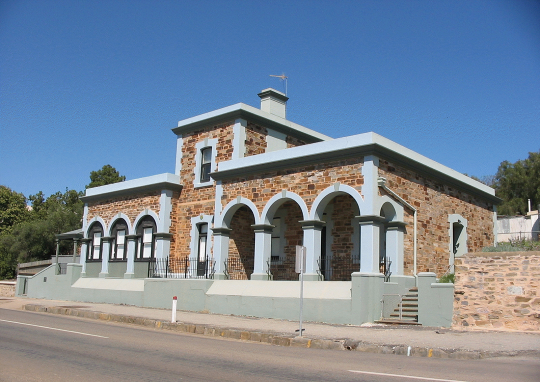
The Former Burra Telegraph Office, now the Art Gallery
© The Burra History Group Inc.
2009
The Burra Telegraph Office
The Burra Burra Post Office
The Post Office was originally known as the Burra Burra Post Office, with Postmasters Thomas Grant (1849), T.W. Powell (1850-1857), W.L. Powell (1858), W. Pearce (1859-1861), J.M. Belcher (1867-1881), and J. Lane (1881-1902). In 1849 the name of the post office was changed to Kooringa and was located in his Chemist shop in Commercial Street.
Burra’s First Telegraph Office, 1860
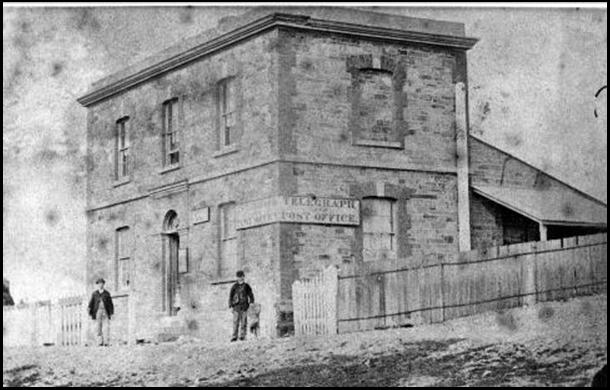
The first Telegraph Office (1860)
On 25th January 1860, J.W. McDonald Esq sent the first telegraph message from a room in the Miners’ and Mechanics’ Institute, Burra to His excellency the Governor-in Chief which read:- “I have the honour to inform your Excellency that telegraphic communication is this day opened between the Burra and Adelaide. God Save the Queen.” The use of the Institute was only an interim measure whilst the new Telegraph Station was being constructed on an adjoining plot leased from the South Australian Mining Association for ninety nine years at a peppercorn rent.
The Kooringa Telegraph Station goes into service
This Telegraph Station was designed by the architect Edward Angus Hamilton and built by Mr. Francis of Adelaide at a cost of £653.
On September 14th 1860 it was announced that the new telegraph office was complete and that the instruments etc. had been transferred from the Mechanics’ Institute next door. The organisation of the land line having been the work of Charles Todd who became famous for his work with overland telegraph lines to places as far away as Alice Springs.
‘The Register’ reported – ‘The building, though putting forward no vain pretensions as to architectural effect, presents a very possessing appearance, while the commodiousness and good workmanship it contains makes it a model for our local tradesmen.’
The Telegraph Station and Post Office (1861)
The amalgamation of the Post Office and Telegraph Station in one building caused considerable consternation among the locals.
‘The Register’ – ‘The Telegraph Office is not central, but on the extreme outskirts of the township and is perched up on a hill, so high and inaccessible as to forbid the near approach of a mail cart.’ The road was unmade and mail coaches would not be able to turn.
Furthermore Mr. W. Pearce who had run the Post Office since 1859 was to lose his position.
Alterations to the building that provided for a Post Office and Postmaster’s residence were commenced in August 1861 and completed in October, with the postmaster commencing in December 1861.
A Place in History
On 16th December 1862, the Mt. Remarkable mail-coach driven by John Chambers arrived shortly before 6.30 in the evening outside the Kooringa Telegraph Station. With difficulty a very small and emaciated figure of one of Australia’s greatest explorers, John McDouall Stuart stepped out of the coach with another of his party, Patrick Auld. Suffering from scurvy and permanently impaired eyesight, the result of spending a year traversing the Australian Continent from South to North and back again, he painfully made his way into the telegraph office amid the cheers of a rapidly gathering crowd to despatch his historic telegram.
Kooringa, December 16, 1862
‘Through you, I beg to inform His Excellency, the Governor-in-Chief and the Government that I have accomplished the object of the expedition.
Party behind, all well.
I will be in town by the evening train tomorrow.’
John McDouall Stuart commander of the South Australian Great Northern Exploring Expedition to the Commissioner of Crown Lands.
Welcomed by the Burra Chemist Mr. T.W. Wilkinson, Stuart, Auld and Finke were lodged overnight at the Burra Hotel and at about half past eight the next morning they were farewelled by a large crowd as they boarded a mail coach for Kapunda, where he then took a train to Adelaide. Stuart was probably the first explorer to complete an expedition by rail. Others followed; John Forrest in 1874 and Ernest Giles in 1876.
Additions to the Post Office (1875)
With an increase in telegraph and postal activity, in 1875, the building was extended to the south with the arches that are still feature of the present day building.
Federation of Australia (1901)
With the advent of a Federal Government, in 1901 all posts and telegraphs in Australia, came under its authority, together with the land and buildings. In May 1911, Mr. J.A. Pearce contracted to demolish part of the original building and add a new wing to the north incorporating arches in the same style as the south wing and bringing symmetry to its architecture. These additions were to provide a telephone exchange for a telephone service between Burra and Adelaide. At this time the Postmaster General announced that the erection of 53 miles of copper wire would link Kooringa with Peterborough and telegraph poles were being erected around the town to connect businesses and the police to the telephone.
Electric Lighting
One continual complaint was that the lighting in the building was poor and the Postal Department had resisted acetylene gas lighting, but in 1915 it accepted a tender to light the building with a petrol gas plant. As promised, when the town of Burra was supplied with electricity from the Burra Electric Supply Co. in 1924, the postal office got electric lights.
100 Years of Service
Although it had been renamed as the Burra Post Office in 1939, this building served its community for some 100 years when it closed in 1960 and the Post Master General’s Department (PMG) built a new Post Office in Market Square. For the next 30 years the building was used for storage and other purposes and its interior fell into disrepair.
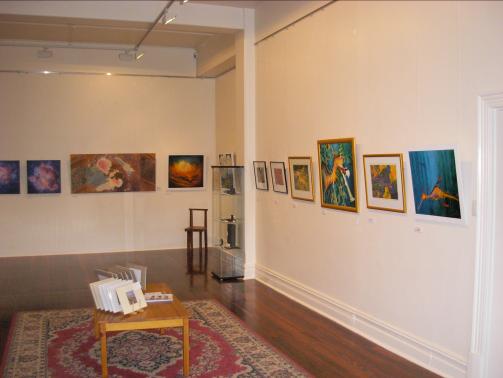
An Art Gallery for Burra
In 1993, 450 signatures were collected on a petition supporting the establishment of an Art Gallery in the old Post Office building. The Burra Council purchased the property from the Commonwealth for $132,000 and took possession in February 1994. ArtsSA provided a grant of
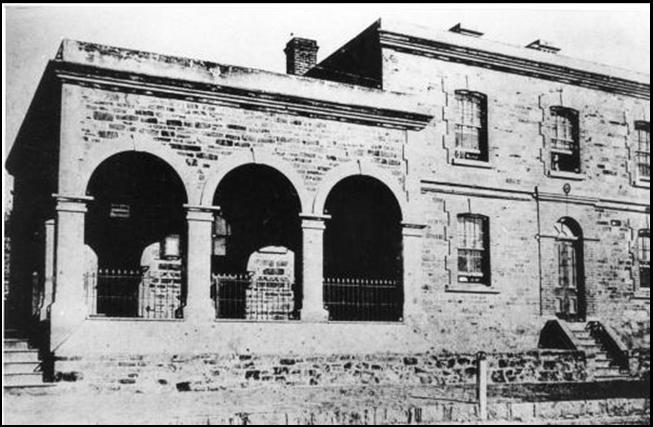
The photograph above shows the new south wing ,incorporating the characteristic arches, on the left that was added to the original telegraph and postal office in 1875.
$36,490 for the refurbishment of the building and The McDouall Stuart Board of the Burra Art Gallery Incorporated was established.
On 16th December 1995 to mark the Burra Jubilee 150 Year, a plaque was unveiled at the entrance to the Gallery, recognising the achievement of John McDouall Stuart and his nine companions.
Preserving the Past
Restoration and refurbishment of the building was carried out in two stages and the Art Gallery was opened on 5th October 1996 with an exhibition entitled ‘Family Collections and Connections’. The gallery was named The Burra Regional Art Gallery for the Mid-North by the SA minister for Arts, Diana Laidlaw.
The Gill Collection
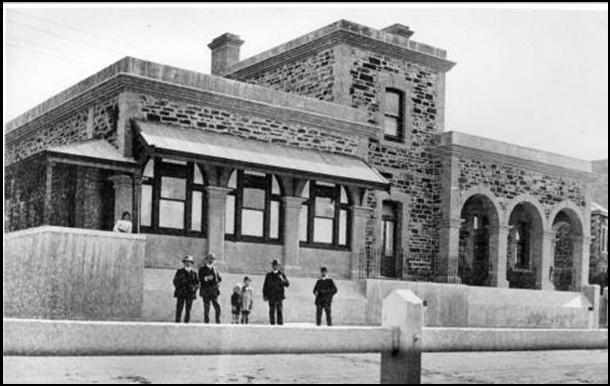
This picture taken after the significant alterations involving the demolition of most of the original building and the addition of the northern wing duplicating the arches in 1911.
The Gallery houses four major works of Samuel Thomas Gill who produced some 12 watercolour paintings of Burra in 1847 and 1850. The paintings on display here were commissioned by the South Australian Mining Association, the owners of ‘the Monster Mine’ and founders of the township of Kooringa and are of great historical significance to the district of Burra. Three paintings are of the Burra Burra Mine and the other is a panorama of the township of Kooringa.
References:
The Burra Record
The Story of the Monster Mine Ian Auhl
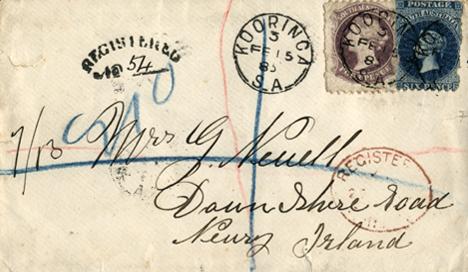
The post card above shows the Kooringa postmark dated 15 February 1885
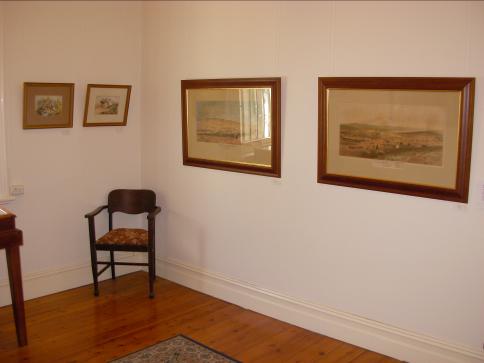
The S. T. Gill Collection
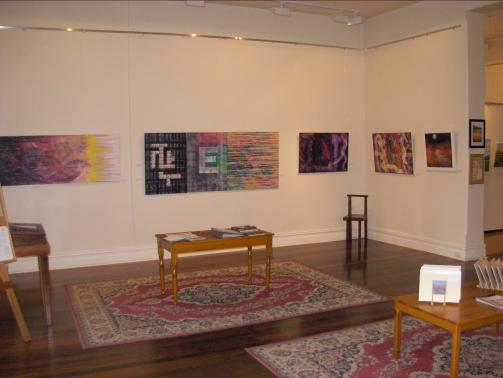
The Burra Regional Art Gallery