BURRA CREEK GUIDED WALK
BURRA
SOUTH AUSTRALIA
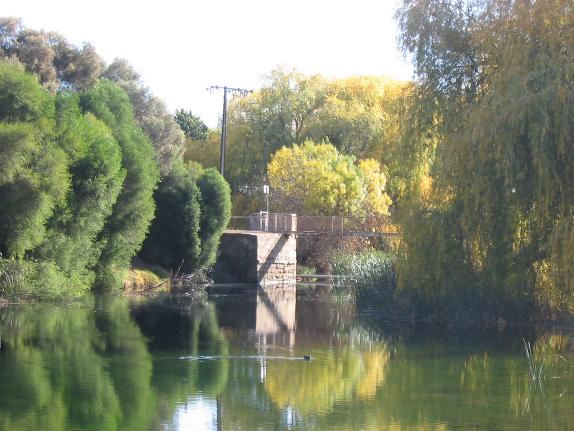
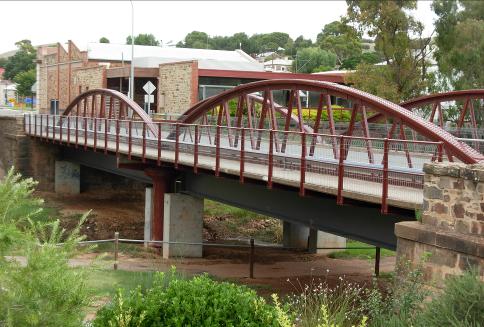
The Bridge Street Bridge over the Burra Creek in 2006
© The Burra History Group Inc. 2011
1
Compiled by Julian Ratcliffe for the Burra History Group Inc.
2011
2
Introduction
This walk along the Burra Creek will take you back in time to some of the historic sites that were known to the early pioneers in the township of Kooringa. It will give you an insight into the importance of the creek and its influence on their lives during the 19th Century mining era.
Historic Sites Visited
Market Square
Thames Street Cottages
Kooringa Primitive Methodist Church
Bridge Street Bridge
Miners’ Dugouts
Dead Man’s Bridge
Kooringa Bible Christian Church
1870s Cottages
Kingston Street Bridge
Bible Christian Chapel
Paxton Square Cottages
Town Hall Footbridge
Unicorn Brewery
Burra Model School
The Burra Smelter
Welsh Creek
St. Just Street, Redruth
Smelter’s Home Hotel
Boy Scout Hall
Bleak House
Roach’s Flourmill
The Burra Electricity Supply Powerhouse
Mine Store and Storeman’s Residence
Mine Bridge
Peacock’s Chimney and Johnny Green
Jubilee Fountain
St. Mary’s Anglican Church
St. Joseph’s Catholic Church
3
BURRA CREEK GUIDED WALK
Market Square – 1846
This open area at the end of the road from Adelaide has been the business and commercial centre of Burra since its beginning in 1846 as a part of the original mining company town of Kooringa. During its history it has seen bullock teams lying down waiting their turn to be watered at the Burra Creek and for the drays to be loaded.
Thames Street Cottages – 1846
The Thames Street Cottages were the first cottages built in Kooringa, a company owned township. Built in 1846, soon after the laying out of the town, the first six of these double cottages were designed by the architect George Strickland Kingston, a director of the S.A. Mining Association, for mine employees.
Constructed of bluestone and originally having floors of local slate, they were designed to house two families, being separated by a solid dividing wall. One prominent feature of these cottages is the massive four-way chimney in the centre of the building serving fireplaces in each of the four rooms. Each family had a bedroom at the front of the cottage which is entered from the side of the cottage with a kitchen behind having a doorway to the backyard. The cottages’ canvas or calico ceilings and stone walls were whitewashed; the roofs were made of split timber shingles. These shingles are still in place under the galvanised iron roofs that were first erected in 1872.
These cottages were rented to miners until at least the 1870s when freehold title was offered by the company as they gradually began selling off their holdings. They are amongst the earliest domestic buildings in South Australia still in occupation.
During the years 1846 to 1850, over 100 smaller cottages were built in Kooringa for miners, but unfortunately most of them have been demolished, the most notable exception being thirty three cottages in Commercial Street, known as Paxton Square.
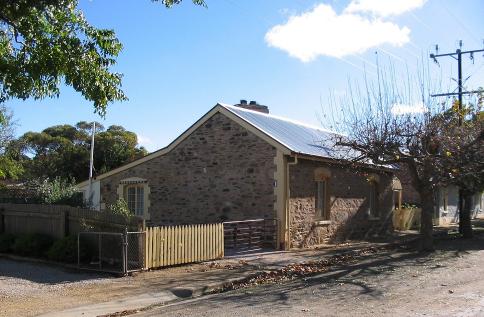
The Former Primitive Methodist Church (1849 and 1879)
Originally this hall in Thames Street was the Primitive Methodist Church. Whilst the original church was erected in 1849, extensive modifications in 1879 gave us the present structure. The church manse attached, on the northern side of this building has been demolished.
It became the Masonic Hall in 1900 when the three branches of Methodism combined. (Bible Christians, Primitive Methodists, and Wesleyans)
It is now a private residence.
4
The Bridge Street Bridge - 1850
This was the first substantial town bridge, one that would allow a horse and buggy to cross the Burra Creek, in Kooringa. All the other creek crossings were either fords or footbridges.
This bridge was financed as follows; SA Mining Association £100, William Paxton, a director of the Mining Company, £50 and the remaining £50 by the people of Kooringa. The frequent flooding of the creek often damaged these bridges and the great flood of 1877 swept this Town Bridge completely away. What remains today are the western buttress and a much less substantial footbridge. See the front cover.
The Miners’ Dugouts (1845)
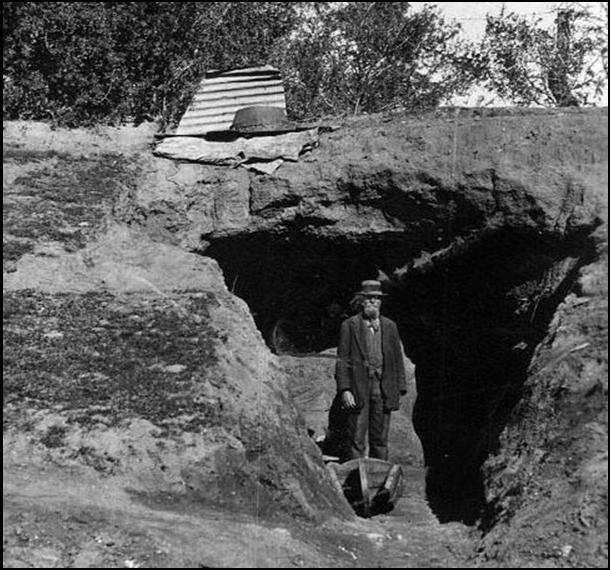
In the early years, the rapid influx of miners who emigrated from Cornwall and Wales to the Burra Burra mine led to a shortage of housing. This was overcome in typical fashion by the miners who dug their homes into the clay banks of the Burra Creek and its tributaries. When the first dugout was dug by the miners John and Robert Collins in the summer of 1845-46, they were perfect for the conditions, being close to a source of water, providing shelter from the cold in winter and the heat in the hot summers. Being rent-free and easily constructed, others followed soon after.
5
In 1851 about 1800 people out of a total population of 4000 lived in almost 600 of these dugouts that extended along the creek for about 2 miles.
“The Register”, the Adelaide newspaper, reported in 1851 “this creek with its habitation in the banks on both sides forms one of the most singular spectacles ever beheld. The miners have excavated dwellings like rabbit holes, in lines as thickly under the banks of the creek as they could be placed, a foot or two intervening between them, sometimes merely a mud bank as a division wall.”
These dwellings were often single roomed with chimneys, formed on the bank top with barrels cemented in mud that looked like tree trunks alongside a roadway running along the banks and over the housetops.
It was reported that practical jokers sometimes removed these barrels leading to passers-by making an ‘unorthodox entry’ into the homes below.
‘These rabbit burrows being variously constructed, some with mere holes for doors and windows: some with substantial doors and even glazed windows: a few have shingled verandahs and many are whitewashed inside and out, with some papered or carpeted within.’
As can be imagined the sanitary conditions along the creek rapidly deteriorated with many cases of “fever” being reported. (Typhus, smallpox and typhoid fever)
The 1851 census indicates that most of the dugouts were occupied by the families of miners who were Cornish, Welsh or Scottish. Other residents included carpenters, masons, shoemakers, saddlers, sawyers, mechanics, builders, clerks and even a doctor.
Whilst the South Australian Mining Association built some housing for their employees, which they were expected to rent from the Company, because the rents were high, the miners chose to dig their homes into the banks of the creek and live rent free under these poor conditions.
In 1851 a series of three floods devastated “Creek Street” driving the miners from these dugouts to leave them virtually deserted, for a while. In fact floods were a constant hazard for “the dugout people.”
Eventually a major flood in 1859 forced the last remaining dugout dwellers from the creek.
During the Back to Burra celebration in 1925, three remaining dugouts in were renovated and displayed to the public. These dugouts were completely rebuilt in 1950 by the Burra Council and The National Trust as a tourist attraction.
In 1849, the artist William Cawthorne made a drawing of the dugouts, which now hangs in the Mitchell Library in Sydney.
6
Dead Man’s Bridge
First known as Boundy’s Bridge, this bridge was built very early in the history of Kooringa being placed there by public subscription before either a district or town council existed. Built across a steep-sided ravine that leads to the Burra Creek it carried the hearses taking the deceased of the town to their last resting place in the cemetery. It became known as ‘Dead Man’s Bridge.’
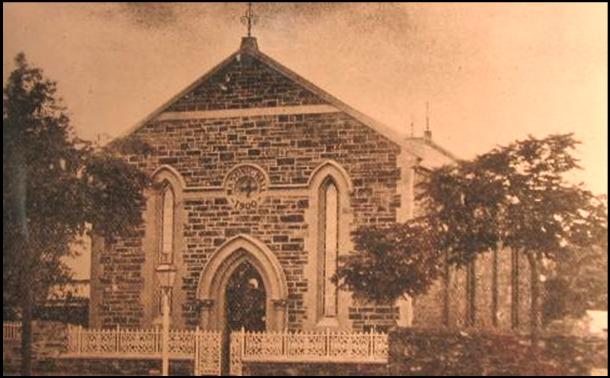
Bible Christian Church (1859 – 1909)
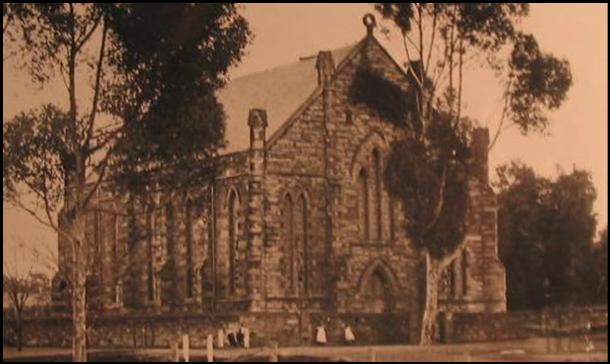
This large church, on the corner of Bridge Terrace and Bridge Street East was ‘erected by Cornish miners in 1859’, to replace the original chapel in Paxton’s Square. Apparently this church was well attended providing instruction in the scriptures and attendance at Sunday school almost being compulsory. With the formation of the Methodist Union in 1900, services were also discontinued at this site. In protest, a group of elderly ladies
7
took turns each Sunday in occupying the steps of this popular church that was now closed, rather than joining with other Methodists.
The weight of the slate roof on this church caused a wall to bulge dangerously and in 1909 its demolition was attempted using dynamite. This was only partially successful and the church remained as a ruin until its final demolition in 1930.
The Bible Christians
The Bible Christians were a breakaway branch of the Wesleyan Church in Cornwall. The first Bible Christians in Australia were Cornish miners who settled in Kapunda (1844) and Burra (1845). Their first leader was John Blatchford, a Cornish miner and lay preacher, who arrived in 1847. He found many Bible Christian adherents among the miners who had migrated from Cornwall and the first services he held were outdoors under the gum trees that lined the Burra Creek or in Blatchford’s own dugout in Welsh Creek. Together with 49 other members he formed a society holding regular services and classes with plans to build a chapel. Their plans came to fruition with the opening of a church in 1849 adjoining the first row of Paxton Square Cottages, originally Henderson’s row, and soon had a congregation of over 200 attending every Sunday. They soon outgrew this small chapel and sought a larger church.
Cottage Row - Ullmann’s Bakery 1872
This cottage row is clearly visible in an old photograph of Kooringa taken prior to the erection of the Unicorn Brewery in 1873. The cottage on the corner has been demolished and was Mr. William Ullmann’s bakery between 1869 and 1902. After being assaulted by bigotted youths, Ullmann sold the bakery to Charlie Morgan and returned to Germany.
The Kingston Street Bridge (The Kooringa Bridge – 1879)
This cast iron bridge was completed in 1879 and replaced the Bridge Street Bridge, which was washed away by a flood in 1877. Before its construction there had been a ford at this site. Built a little further upstream from Bridge Street, it consists of two 18 metre spans supported on two cylinders sunk into the creek bed. A concrete deck was added in 1935. The bridge was reinforced with steel girders and concrete columns in 2004.
The Bible Christian Chapel - 1850
Construction of the Bible Christian Chapel, on the corner of Bridge Terrace and Kingston Street, commenced in 1850 and was completed in 1852. This little chapel was the first Bible Christian Chapel in Australia. Alongside this chapel was a manse that has been demolished. Together they formed part of the original Paxton Square. Apparently in 1856 the
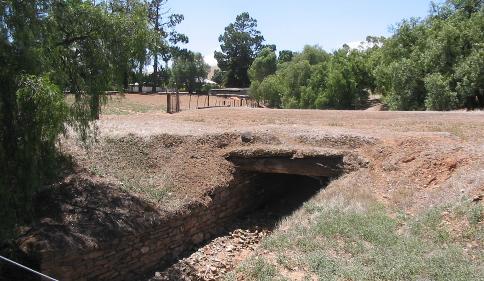
Dead Man’s Bridge Ayers Street, Burra
8
chapel was extended to provide for its growing congregation. This caused some consternation with the bullockies as this reduced the opening between the buildings through which their drays were driven to the Mine after fording the Burra Creek. This extension was subsequently demolished and the building seen today has been used as a green grocer’s shop, a garage and as a warehouse. At present it is the office of the Paxton Square cottages.
Paxton Square - 1848
In 1846 the South Australian Mining Association laid out its private town of Kooringa to provide for its miners and artisans. Two-room stone cottages were built by the company to be leased to its employees, but because the life-time of the mine was uncertain, and wishing to avoid the rents charged, the miners preferred to dig houses into the clay banks of the Burra Creek and its tributaries. By 1850 there was close to 2000 people living in dugouts along the banks of the creek.
As early as 1848, floods had washed people out of these homes and in an attempt to entice families out of the dugouts, later in 1848, the company laid out a square of cottages named after William Paxton, a Mining Company Director. They were to be leased to miners for three shillings a week out of an average wage of one pound five shillings. The original
9
stone cottages had roofs of split timber shingles but these were covered with galvanised iron in 1873. There is evidence that a well was sunk within the boundary of the square to supply water for the tenants.
Today these cottages are owned by the Regional Council of Goyder and provide accommodation for tourists.
Town Hall Foot-bridge
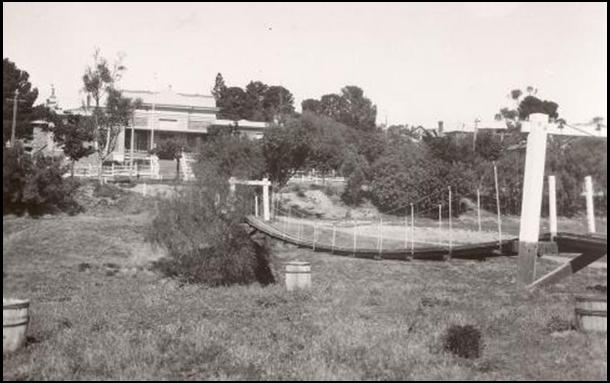
Since the 1880s, this has been the site of a series of footbridges that enabled school children to go to the public school across the creek from the town in all seasons. Previously the children had used the footbridge at the back of the Miners’ Arms Hotel, the present Burra Hotel, which took them through an ‘undesirable environment.’ In 1915 the wooden bridge that had been provided, was swept away in a flood. In 1916, it replaced by a swing bridge that served its purpose in various states of disrepair up until 1960 when it was replaced by the more substantial structure that we see today.
Unicorn Brewery Cellars
The Unicorn Brewery (1873-1902)
This was not the first brewery in Kooringa (Mr. Crawford of Hindmarsh Brewery -erected the first brewery alongside the original Burra Hotel on the site of the present Burra Hospital).
With nine hotels in the town and the imminent extension of the railway line to Terowie and eventually Broken Hill, Fredrick Thomas Jones took the risky decision to build a new brewery in Kooringa in direct opposition to the existing brewery of W.H. Williams. It was completed in 1873. The brewery cellars were completed in 1874. In 1875, finding himself in financial difficulties, Jones had the site transferred to William Henry Banks.
In 1870 W.H. Banks had arrived from Kapunda to run the Courthouse Hotel in Redruth. In 1871 he bought the Miners’ Arms Hotel in Kooringa (the present Burra Hotel). On assuming control of the Unicorn Brewery he became its new brewer.
This new brewery, which eclipsed the opposition’s old horse powered operation, boasted steam driven efficiency, a maltster and a cooperage. The Engine house with its wood-fired boiler (22feet long and 5 feet in diameter) and a steam engine that powered two 5HP force pumps for moving wort and beer around the brewery also produced steam for sterilising and cleaning.
Throughout the nineteenth century all barley, sugar and hops was imported. The water was taken from a well on the property, the high mineral content being ideal for beer brewing. The malt was produced on the site and after adding the hops was lifted to the top floor of the
10
prominent bluestone tower by steam power, where it was poured into a vat and sterilised with steam. After filtering, the yeast was added and fermentation commenced. The new beer was run down by a gravity feed system of pipes into the hogsheads in the extensive underground cellars, where the temperature was a cool 65 degrees Fahrenheit (180C). Here the beer slowly underwent a secondary fermentation producing the all-important carbonation of the beer. Up to 500 hogsheads could be stored at any one time. These hogsheads were manufactured and repaired at the on-site cooperage. Beer varying in strength from weak X to very strong XXXXXX was produced during the brewery’s operation as well as porter (stout). There is evidence of the cellars being extended at sometime and that some bottled beer was produced.
The brewery ceased production in 1902 and was sold in 1905. The reason for its closure was the introduction of government regulations controlling the production of alcoholic beverages. The Unicorn found it too
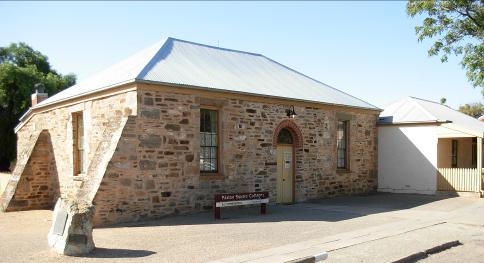
Bible Christian Chapel
11
expensive to comply with these requirements and its owners transferred operations to the Walkerville Brewery.
Beginning in 1911, the characteristic brewery tower together with most of the other brewery buildings were dismantled for their stone, when cottages were built on the property.
Young lairs finding their way into these cellars years after they had been abandoned were spooked by the eerie silence and the appearance of ghostly shadows. A hasty departure followed.
Acquired by the District Council of Burra in 1987, the cellars were opened to the public as a tourist attraction in 1989.
The Burra Model School 1878
In 1878, education was something of a luxury and was not compulsory in South Australia until 1875 and then only between the ages of seven and thirteen. “Free” education was implemented in 1892. Prior to the opening of the Burra Model School, in January 1878, only the children of parents who could pay the fees, attended various private schools in the Burra.
In the year before the new public school was opened, it was estimated that of the 750 children between the ages of 7 and 13, less than 500 were attending a school. Children of working class parents generally left school at the age of ten and after only a year or two of schooling were barely able to read or write. An education census in 1877 revealed that, of the 927 children of school-going age in the District of Burra, most of whom lived in the five Burra townships, 130 could not read or write, 216 could read only and the rest could read and write to a satisfactory standard.
In 1878 when education became compulsory, the government began building its own schools and appointing headmasters and teachers. When the Burra Model School was first opened, school attendance was very poor. In September 1878 the average attendance for that month was 445 of the 641 required to attend. One reason for this was the poor health of children and a high incidence of infectious diseases like measles, whooping cough, scarlatina, diphtheria, tonsillitis, typhoid and scarlet fever.
Until education became free in 1892, many parents, in those days of large families, were unable to afford the fees, which ranged from fourpence to ninepence per week for each child, no small amount when an average weekly wage was less than £2. In 1881 the School Board granted 80 applications for free instruction. This led to “free” children being branded as paupers through no fault of their own and, in general, no fault of their parents.
The misery and poverty of many Burra Families was reflected in the excuses for absences from school. These included the inability to meet the
12
cost of fees and books, “no boots”, “no clothes fit to send children in”, “the only pair of trousers in the wash”, “gone droving with dad”, “needed for harvest”, and in winter, “feet too bad with chilblains”. August Wittber, the second headmaster of the Model School, was so distressed by the lack of boots among the schoolchildren, in 1886, that he organised a series of musical evenings at the Institute to raise funds for the purchase of 40 pairs of boys’ boots.
Despite the Model School having cheaper fees and trained, certificated teachers, the numbers in the new school rapidly fell during its first year from an average attendance of 326 in term one to 248 in the final term. The school had become unpopular because of too few teachers to the extent that only three out of the twelve rooms were occupied and as a result, several private schools, known as “mushroom schools” opened and ultimately closed during the period from 1878 to 1892, when fees were abolished in government schools. The longest surviving private school was “The Sisters’, St. Joseph’s,” School opened in 1857 and closed in 1970.
The Burra School remained half empty for about forty years and it took many years and much court action for parents to realise that education was compulsory. The school’s opening in January 1878 was preceded by the closure of the mine four months before and this had a drastic effect on the town population.
13
In 1878 a headmaster and four teachers were meant to teach 400 students. This resulted in the school becoming unpopular a situation that continued until 1890 when some improvement was noted.
Burra District High School
In January 1913 it was announced in the local newspaper The Record “The Education Department has decided to open a High School after the holiday.” Prior to this, only parents who could afford it had sent their children to boarding schools in Adelaide for their secondary education, so most children finished their education at age thirteen. Although secondary education had been made available in some country districts as early as 1907 it was not until 1812 that efforts were made to provide this in Burra.
For some reason very few parents availed themselves of this opportunity and even when, in 1946, the school leaving age rose to 15, enrolments were still less than 50.
In order to continue on to secondary education from 1913 until 1944 students were required to pass the Qualifying Certificate, for many, a rather daunting task.
The Community School
The concept of a community school incorporating a community library and using the community to assist in the education of students was first mooted in 1974.
In October 1975, The “Record”, announced “The state’s first community school for Burra” It was to be a reception to year12 school serving the whole district. After government acquisition of additional land, the construction of new buildings to replace the transportable buildings that had been added over the years was commenced in 1977. For the school’s centenary celebrations the concept of a community school was put into practice prior to the completion of the buildings. The Burra Community School and Community Library opened in 1978.
The Burra Smelter 1848 - 1868
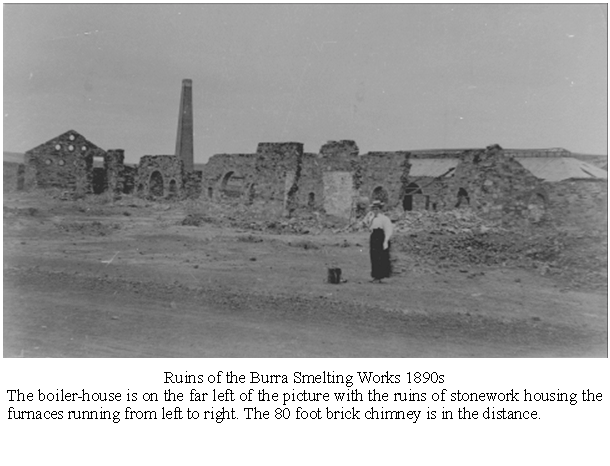
At the time of the emergence Burra Burra Mine, Swansea in Wales was the centre of world copper smelting, not because it had copper mines, but because it was rich in coal. About 4 tons of coal was required to produce 1 ton of copper, so it was more profitable to ship Cornish copper ore to the coal for smelting rather than the other way round. To begin with, South Australia’s copper mines followed suit, its ore being treated at Schneider and Co.’s Spitty Smelter at Llwchwr (now known as Loughor).
Burra’s ore was greatly sought after by British smelters not only because of its high copper content but also because it contained no sulphides. Sulphide ores required up to ten smelting stages to produce refined
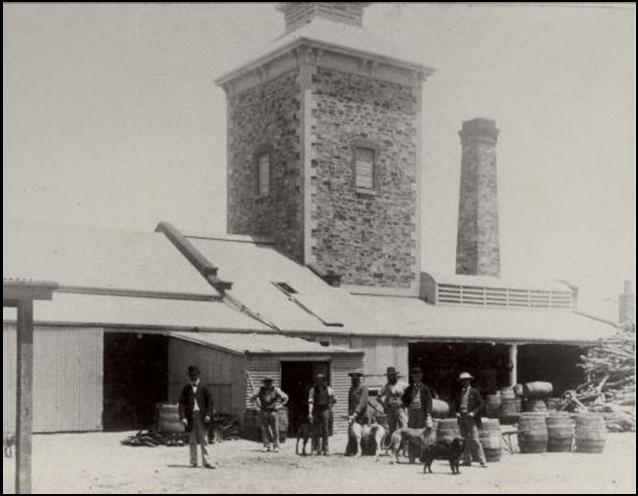
The Unicorn Brewery with Edward Catchlove Lockyer, the manager, in top hat and tails on the left of the photograph.
14
copper. By adding the Burra ore, which was composed of carbonates and oxides, the number of stages could be reduced to five.
The Burra Mine’s distance from Port Adelaide cut into potential profits, as enormous amounts of money, an estimated £53,000 in 1848, were outlaid on carting the ore by bullock drays. Taking as long as three weeks for the round trip for a bullock dray to cart 2 tons of ore, the pressure was on to establish a local smelter. By 1848 three smelters had been constructed in the colony, one in Burra, one at Apoinga and one at Port Adelaide, each fuelled with charcoal produced from local timber rather than coal.
Burra’s First Furnaces
The foundation stone of the smelting works first furnace house was laid by the Patent Copper Co. in December 1848, on land leased from the S.A. Mining Association. Its first furnace was lit less than four months later. When completed in 1849, this furnace house held a row of eight furnaces
15
each with its own chimney. These furnaces were coal-fuelled reverberatory furnaces that were supplied with imported coal and flux materials transported from Port Wakefield, along the Gulf Road. From 1850 onwards, supplies of iron ore found locally, at Black Springs, were used as the flux material. Local timber was used to produce charcoal to supplement the coal reserves necessary for smelting. The refining house with its three furnaces was completed in 1850.
A second furnace house with nine furnaces in two rows, had underground flues that led to a single large red-brick chimney, was completed after delays due to shortages of labour and building materials, in 1853. Also on the property were a crushing house, a sawmill, as well as workers sheds, cottages, offices and a mechanics workshop,
Up to twenty one furnaces were constructed on the site, but there is no evidence that they were ever all operating at the same time.
Smelting operations could only proceed during the summer months because during the winter the Gulf Road, which was constructed and maintained by the company, was subject to flooding, bridges were damaged and the bullock drays often became bogged. Even in summer, flash floods or waterholes drying up hampered cartage operations. Another method of using mules, imported from Chile with their muleteers, to carry the loads in panniers on their backs was tried, with limited success. Then carts were designed for the mules so that they could move supplies in all seasons. In 1856 the company petitioned the government to extend the railway line to Burra. This did not happen until 1870, the year after the smelter closed.
The Victorian gold rush, in 1852, brought the Burra smelting operations to the brink of collapse. By 1855, with labour shortages overcome and the cartage of materials, like coal from Newcastle solved by using mules, things improved and in 1860-61, the Smelter saw its most prosperous year. From 10,373 tons of ore, 3,007 tons of copper was produced.
In 1861, because the Burra Mine lode was dwindling, the Company erected a new smelting plant at Port Adelaide. This was the beginning of the end for the Burra Smelter and it became little more than an ancillary to this new plant, that took ore from all of its contracted mine sites, particularly from the Wallaroo and Moonta mines. Smelting operations ceased in 1869.
Welsh Creek 1848
This name dates from the establishment of the Patent Copper Company’s smelting operations in 1848. Many of the employees of the smelter, because of its proximity to their work, chose to live in dugouts along this creek and because they were mainly Welshmen, this name was adopted.
16
St. Just Street, Redruth 1849
We have left the township of Kooringa and have now entered into Redruth, the township established, in 1849, by the Government of South Australia where they built a police station and lock-up with stables for the constables’ horses, a courthouse and eventually a gaol.
This township was named Redruth and has street names that the Cornish miners would have recognised from their home country.
The Smelter’s Home Hotel – 1849
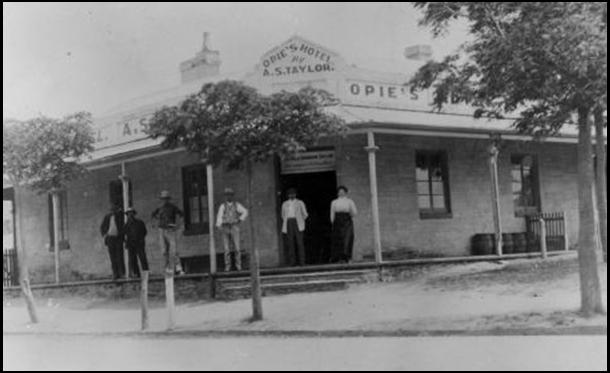
Originally named The Smelter’s Home Hotel and owned by William Paxton, this hotel was established, in Aberdeen, just across the Burra Creek from the Burra Smelter, in 1849. It was draw its thirsty customers from the smelting works. In 1861 it was bought by Nicholas Opie and became known as Opie’s Hotel. From here he ran the mail and passenger service to Kapunda in direct opposition to Rounsevells who had previously had a monopoly on this business.
It closed in 1917 and its license was transferred to the Booborowie Hotel. It then became the home and business premises of L.R. Fuss, a carpenter, until his death in 1968. It was then rented out as four flats and is now a private residence.
Boy Scouts Hall - 1919
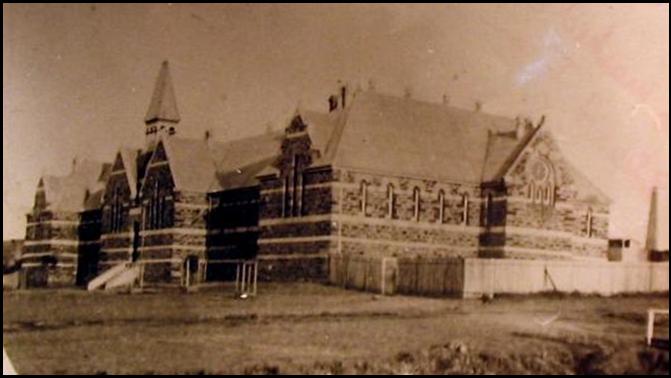
Burra Model School 1888
17
This building was erected by the Boy Scouts on land donated by Mr. James Reed, after the rooms it used in the White Hart Hotel were destroyed by fire. It was opened on the 1st February 1919 by the Mayor Mr. E. Crewes. That same year, it was used as an isolation hospital during an influenza epidemic in the town and the telephone was laid on to the building. It was used as the Boy Scouts Hall for many years. It is now a private residence.
Bleak House 1848
This cottage was built in 1848 by the South Australian Mining Association as the Mine hospital where miners who became sick or were injured at work could be treated by the resident doctor. The miners were charged a levy to maintain this service. It was not open to members of the public, who were forced to seek the assistance of Dr. Bull a freelance doctor. Unfortunately early in 1849, the cottage was rented out to Peter Spargo an engineer who was employed at the mine installing Roach’s pumping engine, which his family occupied until July 1850. A new mine doctor, Dr. Henry Chambers moved in and it began serving its intended purpose. He was eventually replaced by Dr. Mayne who served from 1854 to 1868. But the facility, although financed by the miners, was little used, because the Cornish miners had an aversion to using this hospital, as it frequently became the morgue for victims of fatal mine accidents. This isolated cottage on the side of a bare hill soon earned the name ‘Bleak House.’
In 1871, it was let out as a residence. Between 1887 and 1907 it was the Burra High School, a private school for girls run by Mrs. McLagan and after her death in 1898, her sister Miss Annie Millar. Since then it has been a private residence.
Roach’s Flourmill 1874
John Roach established a flourmill on the western bank of the Burra Creek and this operation would soon have opposition from a rival in Butterworth’s flourmill that was nearing completion in Aberdeen. These were the first flourmills in Burra with most of this vital commodity previously coming from mills in Clare.
The Burra Powerhouse - 1924
This building was erected by the Burra Electric Supply Company to house a diesel-driven generator to supply electricity to the townships of Burra in 1924. It was situated between the population centres to reduce the noise associated with its operation at night and for ease of supply to Kooringa
18
and Burra North. Before this, some of the more affluent members of Burra had already installed their own generators on their properties, even providing their neighbours with electricity. It ceased operating in 1958 when the Electricity Trust of SA provided Burra with electricity from the grid. It is now a private residence.
The Mine Store and Storeman’s Residence - 1847
This building is now a private residence. It was erected in 1847 at the entrance to the Burra Mine and is one of the oldest remaining mine buildings in Australia.
It comprised offices, stores and storeman’s residence adjoining a spacious yard surrounded by a high stone wall. It was a depot for building timber, iron and mining machinery.
The Mine Bridge – 1868
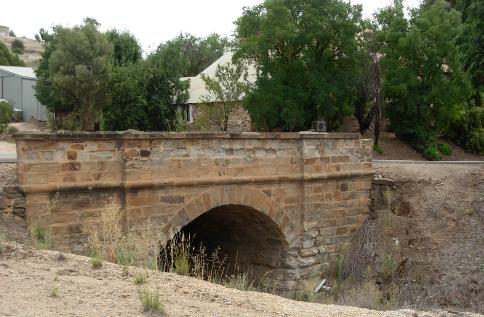
The Central Road Board contracted Messrs James Tiver and William Woollacott to erect this bridge in 1868 to a design by their Superintending Surveyor Mr A. Macauley. The stone was drawn from Hampton quarries with the coping from Mintaro. The crossing of this creek which conveyed
19
all of the water from the Mine into the Burra Creek was a difficult one and it divided the townships of Aberdeen and Redruth from Kooringa, causing considerable hardship for the people of the Burra.
Plans to widen and straighten the road were drawn up in the late 1930s and they resulted in the removal of the western parapet.
Peacock’s Chimney
This chimney was built in 1857 to provide the updraught for the boilers alongside Peacock’s Engine-house, named after William Peacock a director of the South Australian Mining Association. It stood on its original site until 1971, when mine engineers planning the modern open-cut operation decided to demolish it and Peacock’s Enginehouse. The engine-house which had been the longest serving engine-house at the mine was demolished with dynamite. The chimney was dismantled stone by stone and rebuilt on its present site by the National Trust of South Australia, to mark the entrance to the mine site.
Johnny Green
The figure atop this chimney is ‘Johnny Green’, the mascot of the Burra miners. Originally made of timber, it stood on top of Roach’s pump house, named after the mine captain, until about 1855.
A second one made of sheet-iron was placed on the poppet of Morphett’s Enginehouse in 1858 where it remained until 1925, when after a fire in the Morphett’s shaft timbers that destroyed it; ‘Johnny’ was found amongst the ashes. In 1933 ‘he’ was placed on a pole at the mine entrance. In 1967 vandals cut ‘him’ down. A third ‘Johnny Green’ was made to coincide with the relocation of Peacock’s Chimney were ‘he’ now stands
Jubilee Fountain - 1888
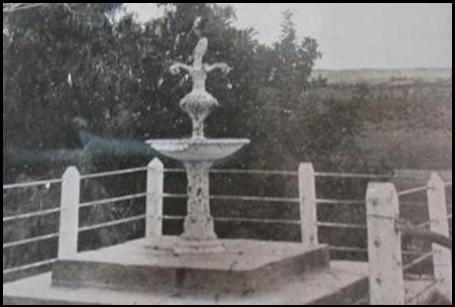
This fountain was erected in April 1888 to celebrate the Golden Jubilee of Queen Victoria’s reign and the foundation of the state. It was paid for from surplus funds raised for a special train trip to Adelaide so that the town’s children could see the Jubilee Exhibition. The cast iron fountain was manufactured at MacFarlane’s Foundry in Glasgow, is adorned with lizards and flowers and was meant to refresh walkers as they hiked along Jubilee Avenue between Kooringa and the northern townships of Aberdeen and Redruth. Jubilee Avenue, a tree-lined pathway was established with the planting of trees, sugar gums and white cedars, in 1887. Frustration was expressed, in the Burra Record, at the length of time that it sat at the railway station during the summer of 1887-88, before being installed.
St. Mary’s Anglican Church - 1879
20
The first Anglican services held in Burra were conducted in a stone building situated in Kangaroo Street in 1847.
The First St. Mary’s Church
In 1849, the first Church of St. Mary was erected on a site donated by S.A. Mining Association and stood close by the original place of worship. This church of St. Mary on Limestone Hill, on the corner of Ware and Church Streets, was demolished and a few treasured possessions, the Altar Table, the iron cross surmounting the old church and two stained glass windows were transferred to the new building. One of these windows, a ‘zinc light’ dating from1873, is by Edward Brooks, South Australia’s first stained glass maker.
The Second St. Mary’s Church
Built in 1879 at a cost of £4,000, by the Burra firm of Sara and Dunstan on land granted by the Mining Company, like a miniature cathedral, the church is built of local stone, with pine floors and ceilings. It is rich in memorials commemorating the names of well-known local pioneer families. The great window above the font was crafted in London by Jones and Willis in 1921 and the St. Michael window on the eastern wall was by Whitefriars of London. The particularly fine stained glass windows are a feature of the church.
The church’s 1905 Dodd Pipe Organ is apparently one of the finest English organs in Australia. It was overhauled in 1981 at a cost of $4000.
The Parish Hall was built by parishioners, in 1893, as a Sunday school and for other church activities.
St. Joseph’s Catholic Church - 1874
The first Catholic services in Burra were held in 1849 when the priest came from Sevenhill.
In 1853 mass was celebrated regularly each month at either Howley’s Cottage in Paxton Square or Knevett’s house in Chapel Street. At the beginning of 1857, Knevett’s house was purchased, and blessed to serve as a church and school and a building was erected nearby where the priest could stay on his visits. A lay teacher, Mr. Fogg, conducted a school for Catholics from then until the 1870s when the Sisters of St. Joseph took over education in the parish. The Catholics in Burra during the mining boom were mainly Irish teamsters or Chilean Muleteers who carted copper ore along the Gulf road to Port Wakefield.
The Original St. Joseph’s Chapel
When in 1871, the South Australian Mining Association presented a site for a Catholic church in Commercial Street; a small church, St. Joseph’s, was built by the Jesuits from Sevenhill. The swelling congregation soon
21
outgrew this building and after some difficulty with the original contract, the present church, in Market Street, was completed in 1874. This church, described as being early Gothic in style, was constructed to accommodate 300 people with a gallery above the entrance. However it was not until 1974 that this church was consecrated. The convent and school was opened in 1882 and the presbytery in 1885. The convent and school closed in 1970. It was the longest serving private school in Burra.
The original spire of the church was removed in 1968 as it had become unsafe. It was replaced in 2009, restoring the building to its original configuration.
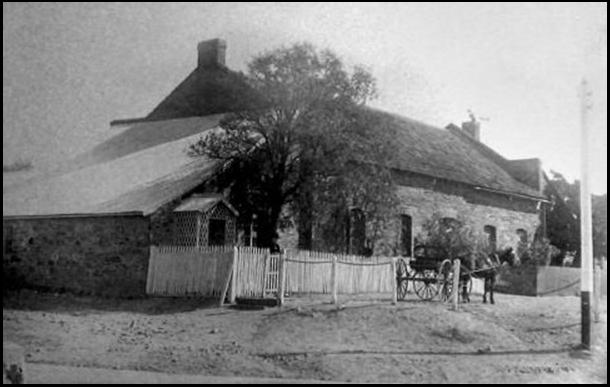
When this photograph, of the Mine Store, was taken the shingled roof was still in place and telegraph lines linking the township of Kooringa to the railway station had been installed.
22
23
24
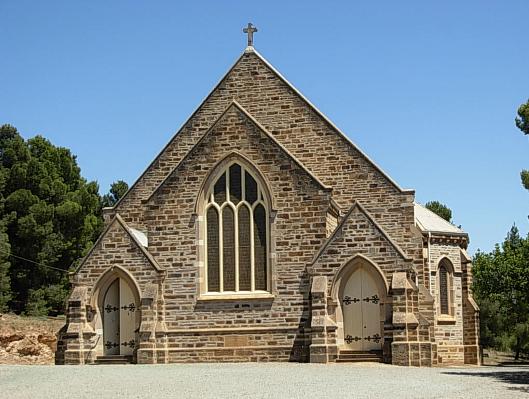
St. Mary’s Church, 2009
25
26
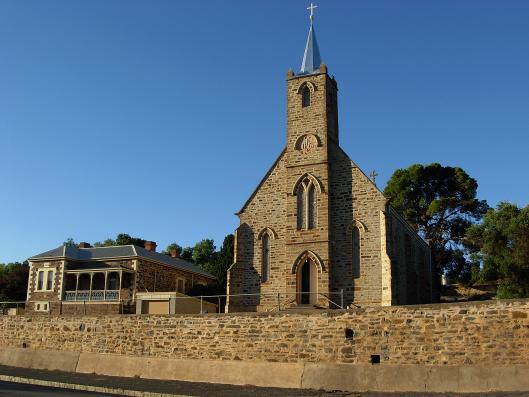
St. Joseph’s Church and Presbytery, 2010
27
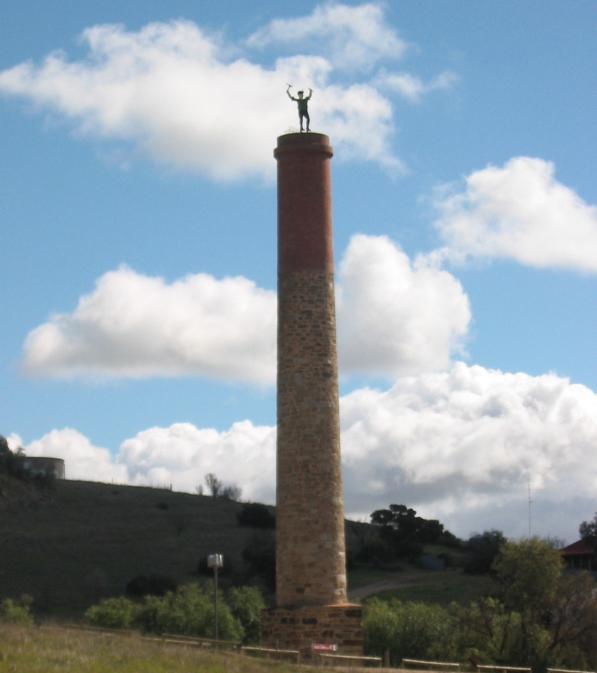
Johnny Green atop the reconstructed Peacock’s Chimney at the entrance to the historic Burra Mine Site in 2009.
28