SMELTING THE ORE OF THE BURRA BURRA MINE
1845-1877
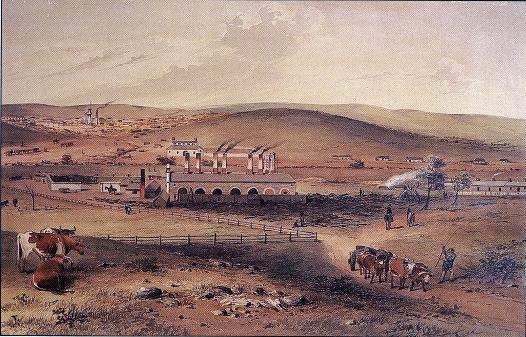
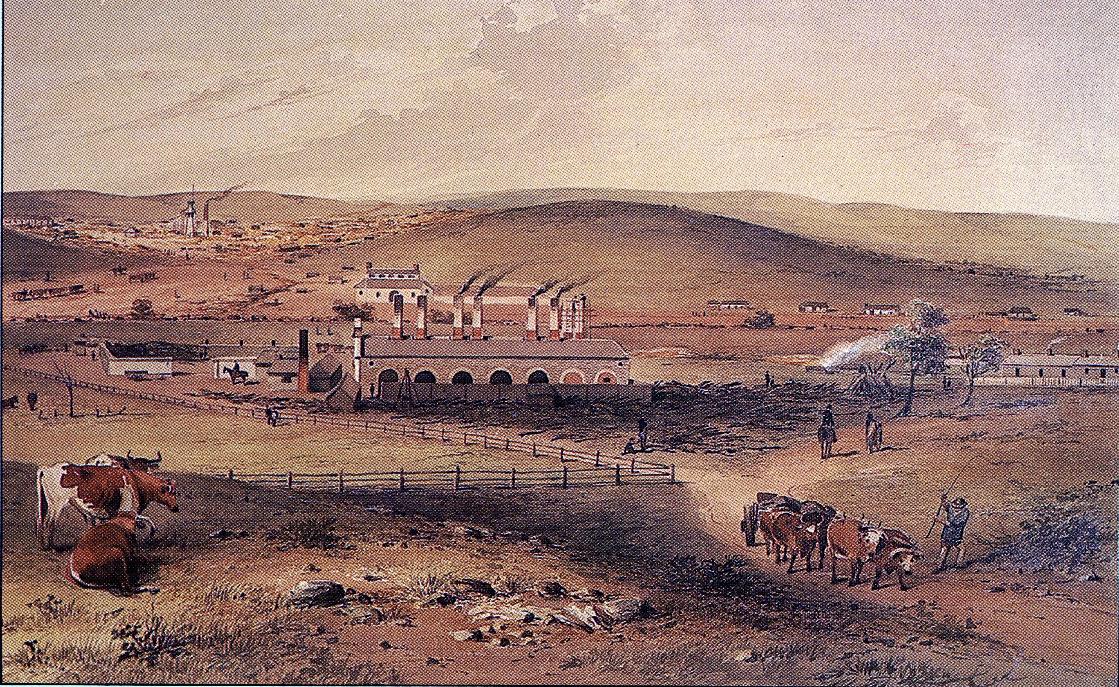
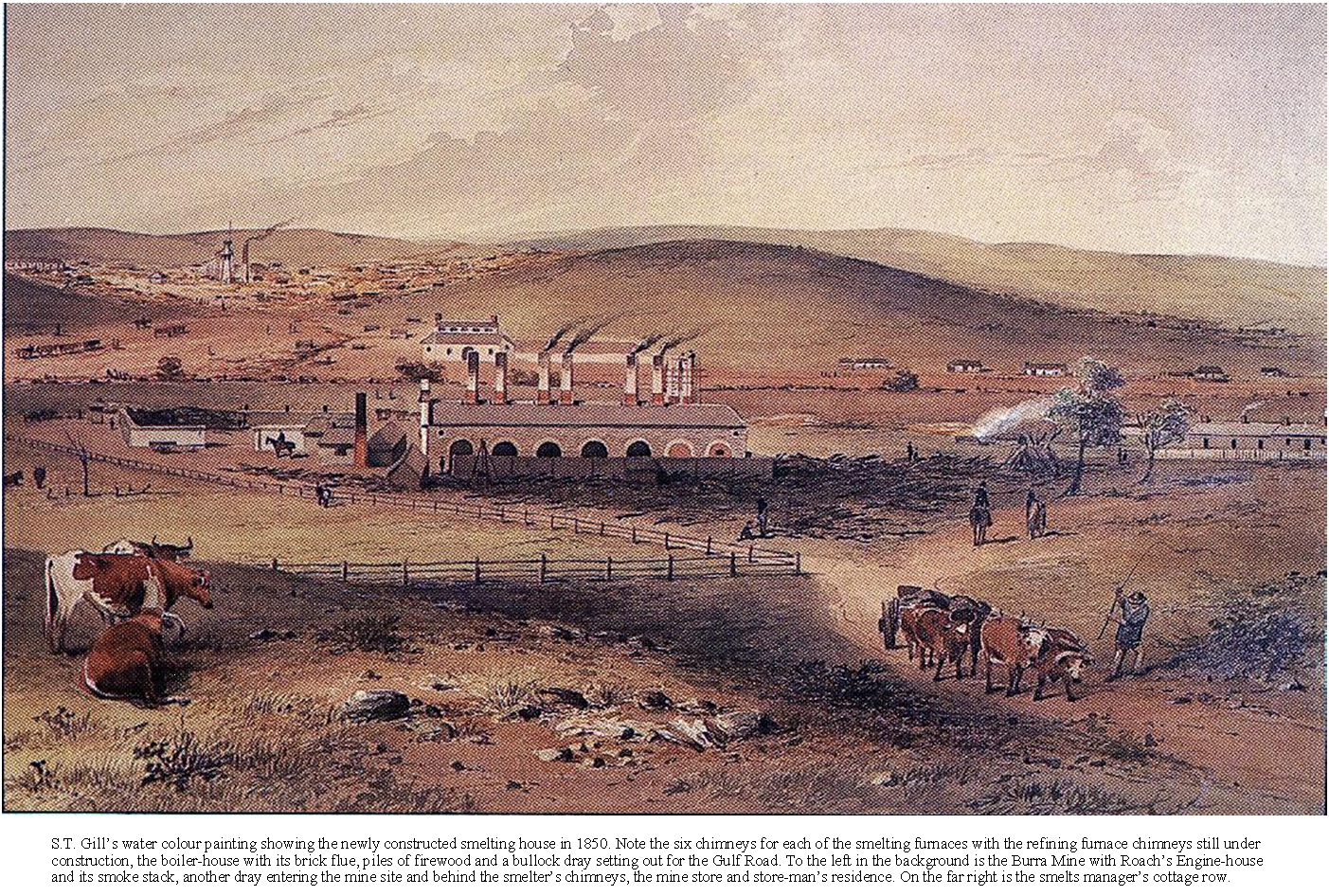
The Burra Smelter in 1850
by
Samuel Thomas Gill
Image supplied by the Art Gallery of South Australia
Compiled by Julian Ratcliffe for the Burra History Group Inc.
2011
1
BURRA’S COLOURFUL ORE
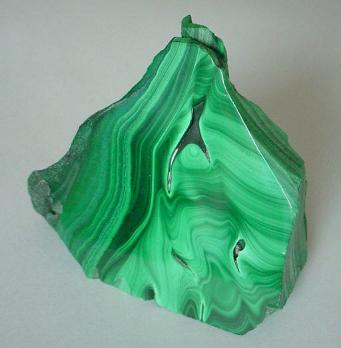
Malachite
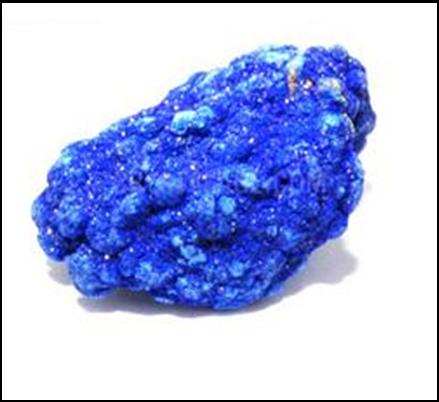
Azurite
2
SMELTING BURRA’S COPPER ORE
World Copper Smelting
At the time of the emergence of the Burra Burra Mine, Swansea in Wales was the centre of world copper smelting, not because it had copper mines, but because it was rich in coal. About 4 tons of coal was required to produce 1 ton of copper, so it was more profitable to ship Cornish copper ore to the coal for smelting rather than the other way round. To begin with, South Australia’s copper mines followed suit, its ore being treated at Schneider and Co.’s Spitty Smelter at Loughor near Swansea. So the first ore
3
from the Burra Mine was loaded into drays drawn by slow moving teams of bullocks and hauled over tracks that crossed creeks and rivers the one hundred miles to the colony’s only seaport. One commentator described these loads of brightly coloured malachite and azurite as looking like fresh vegetables going to market.
A Much Sought-after Ore
Burra’s ore was greatly sought after by British smelters not only because of its high copper content but also because it contained no sulphides. Sulphurous ores required up to ten smelting stages to produce refined copper. By adding the Burra ore, which was composed of carbonates and oxides, the number of stages could be reduced to five. Despite this, the Burra Mine was getting somewhat less than a fair price for it when it was sold at Port Adelaide.
The First Burra Smelter
One month after work began at the Burra Burra Mine in September 1845 the directors of the South Australian Mining Association (SAMA) had decided to erect their own smelter on the mine site. In October 1845, they engaged Georg Ludwig Dreyer and his son, immigrants from the Harz Mountains in Hanover, to take charge of smelting operations similar to those used in their homeland under the supervision of Dr Ferdinand von Sommer. They would build a blast furnace fuelled by charcoal that could be produced from the colony’s forests rather than use imported coal. This furnace was to be erected between flanking brick piers against a wall within the Burra Mine store yard.
With construction underway early in January 1846 Henry Ayers, the Secretary of SAMA advertised for 25,000 bushels (over 600 tonnes) of charcoal and contracted with John Bagg a brick maker working at the mine for the supply of ‘100,000 good well burned bricks.’ These bricks were supplied by G.H. Ramsay & Co. of Newcastle on Tyne.
In March of the same year, the smelting house measuring 105 feet by 35 feet was under construction and very large bellows to supply the blast of air into the furnace were being built by James Marshall, an organ builder, in Adelaide. Unfortunately because of a shortage of bricks it was not until October 1847 that these preparations were completed and the first smelting could be attempted. This first trial resulted in about 4cwt (200kg.) of smelted copper matte. A witness reported that the copper ore was first roasted by heaping it on burning logs of wood and then it was added to the furnace with charcoal and a little limestone (calcium carbonate) as a flux and in three hours the copper was run off into moulds, the slag being less dense having been easily separated. One more process would be needed to refine the metal. It was clear at this stage that
4
the process with two horses driving a whim, seriously distressing them, could not provide the necessary blast of air.
A second blast furnace was built by Dreyer with a similar result being described as follows:
The First Smelting Works by Frank Treloar
Some months before the visit of the Directors, arrangements were entered into with a Mr. Dreyer, who claimed to have had experience in smelting in Germany, to go to Burra, erect a small furnace there and carry out trial runs to prove if smelting could be carried out in Burra on more extensive lines. The structure was well advanced when Mr. Burr took office, On its completion it was a small furnace which held the charge and a large pair of bellows supplied the blast and driven off by a whim worked by either bullocks or horses and when working smoothly and satisfactorily it was supposed to put through eight hundred weight of copper a day.
The Furnace Trials - A Costly Failure
When Mr. Dreyer declared it ready for a start plenty of hands were standing nearby either ready to help or out of curiosity. Horses were used on the whim and after a run of 22 hours; about four cwt. of rough copper was produced. It was then found necessary to withdraw the charge and repair the bellows and fixings, which had suffered, badly by the trial. Several days later repairs being effected, another start was made with much the same results except that the horses were very distressed. More time passed in repairs and still another trial was made but the effort to keep up a constant blast was absolute cruelty to the horses besides shaking the bellows to pieces. This ended any further attempts at smelting under those conditions and just what the experiment cost would be hard to say, but from first to last could be classed a costly failure.
Treloar’s account comes from the records of the Burra Burra Mine that he rescued from the abandoned mine offices in 1929.
Dreyer suggested that a steam-driven blower be substituted for the horse-driven bellows. That would have necessitated the importing of a steam engine from England, something the directors of the company would be faced with, though for a different purpose, in the future.
Apparently the Burra Directors were unimpressed. On the 13th of Oct. 1847 they discontinued the smelting and dismissed all workers on the grounds that the operation was too expensive.
In Feb 1850, the smelting works had been converted to another use.
‘A yard is now walled around for the carpenters and the old smelting house into a workshop for their use. On the opposite side is the store.’
Why Dreyer’s Smelting Experiment Failed
Georg Dreyer had 22 years experience smelting the ores from the Harz Mountains in Hanover. These ores were sulphide ores unlike the hydrated carbonate ores of the Burra Burra Mine. Passing a blast of hot air through sulphide ores produced its own heat which sustained the smelting process. When heating Burra’s carbonate ores, rather than producing heat, they absorbed heat which cooled the mixture and slowed the reducing reaction. This is why Dreyer had to redesign his original blast furnace and force more air through the charge in a second experimental blast furnace. Unfortunately he was not able to force enough air through the charge and very nearly killed the poor horses driving the whim in the process.
With the advantage of hindsight, Dreyer’s blast furnace was ahead of its time, because it used exactly the technology now used in modern blast furnaces in steel production. Frank Treloar was merely reflecting the view of Henry Ayers, as he used SAMA’s Mine records as his source of information. Furthermore, the use of limestone as a flux, which is also common with modern smelters, would have meant that Burra’s carbonate ores that were won from dolomite, calcium magnesium carbonate, base rock had a ready supply of flux close by. The limestone would need to be first calcined converting it to lime (calcium oxide).
5
Davy’s Smelting Process The Yatala Smelter 1845
Dr Edward Davy, a physician, using charcoal had successfully extracted copper from 44 pounds of Burra Mine surface ore, part of the first lot brought to Adelaide.
Davy’s process was capable of treating sulphide ores which were coming from other mines in SA including Kapunda. In mid 1846 Davy patented his method in England.
Donald Chaput explained; ‘In July 1846 Davy pressured mine owners and captains to a meeting chaired by Bagot. He outlined the workings and benefits of his process, recommended Port Adelaide as the location for a smelter and stated that the fuel would come from the forests of York Peninsula and Kangaroo Island as well as some Newcastle coal. No financial commitment was made by the miners, who were mocked by the ‘South Australian Register’ for their timid stance and ‘tardiness in smelting our own ores.’
It was the end of 1848 before the necessary machinery had been manufactured in Sydney and shipped to Adelaide so that in January 1849 the Adelaide Smelting Co. at Yatala, Port Adelaide, commenced using the Davy process.’
This smelter consisted of an engine house, a hot blast furnace, a furnace for smelting ore and a casting shed. In addition a smith’s workshop and forge, a charcoal shed, an assay room, there was a refining furnace and a residence.
‘The machinery was a steam engine, two boilers, working the air pump, the blast furnace and refining furnace.’ In 24 hours, eight tons of ore had been smelted using five tons of charcoal.’
Only one process was required for carbonates and oxide ores and sulphides required an additional roasting step before smelting. Lime was used as the flux. By December 1849, over 140 tons of copper had been produced although the machinery and process were still not entirely satisfactory.
The Demise of the Yatala Smelter
‘Built at a cost of £8,000 in 1848, the Yatala Smelting Works was offered for sale in 1850 (the land the smelting plant furnaces, engine and buildings….everything complete.)
Lack of capital was said to be the cause; although lack of ore to smelt, and the monopoly of the Patent Copper Co and Apoinga Smelter were ‘more powerful reasons.’ Ian Auhl
6
The Apoinga Smelter ‘The Swansea Monopoly Defeated’
Charles Penny, who had spent time mining in Mexico and William Owen, an industrial chemist, first successfully smelted Burra ore in January 1849, two months before the Yatala Smelter.
They had set up a smelter in the mallee gum forests known as Tothill’s Scrub at Apoinga, 32km south of Burra, late in 1845. Their experiments had taken some three years to come to fruition and they applied for a patent claiming their innovative smelting process could treat ores bearing as little as 5% copper.
The London Mining Journal reported:
‘The process consists of decomposing the carbonates and oxides of copper using leaves, woodchips charcoal and other carbonaceous matter, during smelting. The furnaces are ordinary melting and reverberatory ones as used in Swansea, modified in that the crown is in closer proximity to the bottom in order to keep the heat down on the mass and the furnace is larger to admit wood as the fuel. The furnace is heated to white heat the ore is introduced through the crown of the furnace and when fused, a quantity of leaves, wood chips, charcoal or other carbonaceous matter is thrown upon it or the ore may be reduced to a powder and mixed with carbonaceous matter prior to introduction to the furnace. The copper when separated from its compounds is received into a cavity in the furnace, after which it is tapped and run into moulds in the usual way.’
Batches of high grade copper ore were bought from the Burra Mine and in January 1849 the furnaces produced their first lot of molten copper. This was hailed as ‘a new age in metallurgy’. In a single process, it was claimed, copper was turned out as tough and as fine as in any overseas smelter using up to as many as seven processes. Initial difficulties were soon overcome and by March 1849, a steady rate of one ton of copper a day was achieved. Production increased to 50 tons per week by 1851 and Penny and Owen were trumpeting their success, claiming credit for breaking Swansea’s stranglehold on the South Australian copper industry. They sent 204 ingots (3 tons) of smelted Burra copper by dray to Adelaide.
This operation by then supported a population of 100 living in a village of about 30 houses with a Post Office, hotel, blacksmith, shoemaker and a general store. Apoinga was a prosperous, growing town with a rosy future.
The Apoinga smelter was a small establishment consisting of three smelting furnaces, a 40 foot smoke stack and a refinery in a fine freestone building from which copper was tapped every eight hours. However, it could only smelt the highest grade Burra ore and three loads of wood of
7
about 2 tons each, were consumed every twenty four hours and the chimney operated on the long-draft principle. In the first three years of its operation, Apoinga treated over 2000 tons of ore from the Burra Mine. With only three furnaces and an ability to treat only high-grade ore, it could not handle all of the Burra Mine’s ore.
Changing Fortunes
Suddenly the tide of fortune turned. Gold discoveries in Victoria dealt the South Australian mining industry a staggering blow. Miners, farmers, blacksmiths; practically every able-bodied South Australian man packed his swag and hurried off to make his fortune at the Victorian diggings. Production at the Mine fell and the Burra Smelter closed down. Burra became something of a ghost town.
However, the reduced amount of ore coming from the Mine was enough to keep Penny’s Apoinga Smelter in business. His men wanted to leave for the goldfields, but were under contract and he held them to it! Day by day they saw others pass the smelter on their way to seek a fortune in gold. Unrest grew to an alarming degree. At last the men could bear it no longer and dealt with it in a cunning way. When the slag was taken from the furnaces they made sure generous amounts of good copper went to the dump with it. As a result smelting expenses remained high but receipts dropped to a point where poor Mr Penny was in financial difficulties. The smelter closed and the triumphant workers rushed off to the goldfields.
Some years later when the smelter was re-opened for a short period at Apoinga, a huge lump of copper was found at the bottom of one furnace. It took 18 bullocks to drag it out!
In 1855, the Apoinga Smelter was put up for sale by Charles Penny who had bought out his partner William Owen for £1000.
All that remains of this enterprise, 100 years on, is a paddock where sheep quietly graze. Long gone the dray loads of ore in the charge yard, the roar of the furnaces and the lurid swearing of the bullockies, anxious to unload and race down the slope to the hotel to slake their thirst. There is the slagheap and a scattering of firebricks bearing the imprint of a long forgotten brick-maker called Ramsay.
A Link with a Pioneering Local Industry
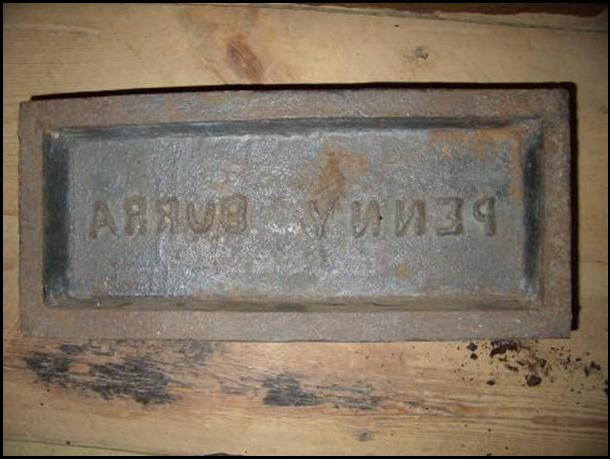
The National Trust of South Australia, Burra Branch has among its archive artefacts now stored in the former Redruth Courthouse a small cast iron ingot mould used to produce copper ingots at the Apoinga Smelter. It has the words ‘Penny Burra’ embossed on it, which establishes it origin, as Charles Penny was the owner of the Apoinga Smelter.
8
But the Time Will Come
By 1848, it was clear that huge smelting profits certainly awaited any party that could smelt the Burra ore successfully and on a large scale in South Australia. To some it was also clear that a coal fuelled smelter could operate in South Australia. Ships sailing from England generally were forced to carry a substantial amount of usually worthless ballast for stability. On arrival at Port Adelaide large quantities of unwanted gravel and stones were heaved overboard to make room for paying cargoes of copper or lead for the return journey. It was in the interests of shipowners wherever possible to find a market for ballast materials. What better saleable ballast material could there be than coal? On such terms it was possible for coal to be landed in South Australia more cheaply from England and Wales than from Newcastle in the neighbouring colony of New South Wales.
In February 1848, the London Mining Journal expressed the situation as follows:
‘How long will it be before the British capitalists open their eyes to the
9
importance of mineral discoveries in South Australasia? With British capital an iron railway for horses would soon connect every mine in the colony with the shipping port and only think what profits would be realised then. But no! You Londoners prefer to dealing with Spaniards, Brazilians and Mexicans than with your own countrymen. But a time will come when this province will be thoroughly understood and then John Bull, who would have nothing to do with us when mineral lands could be had cheap, will be fretting and fuming that he has to pay dear for what he, a few years before, might have had at little cost….
You who are so well acquainted with the feeling in England, will at once say, ‘I’ve burnt my fingers in Mexico, or Brazil, or Cuba – ergo, I would also lose money if I tried South Australia.
But the time will come; English capital will lay down railroads for us to our mines, will establish smelters and erect steam engines for us; and English capital will receive dividends such as have not been heard of for years past.’
The Patent Copper Company
In 1848, Schneider and Co., in possession of the exclusive rights to Napier’s patented process, made a bold move to secure a larger share of Burra’s ore. They formed an associate company, the Patent Copper Co., in London with a view to establishing a smelter in South Australia. This was a move to avoid Britain’s restrictive copper import tariffs and navigation laws of 1842 that had damaged trade in high grade foreign copper ore to Swansea by the end of the 1840s.
It seems certain that Henry Ayers the Secretary of SAMA had lobbied Henry Schneider the company’s senior director and also a director of the Burra Mine to take on this new smelting venture.
The South Australian Register reported in May 1848 that the Patent Copper Co. had chartered the Richardson a barque of 361 tons, in Swansea, to transport materials, men and staff sufficient to establish a smelting works in South Australia. The Richardson departed on 10th June 1848.
Other vessels were to follow immediately with further materials for 30 furnaces which could produce 10,000 tons of copper annually from ores containing 15% copper. The work is to be superintended by Mr Thomas Williams who would also act as an interpreter for his Welsh speaking workers. The cargo aboard the Richardson is listed as;
48,100 fire bricks, 40 tons fire clay, 300 furnace slabs, 200 furnace doors, 120 furnace bearers, 10 tons of sand, 45 tons of castings, 12 tons of wrought iron bars, 1 ton of shovels and other tools, 1½ tons of pig and sheet lead, 30 barrows, 4 dozen brooms, 6 case of laboratory apparatus, 1
10
case of scale beams, 1 case crucibles and ironmongery. All that was missing was bricks for walls and slate for roofs.
Seventy five passengers mainly smelting workers and their families, mostly from the Swansea district, commenced the journey and two babies were born at sea. This was the first sizeable exodus of Welsh smelters, whose expertise was starting to be sought throughout the world. The names of these emigrants were good old Welsh ones like Williams, Thomas, Evans, Morgan and Jones, most of whom only spoke their native Celtic language. They fled Swansea because the smelting industry was under siege, with job prospects declining and where they breathed a lethal ‘fume and stink’. For every ton of copper produced more than a ton of oxides of sulphur were released into the atmosphere causing severe lung damage to the inhabitants. The working men were bound under contract to remain with the Company for seven years. Their arrival in October 1848 was hailed as one of the most important to have ever taken place in the colony.
The Patent Copper Co.’s colonial manager George Searle Walters had arrived in the colony just two months previously and had set about finding a site for the new smelter. He was determined to concentrate on it being at Burra and had also proposed a new shorter carting route from Burra to the head of St. Vincent’s Gulf a distance of some sixty miles. Though his efforts, the new sea port of Port Wakefield was established linking the Burra Mine to the sea along what became known as the Gulf Road. Remarkably, Walters had also secured an agreement with SAMA to allow a smelting works on land comprising about 80 acres adjacent to the mine available to the Patent Copper Co. on a 99 year lease for a peppercorn rent. Needless to say by December 1848 the Patent Copper Co. had its workers excavating the foundations for its furnaces and cottages for its employees. The first of these was a row of brick cottages on the smelter’s property that became known as ‘Sunday Row’. By January 1849, five weeks after commencing, a furnace house to contain a row of 6 furnaces, each with its own smoke stack, was well underway and the first furnace stack was 30 ft. high. These furnaces were coal-fuelled reverberatory furnaces that were supplied with imported English or Welsh coal and flux materials transported from Port Wakefield, along the Gulf Road.
The Lighting of the First Furnace
The first furnace was ceremoniously lit, ahead of schedule, by the Bishop of Adelaide on 31st March 1849. At this time, six furnaces each with their 50 foot stacks were complete with a furnace house that measured 211ft long by 33ft wide, making it the longest building in the province.
11
12
13
A watercolour painting by S.T. Gill, in 1850, shows the completed furnace house with six brick flues protruding from its roof, and the boiler house and chimney at the southern end. Two other brick chimneys, one still under construction, are shown serving two refining furnaces in an adjacent building.
By May 1851, about twenty cottages had been built on Company land situated at the rear of the furnace house, for the accommodation of smelters under contact and their families. Workers taken on by the company at Burra had to find their own accommodation which usually meant ‘dug-outs’ hollowed out of the banks of the Burra Creek and one of its tributaries which became known as Welsh Creek close by the smelter.
Welsh Smelting Methods
The Patent Copper Co. used the Welsh method of smelting, employing reverberatory furnaces. The reverberatory furnace is essentially a masonry hearth with a roof over it. Copper ore which has been finely crushed and concentrated is mixed with flux and spread on the hearth and an intense fire is lit in a firebox at one end of the furnace so that the flame passes over the charge on its way to the flue. There is a chemical reaction between the charge and the combustion gases and the reactions in the furnace are principally ones that reduce the ore to copper matte. The practice was to fire up the furnace for up to twenty four hours then the fire was drawn and the molten copper matte and slag were tapped from separate openings at different levels on the side of the furnace.
The process of alternately heating and cooling the masonry structure is very damaging and reverberatory furnaces had a high proportion of down-time constantly needing repairs to the fire brickwork. Skilled bricklayers and good quality firebricks were crucial to the durability and efficiency of a reverberatory furnace. The cost of refractory bricks was a serious impost on any smelting operation and good quality ones were generally imported from the British Isles.
The Agreement
In 1849, the Patent Copper Co. signed an agreement with the S.A. Mining Association to supply 10,000 tons of ore containing 15% to 35% copper during the first year and 30,000 tons over the next six years, giving them a virtual monopoly over the medium to low grade ore. In return, the smelter paid SAMA two-thirds of the smelted copper price. However it left SAMA to control its richest ore. This loophole allowed SAMA to send its richest ore to the Apoinga smelter, which was a smaller but more successful operation, leading to a dispute between the parties.
In 1851 a new contract was draw up between SAMA and the English and Australian Copper Co., the new proprietors of the smelting site, a London-based company with Schneider and the Patent Copper Co.’s former
14
directors still at the helm.
From 1850 onwards, supplies of ironstone found locally, at Black Springs, were used as the flux material. Local timber was used to produce charcoal to supplement the coal reserves necessary for smelting. The refining house with its three furnaces was completed in 1850. The ironstone was crushed and mixed with the copper ore forming the charge that was fed into the hearths of the furnaces. The ironstone was more than a flux, as it also assisted in reducing the ore to copper matte, the impure rough copper produced in the first smelting process. This copper matte was run off into moulds from the slag which was discarded.
The Gulf Road Lovely Weather for Bullocks
The carting of copper to Port Wakefield and coal back to the Burra Smelter was over poor roads, tracks really. The Gulf Road as it was known, connected a series of waterholes found at Gum creek, Kadlunga, Skillogalee Creek, near Clare, Hoyleton, and Dunn’s Bridge at Balaklava for the bullock teams that hauled coal, copper and other materials between Burra and the Gulf. The bullock drays frequently got bogged after heavy rain, so cartage was confined to the summer months from October to April, as was the smelting. The problem during these summer months, however, was that there was little feed for bullocks and waterholes usually dried up. Drought in the summer of 1850-51 saw not only a cessation of cartage, but also a shutting down of smelting. The following winter saw three floods inundate the Burra Creek washing away the bridge between the smelter and the mine, the workers’ dugouts and damaging the works. Operations at the Burra Smelter resumed in September. And production increased from 50 tons a week to 80 tons. A new road was in operation, 1200 tons of materials were now passing along it weekly and copper was being shipped to England, India and Singapore.
Mules Never Stray; But Muleteers Do
The smelting company’s 1852-3 carting season had been threatened at the outset by an outbreak of gold fever among the teamsters, as they left for the Victorian goldfields. The Burra Mine was almost at a standstill because of a lack of miners and other workers, but the smelter was determined to continue.
Enterprising George Ewbank, who had replaced Walters as the Company’s Colonial Manager in mid 1852 advocated the use of mules, instead of bullocks, for carting. Travelling to Australia from England by way of South America, he had seen mules carrying panniers of copper ore from mines high in the mountains to the Chilean port of Coquimbo. On arriving in S.A. he learnt of the smelter’s carting difficulties and was
15
struck by the suitability of mules for the task. He enthused: ‘Bullocks are always rambling, mules never stray… a hundred bullocks require at least fifteen men to tend them, a hundred mules require three….a mule will do more work than one bullock for although he will only carry little more than half what a bullock will draw, he more than makes up for this deficiency by increased speed. Bullocks cannot travel in winter when roads are heavy; mules can because they always pick their way.’
So it was that the English and Australian Copper Co.’s smelting works found itself in April 1853, without a bullock to its name, having sold them and the drays to the teamsters, and its future success dependent on the arrival of a shipload of mules.
In March 1853, the company had purchased the ship the Malacca to sail to Montevideo to collect the mules and their muleteers. It took seventy stormy days before the little barque and its cargo finally reached Port Wakefield on 18 July 1853. Of the 180 mules taken on board at Montevideo, only seventy survived the trip. The ship’s captain, Captain Coleman, was again sent in search of more mules, setting sail in the Malacca for Coquimbo and Valparaiso. He would not return until April 1854, but this time he had 210 mules and more drivers. Unlike the wild mules of the first voyage, which proved very difficult to handle, these were well broken-in.
As mules could travel further than bullocks in a day, their route bypassed some of the bullock teams’ waterholes. This was especially the case on the difficult Wakefield scrub stretch, where the mules could, after descending the Skilly Ranges, head straight for Port Wakefield passing just north of the town of Hoyleton. After a considerable amount of trouble breaking them in, 24 mules made their inaugural journey on the new route late in November 1853. Carrying ore of from 270 to 320 lbs each, they completed the journey in 52 hours, clearly bearing out the claims made regarding their capabilities. They made the return journey laden with 300 lbs of coal each.
So the Gulf road became a dual highway, one for bullock teams drawing drays, the other for the mules, keeping them well away from the bullocks, as each had an unsettling effect on the other.
The muleteers proved to be as difficult to deal with as the mules, for whilst there was nothing to do, being paid £8 a week, ‘they hung on, but directly they saw the probability of being required to work, they left.’ During the winter of 1854, the ‘smelts’ manager, Williams had become disenchanted with the mules as pack animals, and tried them in harness pulling wagons. He discovered that the mules far out-performed horses in harness, reporting that ‘in harness they do 4½ times more work than the pack animals at less cost.’
16
The third and final consignment of 199 mules and 16 contracted muleteers arrived from Chile aboard the Malacca in February 1855.
A second furnace house with nine furnaces in two rows had underground flues that led to a single large red brick chimney was completed after delays due to shortages of labour and building materials, in 1853.
Also on the property were a crushing house, a sawmill as well as workers’ sheds, cottages, offices and a mechanics’ workshop.
Up to twenty one furnaces were constructed on the site, but there is no evidence that they were ever all operating at the same time.
Coals from Newcastle
Because of a sudden shortage of British coal, the smelting season looked like being delayed in September 1854. However, for three years, Newcastle coal had been stockpiled at Port Wakefield, the smelting company being reluctant to use it, it being judged of poor quality.
With the excitement of the goldfields dying down, furnace-men were returning to Burra and smelting needing to get underway, Hamilton, the manager, decided to use the stockpiled coal. He soon reported that ‘I have been much gratified that the NSW coal is of better quality than expected…..the furnaces have been smelting lately 34 tons a week; they have rarely done so well, the coal being almost wholly ‘Sydney’ coal.’
This discovery resulted in the Company turning away from British coal and using Newcastle coal exclusively, setting the scene for the eventual erection of a smelter at Newcastle by the English and Australian Copper Co. There was a good reason for this. This Australian coal was bituminous coal, which when heated in the furnaces produces coal gas which is a mixture of carbon monoxide, methane and especially hydrogen. All of these gases are reducers with hydrogen the best reducer of them all.
More Welshmen and a New Township 1855
Twenty two smelters, furnace masons, smiths and carpenters from Swansea and Glamorgan, all but one with wives and families, arrived in South Australia on the Glentanner in November 1855. They had been given free passage under the Colonial and Emigration scheme of assisted immigration. In anticipation of an expanded workforce the English and Australian Copper Company had acquired a large section of land close to the smelting works, subdividing it to establish a new township. This town was named Llwchwr, after the town in Wales where the Company’s Spitty Smelter was situated and from where many of Burra’s smelting workers originated. Llwchwr is incorrectly pronounced ‘Lewisher’ by Burra locals.
17
Because the mules were at last functioning well, for the first time the smelting season continued well into the winter months. Eventually by 1857 this would become year-round smelting keeping five furnaces working continuously. This was to result in the Company paying the first dividend in its eight year history.
The Gulf Road Bites the Dust
In August 1857, the smelting company advised that as usual carting would commence along the road to Port Wakefield, but only two months later, all traffic was diverted south to the railhead at Gawler and the Gulf Road was closed. This came as a cruel blow to all of the little settlements that had arisen along this once busy route and voices rose in protest, but to no avail.
In the 1858-59 smelting season Hamilton reported having nine furnaces and two refineries working, the highest yet recorded and that 25% more copper was being produced from the same amount of fuel. The total output of copper that year would be 2,310 tons almost that of the 2,763 tons of the 1850-51 season and would only be exceeded by the 1860-61 season at 3,086 tons. Even as these excellent results were being achieved it was becoming obvious that this could not last, as the copper lode at the Burra mine was being exhausted, as the percentage copper in the ore progressively decreased. This lower grade ore could not be profitably shipped overseas and the emergence of the copper mines at Wallaroo and Moonta on the York Peninsula led the English and Australian Copper Co. to build another smelter at Port Adelaide, one that could handle the sulphide ores from these mines and it was inevitable that the Burra ore would in future be smelted there as well. This new smelter was opened in May 1861. After this the Burra Smelter was in serious decline, with only five furnaces operating early in 1863. By December that year it was four furnaces and in January 1864 all furnaces were closed down for a while for repairs, leading to the closure of the refinery furnaces. From then on, only rough copper was produced at Burra, it being sent to Port Adelaide for refining.
18
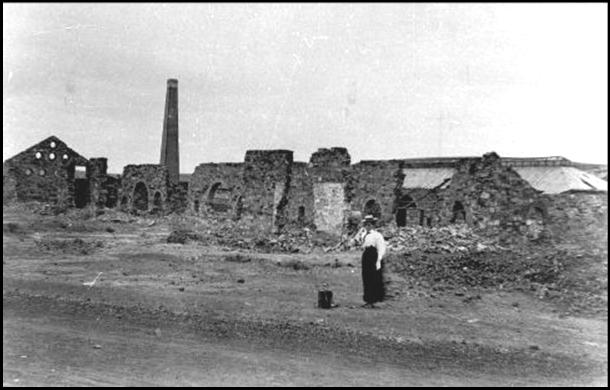
Above: The remains of the first smelting house with the second smelting house behind with its tall brick chimney dominating the scene.
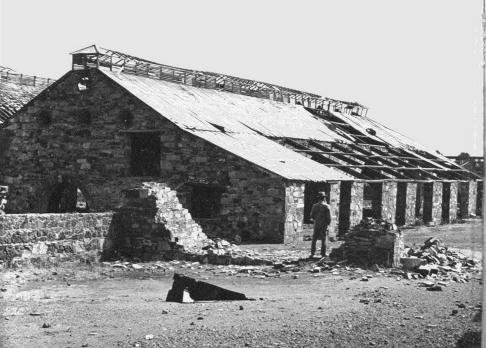
Below: The ruins of the second smelting house c1900
19
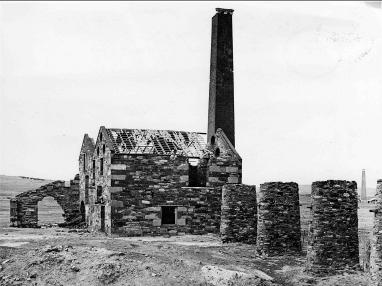
Ruins of Burra Smelter c1900
20
The Burra Smelter Ceases Operations 1869
With the Burra Mine almost at a standstill by April 1867 and the copper content of the ore falling, the Burra Smelter’s fate was sealed. By late 1867, copper production was now only half of that of the 1862-63 season and falling. The last smelting operations were performed early in 1869, twelve months after cessation of activities at the Burra Mine as it awaited advice on how to proceed. The English and Australian Copper Co. had decided to build a new smelter, the Lamberton Works, at Newcastle NSW where there was a ready supply of coal.
Over the twenty years of its operation, the Burra Smelter had produced approximately 27,500 tons of copper. Any valuable pieces of the plant were taken away to the Company’s other smelting sites and accumulated materials, mainly bricks of all descriptions, were sold off. Its properties in Redruth and Llwchwr were also sold and the site it leased from the mining company reverted back to it. So now the Mining Association was the proud owner of two furnace houses, a refining house, a boiler house and engine house, offices, several cottages, one very tall brick chimney with a lengthy flue and a huge pile of what was considered to be worthless slag.
Samuel Paynter and The Burra Slag Extraction Company
The productive years of the Burra Smelter site, were not over, despite the fact that since the closure of the plant, most of what seemed valuable had been sold off. Enormous quantities of glassy black slag, the waste product of the smelting process, had been dumped in huge heaps around the site during the years of copper production. Some of this slag had been used by the smelting company, moulding it into large bricks that went into building walls, but vast banks of it still remained. Following the closure of the smelter, it was not only the plant and buildings that were removed, but also loads of slag were put to use. In 1873, slag was used by the Burra Corporation to make a ford across the creek opposite the railway station. Other users were the S.A. Government and The District Council.
In 1889, it was reported in the Burra Record that Mr. Ralph Bartle had secured a 21 year lease on the site to crush and treat the slag to extract the remaining copper from it. Another report said that 12 men were working there, but by November of that year, the project had been abandoned, it not being considered profitable to transport the slag to Port Adelaide for smelting.
Samuel Paynter of Millicent, made an attempt in October 1891 to crush the slag installing a treatment plant that required 6000 gallons of water a day from the Burra Waterworks. He asked the Burra Council in December that year if they could supply water at a cheaper rate. The project failed either because the task was too difficult or too expensive.
21
In 1895 after an assay of the slag had shown a copper concentration of 2⅝%, Paynter made another attempt in 1898, with the English and Australian Copper Co. requiring him to keep any of the sheds and buildings he used in ‘proper repair.’ Photos taken at the turn of the century by the Tilbrook brothers show the walls of first furnace house but without a roof, the second larger furnace house with most of its roof intact and its tall stack still standing. Also still standing, but roofless was the old smelter’s crushing house with its stack, near Welsh Creek.
Paynter formed a new company, the Burra Slag Extraction Co. early in 1899, and despite reservations regarding the success of this venture, the operations employing new structures and machinery, commenced in October 1900. This treatment plant erected to the south of the slag heap consisted of a powerful stonebreaker, an enormous pair of rolls, a classifier, jigs and a heavy 10-head battery, all powered by a high pressure steam engine fed by two Cornish boilers. Also on site are a store, an office, a blacksmith’s and carpenter’s shop. The water was supplied from a well on the site, which was unable to supply enough water. A powerful pump was installed on the bank of the Burra Creek to pump the required water.
In May 1901, the South Australian Advertiser reported that the plant operated continuously lit at night by arc lights and the extracted copper was heaped ‘on a specially prepared floor. Some of the pieces weighed several pounds, but the majority was like gun shot and up to the size of peas.’ The slag was proving to be a lot harder than expected and this was causing considerable wear and tear on the machinery. Interestingly several old silver coins, dating from the beginning of the Burra Mine, were also extracted during this process.
With a fall in world copper prices the extraction works was forced to close in October 1902, putting about forty men and boys out of work. During the two and a half years of its operation, between 80,000 and 100,000 tons of slag had been crushed realising about half a percent of copper in line with what had been predicted by Andrew Thomas, a chemist, the only surviving member of those sent out to do the smelting years before. In all, this represented around 450 tons of copper with a value of £20,000.
One Final Fling
In December 1906, a new company the Burra Slag Smelting Co. was established by Messrs. Martin and Co. to once again treat the slag left on the site of the Burra Smelter. This time it would involve re-smelting the slag and a furnace was being brought from Leigh Creek for the purpose. Trials were conducted in April 1907 and 18 men were employed. The reports of this operation were short on details, but the blast for the furnace was supplied by a 17 hp oil engine and 30 tons of slag was treated per
22
day. In May 1907 the workers sued for more pay and went on strike. By June, with a fall in copper prices and the slag proving to be ‘highly siliceous’, the project was abandoned and the company was wound up in 1909.
Smelts Paddock
In 1929 when the Burra Historian, Frank Treloar wrote about the ‘remains of the Smelts’ he made mention of the slag heaps and the 80 ft. high red brick stack that dominated the scene, but he failed to mention the furnace houses. It would seem that by then they had been demolished and their stone used for other buildings throughout the town.
The Death of a Burra Landmark
The one remaining structure, the huge 80 ft. stack was destroyed with dynamite in January 1956.
‘Messrs C.P. Thamm and Sons of Burra North did the job on behalf of Mr J.G. Carpenter, on whose property it stood. The Council had demanded its demolition because of the danger to children playing around its base,’ reported the Burra Record. This chimney which was claimed to be originally 100ft high was calculated as 70 ft as it fell. This chimney provided the draught through the furnaces in the second furnace house and was fed by an underground flue 100 yards long. It was 14 ft square at the base with foundations 10ft deep and walls 3ft 6 inches thick. The internal bricks were fire resistant bricks, branded ‘made in 1846’, of white kaolin that were especially hard and had stood up to the elements well. The Kaolin coming from Motherall’s 18 miles east of Burra. The red outer bricks came from kilns in the Burra Creek near the cemetery. The whole structure was reinforced by an estimated 1-2 tons of one inch square steel bars. The chimney was demolished with charges of dynamite that proved difficult to place because of the considerable effort to drill the necessary holes in its base. It fell to earth in one piece, breaking up with an explosion on impact with the ground. The Burra Record added, ‘a goodly number of bricks will in the near future find their way into new additions to the residence of Mr Thamm.’ Thus a valuable piece of Burra’s early history was destroyed forever.
With the exception of the Smelts stables, which are privately owned, most of the site is now the property of the Regional Council of Goyder, and is now a tourist site that reminds us of Burra’s past.
References:
The Burra Smelting Works- A Survey of its History and Archaeology
23
David Bannear (1990)
The Evolution of Early Copper Smelting Technology in Australia
Peter Bell and Justin McCarthy
The Story of the Monster Mine—Ian Auhl
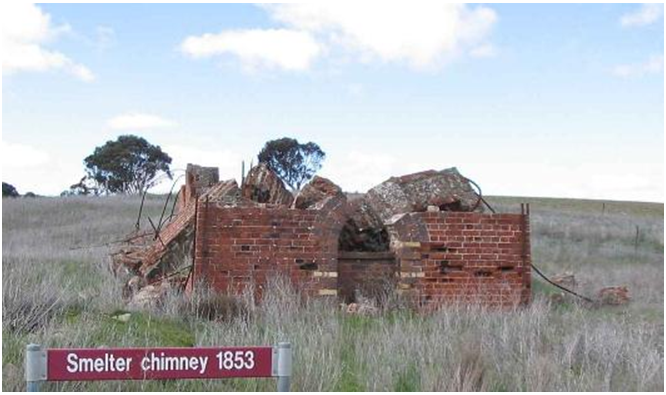
The remains of the 80ft. brick chimney that produced the updraft for the smelting furnaces
Compiled by Julian Ratcliffe for the Burra History Group Inc.
2012
24