Compiled by Julian Ratcliffe
© The Burra History Group Inc.
2017
1
2

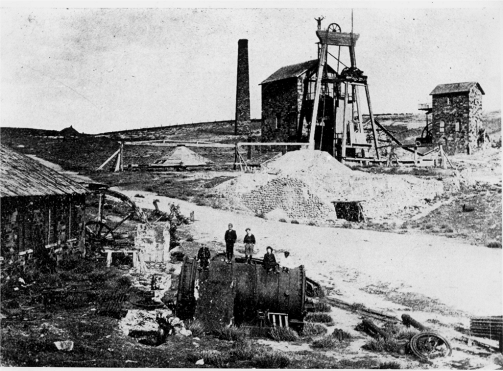
Schneider’s 80 inch (2.03m) diameter pump engine cylinder lying derelict at the Burra Mine site in 1906. This was the engine Bell Freemen brought to the mine on the jinker in 1852.
The Pioneering Journey (1849)
It was not the first time that Freeman had been employed for such a task. In fact, his pioneering journey across the same route using a similarly constructed, though smaller, jinker with a team of 40 bullocks was in 1849 when he hauled the 60 inch beam engine and cast iron beam for Roach’s Pumping Engine House. It would be the first engine of its kind installed at the Burra Burra Mine. For this journey, as with subsequent ones, preparations were needed along the way with the making of creek crossings and the shoring up of the bridge across the Gawler River at Willaston. As an added precaution, sand was spread across the bridge to reduce vibrations as the heavy load passed over. To lighten the load, this crossing involved uncoupling the bullock team and drawing the jinker across using ropes and pulleys. The Industrial Revolution literally came to Burra riding on a jinker.
3
Unfinished Business
As early as 1851, Henry Ayers the Secretary of the South Australian Mining Association had planned to install a winding engine at the Burra Mine. Known as a ‘fire whim’, it was to replace some of the many horse whims that were used to haul kibbles filled with ore to the surface. This plan had been shelved when the urgency of replacing Roach’s pumping engine became apparent and it was only revived as the mine operations recommenced in January 1857 when the stone work for Peacock’s rotative winding engine was commenced. Now the 20 inch, 30 hp beam engine and its boiler would make the journey from Port Adelaide to the mine and it too would be loaded onto a jinker drawn by bullocks and would commence operating in 1858. So our jinker was again taking the load.
That Famous Journey (1858 – 1859)
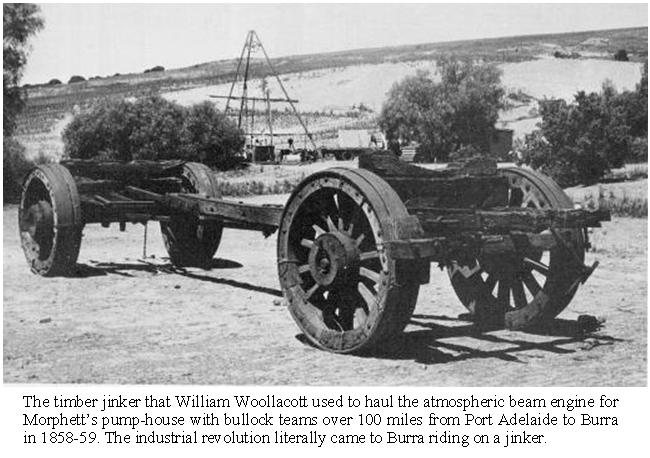
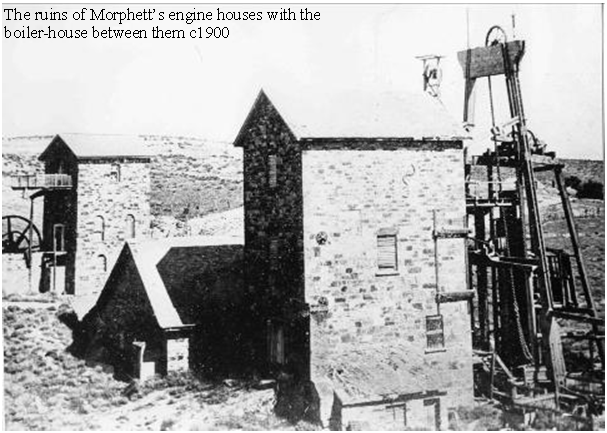
In 1858, a leading bullock driver, William Woollacott used this same jinker again to transport the engine for Morphett’s Pumping Enginehouse to the Burra Mine. The return trip took two months. For some reason this is the trip that captured the imagination of all in its path. News of this cavalcade of Burra’s heavily laden jinker drawn by bullock teams with their attendant bullockies, three on either side of the team cracking their whips, attracted crowds to cheer it on its way as it passed through each township. And on its arrival in Burra, with Woollacott riding high on top of the load, his feat was heralded by the locals with great excitement, dancing in the streets and in true Cornish miners’ fashion, many a beer. This would be the first of a series of trips the jinker would make this year. On this occasion, there would also be six Cornish boilers to make separate trips on our jinker to be installed in an adjacent boiler-house for this more powerful beam engine. And in 1861, Morphett’s 30hp winding engine would make the journey to be installed in its half-house alongside its larger working partner. Morphett’s pumping engine would operate from the time of its installation in 1859 until the closure of the Burra Mine in 1877. Whilst the jinker would be left idle at the deserted mine site till well after all of the remaining mine engines had been removed in 1916; it has outlived them all.
4
5
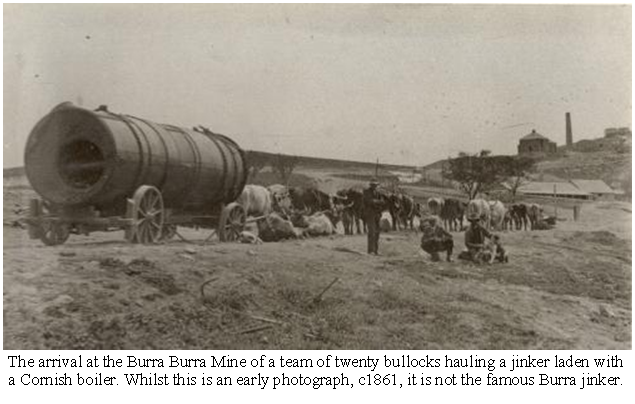
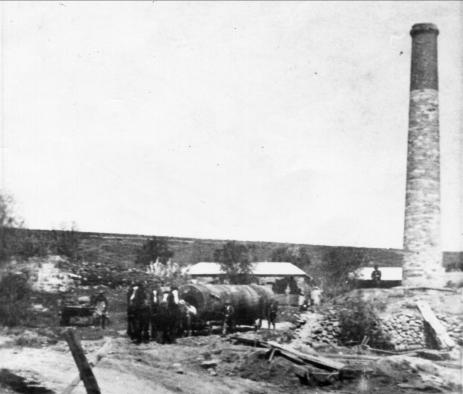
A team of horses hauling one of the Cornish boilers from the Burra Mine in 1916. when all of the mine machinery was removed and sold for scrap. Here it is passing Peacock’s Chimney with the Mine Offices visible in the background.
6
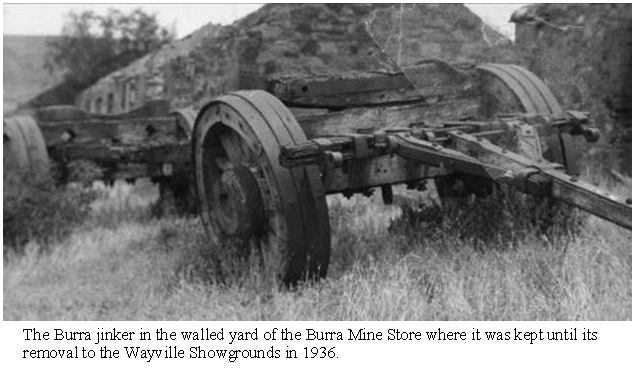
It was in 1936 that the Burra Jinker was donated by the Mc Bride Family to the Royal Agricultural and Horticultural Society and taken to Adelaide for inclusion in a Museum at The Wayville Show Grounds, where it remained until it was returned to Burra in 1962.
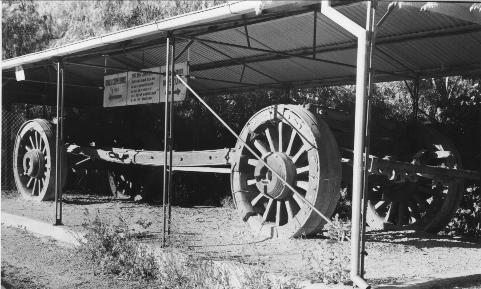
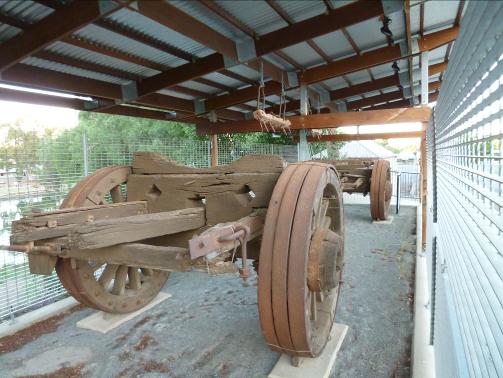
The jinker was moved from the mine store yard to this site in Market Street with a shelter to protect it in 1965.
7
The jiker gets a new home (1965)
The local council moved the jinker from the mine to its current site in Market Street, where it was put on display under a new shelter.
A new protective shelter for the jinker (2014)
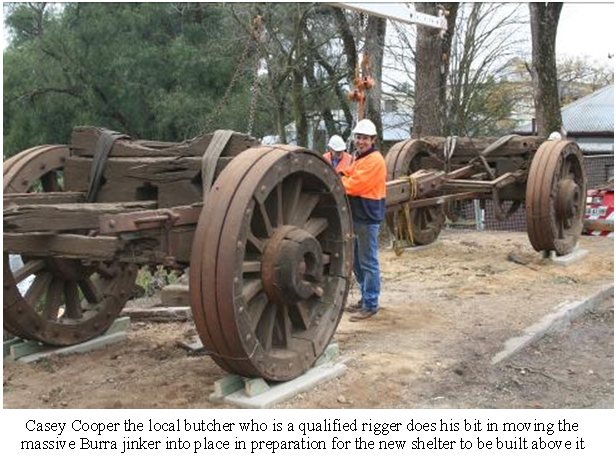
After a motor vehicle collided with this shelter shed resulting in the jinker being dislodged from its original position, the Regional Council of Goyder decided in 2014 to replace the old shelter with a new one; one that offered the protection of bollards along its length.
The Story of The Monster Mine` Ian Auhl
8