Burra Cemetery
Self Guided Walk
By Meredith Satchell & Eric Fuss
© The Burra History Group Inc. 2014.
2
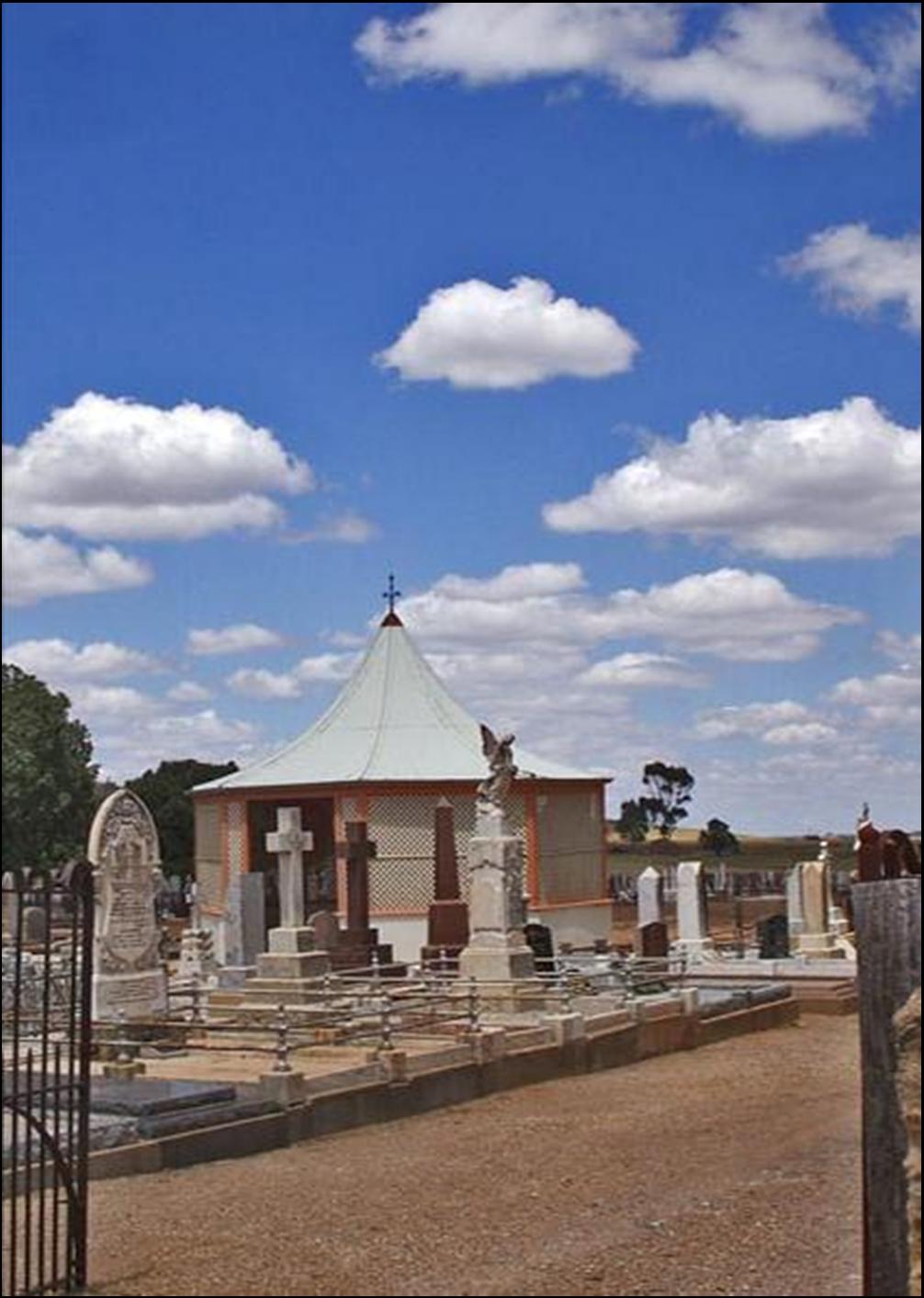
THE BURRA CEMETERY
The Burra History Group has prepared this walk with the idea of pointing out to visitors graves that they believe to be of interest. They have selected sites that have interesting funerary monuments and sites that memorialise local people with interesting stories. In two cases the sites have no headstones or other markers. It would be possible to create an entirely different walk based on other sites, but we believe those selected to be suitably representative.
With one exception we have not extended the walk into the newer portion of the cemetery beyond the major driveway marking the limit of the map provided or to the even newer area beyond the wall. This area could perhaps be the object of a further booklet.
Visitors cannot fail to note that a large central portion of the old cemetery has been cleared of headstones. Many people consider this to have been a terrible act of vandalism and local stories often seem to suggest that the Council sneaked in while no one was looking and swept the area clean. Nothing is further from the truth. While we may now regret the decisions taken in the 1960s, they were not made hurriedly or without opportunity for community input. In the 1950s the cemetery was being poorly maintained. The old area had many graves showing neglect and decay. Weeds were rampant and maintenance of the paths and wall were certainly inadequate. The Town Council said it did not have the funds to adequately maintain the old cemetery. The Council began seeking information in 1961 about how to proceed with clearing the area of graves over 100 years old. Legal answers were obtained. As well as tidying up the site, it was at the time intended to reuse the area rather than open new land outside the wall. This idea was later abandoned.
The local paper carried a notice on 23 July 1963 calling on anyone concerned to respond to the Council’s intention to level and reclaim a portion of Burra Cemetery containing allotments 542-699, 704-753 and 758 to 1,271. It was carried in the Burra Record for three consecutive weeks and in the Advertiser for three consecutive Fridays.
The report in the Burra Record 1 September 1964 reflects the general feeling of a time before considerations of the heritage loss involved were widely recognised or appreciated:
For many years the condition of the cemetery has caused the Council concern and has been the subject of much criticism. Legal issues have hampered Council action. There has been a long wait for approval to reclaim and level a portion of the area. Much research had to be done into particulars of leases, dates of burials etc. and many letters were sent to the concerning authorities. Moves for the central portion of the cemetery to be levelled commenced six years ago and approval to carry out the work has finally been given. Tracing lessees of blocks or members of the family concerned, calling for objections and so on has taken all that time. Last week the Council, with the use of District Council plant, commenced the levelling work. Large shrubs, large trees, broken and crumbling mounds, have been removed and the area flattened. There is a large heap of rubbish to be burnet and the headstones removed will be placed along the boundary wall. A vast improvement is already evident. The 99 year leases on the blocks in this area had already expired.
The old area was not reused for modern burials, but over the years the Cemetery Committee has resited old headstones that survived the levelling. Records do not allow their correct location and so their location cannot be considered accurate. Some from before 1851 are believed to have been relocated from the old cemetery across the Burra Creek.
NOTES
1. Allow up to two hours for the walk if you are reading all the information.
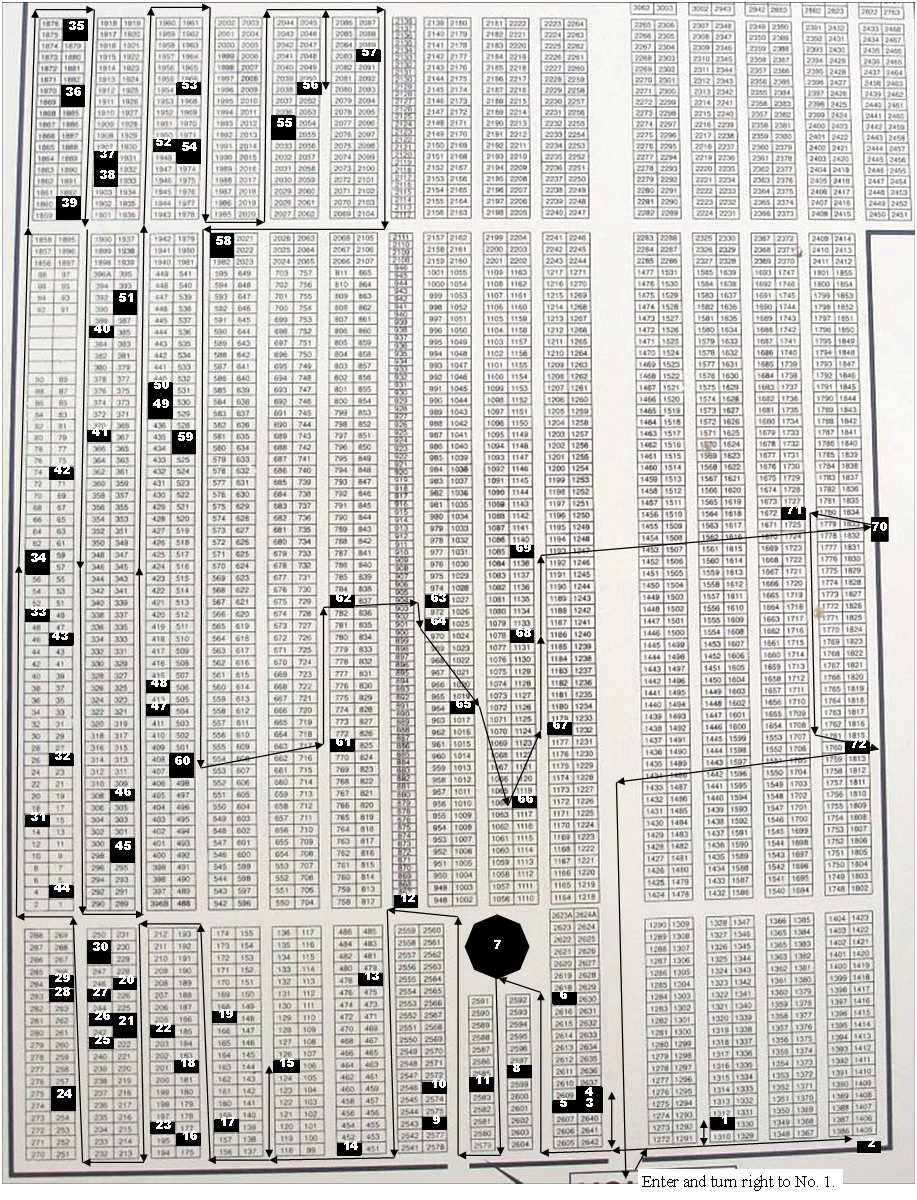
2. Sites 2 and 70 are headstones leaning against the surrounding wall.
3, Sites 61 to 69 in the cleared area of the cemetery are indicated only approximately on the plan and we have no intention of indicating that the plots on the map are either the true site of the burial indicated by the headstone or that the headstone is on the plot number on the plan.
4. Causes of death have been inserted where found.
5. Please be careful while walking around and watch where you place your feet while looking at the headstones. The ground is uneven as the result of erosion, subsidence and rabbit activity etc.
6. In hot weather beware of snakes. While not common, they could be present.
3
4
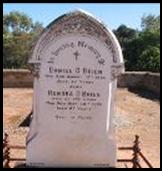
1. O’Brien, Daniel died 15 August 1893 aged 57.
O’Brien, Honora died 30 December 1905 aged 67. Cause of death: gastric jaundice.
Daniel was found under a capsized cart at Baldina about 15 km east of Burra with his feet protruding and his head apparently damaged either by the overturning of the spring cart or by a subsequent kick from the horse, which was found lying on its side, but alive. The investigating policeman had concluded that the deceased had probably gone to sleep or had been unable to see in the dark and the horse had trotted around in circles until it fell over the cutting.
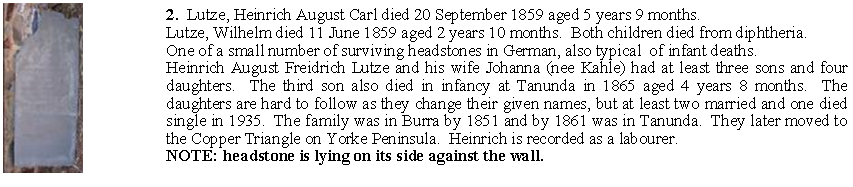
3. Collins, Bertie Ernest died 8 August 1915 aged 21.
Collins, Lilla died 12 April 1931 aged 29.
Collins, Catherine died 18 July 1932 aged 69.
Bertie died in Adelaide of meningitis while at Mitcham Army Camp preparing to leave for WWI.
Hilda (Lilla) was never robust and suffered from asthma from a child. She contracted pleurisy and pneumonia followed, leading to death within a fortnight.
Catherine was Mrs John Collins of Collinsville Stud, Mt Bryan and she died as a result of heart troubles. Mr & Mrs Collins celebrated their golden wedding on 6 July 1932. John Collins died of pneumonia four days after his wife on 22 July 1932 aged 73.
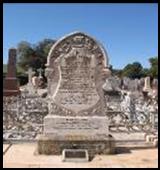
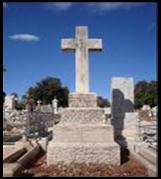
4. Thomson, George William Wyville
Born 28 February 1893, Bordertown and died 24 April 1918 aged 25.
Staff Sgt G.W.W. Thomson was killed in action in France. This memorial is one of a number in the cemetery for the fallen of WWI.
Prior to enlistment he was an officer in the National Bank at Burra and enlisted 31 August 1914. He left Australia with the original 10th Battalion and was in the Gallipoli landing. He was wounded there after six months and invalided to Egypt. He was sent to England and thence to France in October 1917.

5

6

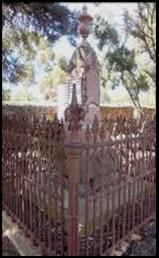
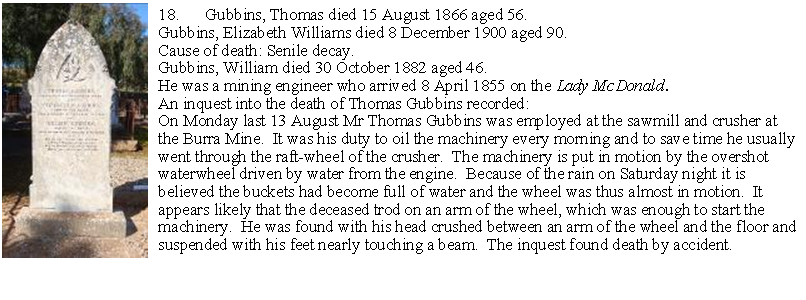
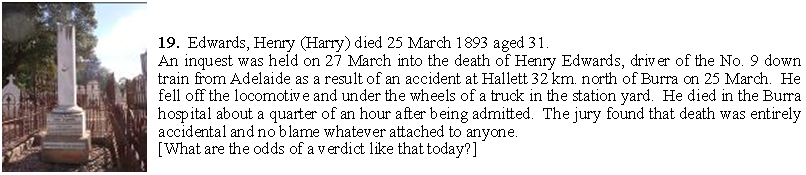
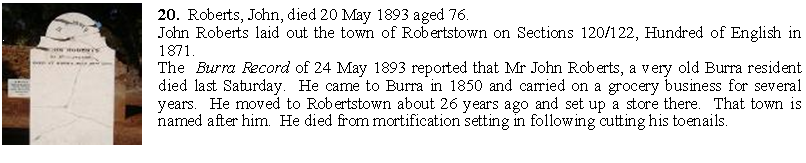
16. Isaac Killicoat died 18 Jan. 1886 aged 76. Cause of death: Diarrhoea.
He was born in Perranwell, a village in Cornwall 5 miles south of Truro on 3 December 1809. As a youth he went into mining and for 19 years before migrating to SA he was Surface Captain to the Tresavean Copper Mine, Gwennays, Cornwall, one of the oldest and largest copper mines in England. In 1848 he was engaged by John Schneider & Co., later the Patent Copper Co., to come to Burra and superintend the purchase of ore from the Burra Mine and others on behalf of the Smelting Co. This he did till the mine closed. He also bought land and grew wheat and hay. More recently he bought Abberton Park, just east of Burra North named after the vessel he came in, and devoted himself to sheep. He also used irrigation there to grow fruit trees, especially oranges and lemons. He was active in public life and greatly encouraged the completion of the Burra railway. He was appointed a member of the first Burra District Council and elected chairman thereof. He was also elected a member of the Midland Road
7
Board: an office he held until his death. He did much to establish the district’s roads and bridges. On mining matters he was a consultant, making two trips to New Caledonia to confer on the Ballade Copper Mine and also to Cobar Mines in NSW as well as to mines in New Zealand and was consulted by the owners of the mines on Yorke Peninsula. He was a member of the Church of England and a trustee of St Mary’s, Burra. Thrice married, his third wife survived him.

8
22. Dyer, Little Emily died 20 February 1865 aged 5 days.
Dyer, Ellen, died 26 September1867 aged 25. Cause of death: Inflammation of the brain.
Ellen was the first wife of Percy Weedon Dyer an early pharmacist of Kooringa. After Ellen’s death he married Alice Parks in 1868. He seems to have had at least three children by Ellen and nine by Alice. A number died in infancy. By 1876 he had moved to the Jamestown area and in 1885 was at Minlaton and at Orroroo in 1898. Alice died at Kingswood in 1925 when the registration suggests Percy was still alive. If true, he would have then been about 90. No death is registered in SA.
| Month | Total Deaths in Burra | Number aged under 5 years |
|---|---|---|
| July | 10 | 9 |
| August | 30 | 25 |
| September | 23 | 21 |
| October | 10 | 7 |
9


10
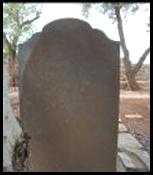
32. Two German Lanugage headstones
32a. Bock, Johanne Christiane Frederike born 1 December 1801 and died 18 December 1862 aged 61 and 17 days. Note inscription in German on the back of the headstone.
Cause of death: Disease of lungs.
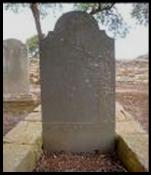
32b. Wimmer, Carl Wilhelm born 18 November 1840 and died 6 September 1865 aged 24 years 9 months and 19 days.
These two almost adjacent headstones are well preserved but hard to read. Note the lengthy inscriptions in German on the back of both and the unusual record of the ages at death down to the day.
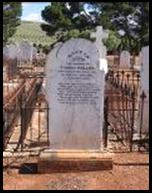
33. Phillips, Thomas, died 24 May 1868 aged 46.
Mr Thomas Phillips foreman blacksmith at the Burra Mine accidentally gave himself a blow in the abdomen with a hammer on Thursday. At first it was thought a trivial injury, but he gradually worsened and died on Saturday. He had been a staunch member of the Wesleyans for twenty years and had occupied his post at the Burra mine for 17 years.
What is worthy of note is the extraordinary verse on this headstone. It comes from the poem On the Sight of a Corpse by Charles Wesley
Ah, lovely appearance of death!
What sight upon earth is so fair?
Not all the gay pageants that breathe
Can with a dead body compare.
Ah, lovely appearance of death!
What sight upon earth is so fair?
Not all the gay pageants that breathe
Can with a dead body compare.
With solemn delight, I survey
The corps when the spirit is dead
In love with the beautiful day
And longing to lie in its stead.
11
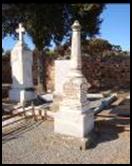
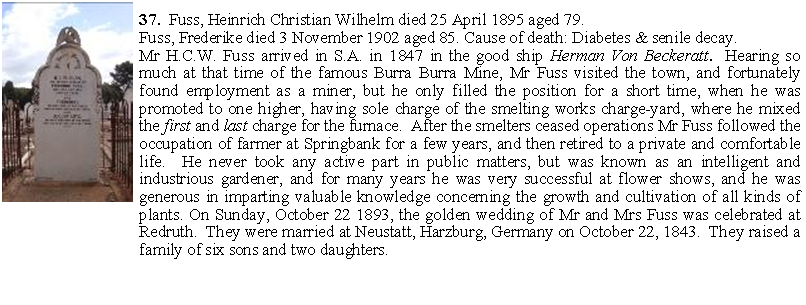
35. Bentley, William died 20 June 1910 aged 73. Cause of death: Chronic cardiac disease.
Bentley, Elizabeth died 18 January 1920 aged 74. Cause of death: Chronic cardiac disease.
Bentley, Alison died 10 May 1964 aged 80.
Bentley, Maria Grace died 9 November 1970 aged 89.
William Bentley was a noted local photographer and artist. His paintings of Burra in the 1850s are an important record of the town. His daughters Rose, and later Alison and Maria ran a delicatessen on the corner of Young and Morehead Streets in the early decades of the twentieth century and later in life Alison and Maria ran a toy and fancy goods store in part of that building.
12
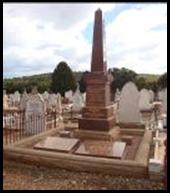
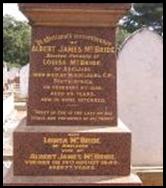
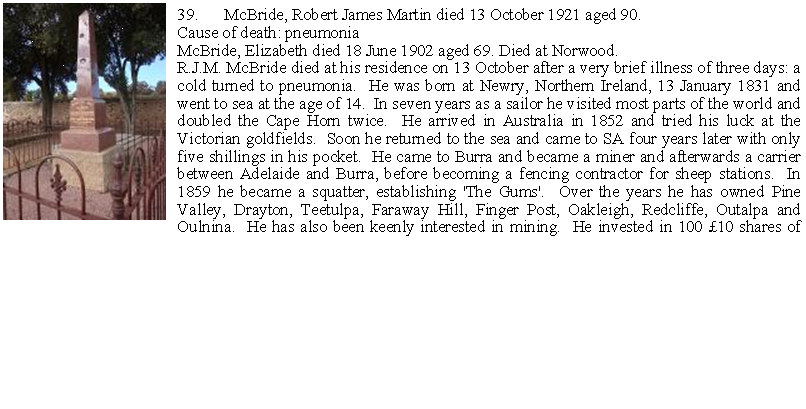
38. Mc Bride, Albert James died 4 February 1928 aged 59.
Mc Bride, Louise died 30 August 1945 aged 77. Died at North Adelaide
McBride, Rita Irene died 22 August 1987 aged 94.
Mr A.J. McBride died in South Africa from influenza. He, left on a world tour at the start of December. Influenza struck at Middelburg Cape Colony, 150 miles north of Port Elizabeth. At first no anxiety was felt, but quite suddenly pneumonia set in and Mr McBride died of heart failure.
Albert James McBride was the third son of R.J.M. McBride the noted pioneer pastoralist. He played a considerable role in developing the dry areas for pastoralism. He bought and redeveloped a number of the older properties, so increasing their carrying capacity by at least fivefold. His early training began on 'The Gums' then owned by R.J.M. McBride. After marrying he went to the city for a while, but soon returned and started again. He bought the stations of Faraway Hill, then Teetulpa, Braemar and in the north, Thurlga, Yardea, Wilgena, Wooltana and others. At his death A.J. & P.A. McBride controlled some 5,000 to 6,000 square miles of sheep country. He was born in Kooringa and educated at Prince Alfred College. He gained business experience working for Elder, Smith & Co. For many years he resided in Burra and did a deal of public work. For years he was a member of the Hospital Board and was on the Town Council December 1914-November 1919 and on many committees. In the war years he was a generous donor to patriotic efforts. He was a quiet benefactor to many more than was widely known. He was a skilled horseman, both at riding and driving. In later years he also kept race horses. He was one of the first men in Burra to get a motor car. He was as great a philanthropist as his father, though few of his generosities were made public.
Mc Bride, Philip Albert Martin died 14 July 1982 aged 90.
Born in Kooringa, Burra on June 18, 1892
Philip worked on family farms in partnership with his father. In 1920 father and son became joint managing directors of A. J. & P. A. McBride Ltd, a grazing company that later controlled vast sheep stations stretching across the arid pastoral zone of northern South Australia. After his father’s death in 1928, Philip became its sole chairman, a position he was to hold for fifty years
He was president of the South Australian Stockowners’ Association in 1931 when he won the Federal seat of Grey for the United Australia Party, after unsuccessfully contesting State seats in 1927 and 1930.
In 1952, when he was Minister for Defence, Sir Philip was widely spoken of as a possible Prime Minister.
Sir Philip, who became a KMCG in 1953, retired from politics in 1958 to concentrate on his pastoral interests.
He was president of the Liberal Party from 1960 to 1965.
13
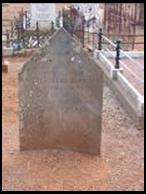
40. Stace, Arthur Hill died 10 September 1851 aged 29.
An early and relatively well preserved headstone of less common type. A.H. Stace was the licensee of the Southampton Arms Hotel at Aberdeen.
NO HEADSTONE for Lot 73, but walk on 3plots to that of John Roach
On the opposite side of the path is Plot 73.
42. Evans, Anthony died 25 November 1867 aged 104. Cause of death: Senile decay.
Anthony Evans died at Llwchwr near Redruth in the house of his daughter Mrs Edwards. He was born at Llanelly in South Wales on his father’s farm, where he worked until he was 24. He then married and worked at a furnace in the smelting works at Llanelly for 28 years. After that he moved to Swansea and continued to work there at the smelters until aged 85. At that time his daughters, Mrs Edwards and Mrs Morris of Port Adelaide, with their husbands and families, being employed by the English & Australian Copper Company to come to SA, brought him with them, with the consent and assistance of the company. They arrived on the Richardson in 1848. On his arrival in Burra he obtained employment at the Smelting Works as a watchman for 22 shillings a week. He held the appointment at a reduced wage until his 98th year. Being then unable to do much walking, he retired and the company paid him 15 shillings a week until he died. Had she survived his eldest daughter would have been nearly 80 and the youngest is about 50. His wife died when he was 65, so he has been a widower for almost 40 years. At the time of his death he had 118 descendents. He was a man of very regular habits and drank no intoxicating beverages except sparingly of ale and beer. He took care to vote at each election. He died quietly at breakfast time, expiring before Dr Dashwood arrived.
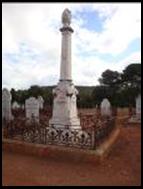
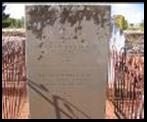
43. Woollacott, Mary died 2 July 1868 aged 56. Cause of death: Heart disease.
Woollacott, William died 13 May 1881 aged 61. Cause of death: Stroke.
SA Register of 4 October 1848 reported the arrival of the Richardson from Swansea with 80 souls, all connected with the smelting company at Burra. Travelling in steerage were
William Woollacott with his wife and four children. William was a pattern maker and a haulage contractor. He soon set himself up as a private carrier with big contracts to supply the smelters and the mine with timber. He achieved local fame in 1858 transporting the heavy machinery for Morphett's Enginehouse from Port Adelaide to Burra. The jinker carrying part of a cast iron cylinder weighing 15 tons was hauled by 36 oxen. Other wagons carried other parts of the machinery and the contract for their transport was reported to be the enormous sum of £1,000. The nature of the task is hard to imagine, with no made roads to follow and few bridges. The arrival of the load in Burra was greeted with cheering, bonfires, dancing in the streets and boxing and wrestling matches. Plenty of beer flowed and numerous Cornish pasties were consumed.
14
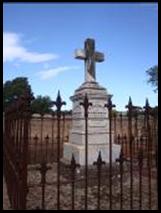
44. McCulloch, Alexander died 16 October 1890 aged 80. Died at Glenelg SA.
He came to SA in the Oriana in 1836. He bought 200 sheep from Murray to whom he acted as shepherd, the two flocks being depastured together. He took a run on the Gilbert where he bought land. Soon after he took up land from James Logan at Gottlieb's Well (near Terowie) and later extended it to Nackara. Here he was renowned for his hospitality with sometimes 20 visitors at a time. In 1865 he took up Princess Royal near Burra where the magnificent homestead was designed by Edmund Wright and built in 1866. He was greatly respected for his charitable work. Generally he was very retiring and his only public office was as Member of the House of Assembly in 1861. He was very liberal to the Anglican Church, in 1881 changing a £500 loan into a gift. In the 1870s he and his wife supplied rations to the Burra poor at Christmas—in 1876 55 families received the following ration per family: a quarter of a sheep, 3 pounds sugar, 2 pounds currants, 2 pounds raisins, l ounce spice, 8 pounds potatoes, 12 pounds flour, 4 pounds bread and a bottle of English Ale (doubled if family was more than 5 persons). A total of 3,700 pounds of rations was distributed (excluding the liquor).
15
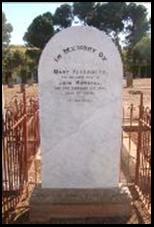
47. Rumball, Mary Elizabeth died 9 February 1881 aged 54. Cause of death: Cancer.
Mary had a rather adventurous life. She was born near London in c. 1827 and was in domestic service with the Governor of Gambia in West Africa where she met and married another servant John Rumball. They were married at Government House, Bathurst, Gambia in 1849. The young couple returned to England where their eldest son was born in 1850. John then got a job managing a sugar plantation in Jamaica. Their second son was born in Manchester, Jamaica in 1852. Mary then insisted they leave as she believed John was developing too much of a taste for rum. In 1854 she had a stillborn child in New York. They are then said to have paused briefly in China en route to Victoria where a third son arrived at Mt Blackwood in 1856. Two daughters and four sons followed. By 1870 John was managing the horse-drawn tramway from Strathalbyn to Victor Harbor and it was at Victor Harbor that the youngest son was born in 1870. In 1874 John Rumball was appointed the second stationmaster at Burra. Mary died from cancer in 1881, but John continued as stationmaster till 1893 when he was forced to retired aged 72 due to retrenchments in the general depression of that period. He was a popular stationmaster and a deputation of eminent members of the local business community waited on the Commissioner of Railways seeking his re-instatement.
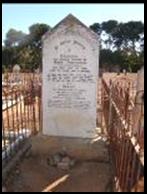
48. Trevilyan, George died 8 June 1890 aged 50. Cause of death: Found drowned in a well.
Trevilyan, Mary died 6 December 1906 aged 60.
George Trevilyan was a miner.
The main point of interest is the tombstone with its typical Victorian sentimental verses. Note that the deceased lived at Copperhouse, a now defunct settlement just west of the Burra Mine.
George Trevelyan of Ashmore, formerly a railway packer was found drowned in his well. It is thought he threw himself in while temporarily of unsound mind following influenza.
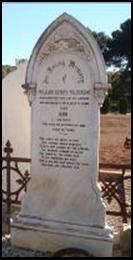
49. Wilkinson, William Henry died 1 November 1879 aged 64 at Gawler.
Wilkinson, Ann died 18 October 1886 aged 72. Cause of death: Senile decay.
This is a fine example of the headstones of the era.
Dr William Henry Wilkinson was an early pharmacist in Burra and his son T.W. Wilkinson established a chemist business whose name continued long after the Wilkinson family had disposed of it. The dispensary site can still be identified in Market Square by the pestle and mortar on its parapet. W. H. Wilkinson was born County Wexford, Ireland, 14 March 1815, entered the army at 17 and served 21 years: 2 years as a private, 4 as a corporal and 15 as a Hospital Sergeant. Arrived in SA in 1858 and became a chemist and druggist at Gawler and later a medical practitioner. He was made a JP in 1860.
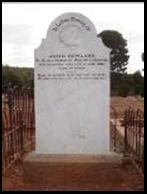
50. Edwards, John Rowland died 11 June 1888 aged 34.
The local paper of the time reported:
There have been a large number of typhoid cases in the Burra Hospital this year, though all have come from the Barrier [Broken Hill]. Another death last Monday is added to the list. It was J.R. Edwards, formerly of Burra in the employ of Drew & Co. and latterly of Broken Hill for the same firm. He leaves a wife and five children.
Typhoid was a regular occurrence in nineteenth century Burra, but note here that all the deaths in this year had been cases coming from Broken Hill. Burra Hospital was serving a huge area of north-eastern South Australia and into NSW.
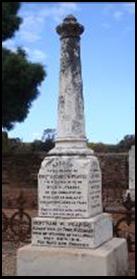
51. Pearse, Bertram Wellesley died 26 May 1916 at Gallipoli aged 33.
[Note the surprising error for 1915.]
The local paper reported his death:
‘Trooper Bertram W. Pearse of the 2nd Reinforcements, 3rd Light Horse, was killed 26 May at the Dardanelles, aged 34. He was the eldest son of Mr Thomas H. Pearse of 'The Gums'. He owned Caroona Station and was on the Hallett District Council. He was a Freemason, a member of the SA Cricket Club, the Commercial Travellers' Club, Burra Rifle Club and was once a racing cyclist. He leaves a wife and one child.’
This is one example of a number of headstones serving as memorials to those who died overseas in World War I
16
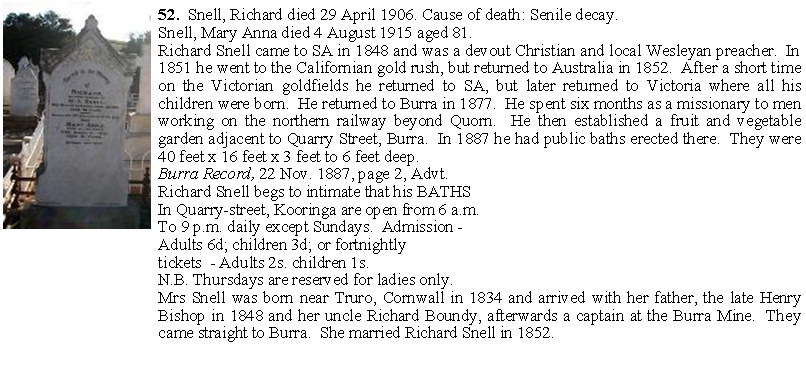
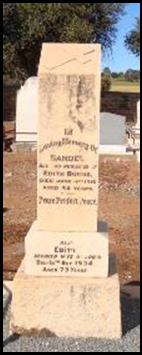
53. Burns, Samuel died 4 June 1916 aged 58. Cause of death: Cerebral haemorrhage.
Burns, Edith died 18 October 1934 aged 79.
Samuel Burns was born in Burra in 1858. In about 1886 he established his blacksmith and wheelwright’s business. He was a Town Councillor for four years and then Mayor for 1910. He was very active in the Oddfellows and Rechabite Lodges and rose to Senior Warden in the Masonic Lodge. He was also a local preacher. In October 1910 he had a serious stroke from which he made a remarkable, but incomplete recovery. A further stroke five weeks before his death was followed by another that resulted in his death.
Mrs Burns was born in the Wakefield District in 1859. She was a large hearted and sympathetic woman who, despite caring for nine children gave her husband every assistance in his civic and church interests. Before Methodist Union in 1900 they were staunch supporters of the Bible Christian Church and after union they continued their enthusiasm with the Methodist Church. They extended hospitality to visiting ministers and to a wide circle of friends. They were also the centre of a social circle of young folk especially those moving in musical circles. After Mr Burns' death and her removal to Dulwich Adelaide Mrs Burns led a more retired life.
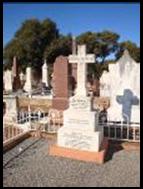
54. Treloar, Ida Muriel died 14 May 1900 aged 14. Died atNew Parkside.
Treloar, Frank died 16 September 1934 aged 82. Died at Croydon West.
Treloar, Sarah Esther died 22 November 1938 aged 86. Died at Croydon North.
Frank Treloar was born at North Adelaide 1 June 1852, the eldest son of one of the pioneers of SA. His parents had arrived in SA in the early 1840s. His father after a successful trip to the Victorian gold diggings took up land at Watervale and with his wife and Frank, then only five months old, left by bullock wagon for their new home, which was a tent until a house could be built. He was educated at Mr Coles' school at Watervale. At 14 he went to work for an auctioneer for four years and then went into the wheat trade at Hoyleton. He next took up farming near Orroroo and struggled with drought for five years before losing all and retreating to Watervale. After six months he was appointed manager of Gum Creek Station just west of Burra, owned by Sir John Duncan. At the time the station comprised 32,000 acres and there was also an eastern block belonging to the proprietors who ran from 100,000 to 130,000 sheep. He held the position for many years. While there he supported the Burra Coursing Club; acting as judge at meetings. In 1899 he came to reside in Burra, where he acted as Secretary for the Burra Hospital, the Show Society, Burra Sports Association and was also clerk for a number of years for the Hanson District Council. Mr Treloar was also a Burra Town Councillor and was prominent in the Masonic Lodge and a member of the Oddfellows and Foresters Lodges. He left Burra in November 1930 to reside at Croydon, but he maintained close contact with the town until his death. He was a clever writer and many interesting articles from his pen appeared in the columns of the Burra Record. He can truly be regarded as the first historian of Burra and its mine. He was esteemed for his geniality and honour.
17
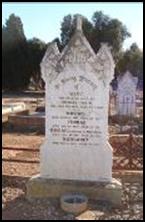
55. Tobin, Mary died 10 January 1904 aged 63. Cause of death: Tuberculosis.
Tobin, Michael died 3 April 1897 aged 28.
Tobin, Michael died 14 February 1911 aged 84. Cause of death: Heart attack.
Tobin, Margaret died 2 August 1912 aged 40. Cause of death Tuberculosis.
This typical family plot and headstone is perhaps most notable for the fate of Michael Tobin Junior. The Burra Record of 7 August 1907 reported:
Joseph Tobin has returned to Burra with his brother Thomas, after the death of their brother Michael. Michael was speared by an Aborigine at Wadda Walla in WA on 6 April. The deceased was in a party opening up a stock route from the gold fields to the far north, led by A.W. Canning. He was speared twice, killing the native with a shot as the second spear was launched. He was conscious for 17 hours after the attack, but knew he was dying. His name is perpetuated in Tobin Lake. The fatality was some 500 miles from Wiluna and news did not get out until 5 July. [Tobin Lake is a significant one that crosses the Canning Stock Route at approximately the latitude of Onslow on the coast of WA.]
Note that the headstone carries a date of 1897 instead of 1907.
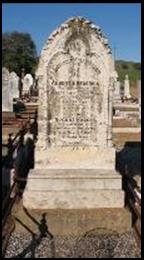
56. Brandt, Albert Frederick died 9 October 1907. Cause of death: Diabetes.
Brandt, August Robert died 19 November 1929 aged 40.
August Brandt volunteered for WWI early in 1915. In June 1916 he was severely wounded and was returned to Australia to recuperate. In January 1917 he was returned to the front in Palestine and served five heavy months of fighting before falling ill and reduced to light duties by February 1918. When he was discharged after the war he was permanently affected by his injuries and never able to undertake heavy work. In September 1929 the local paper reported that the Burra Red Cross had raised £37 at a recent jumble sale and had decided to give £10 of it to Mr Augie Brandt who was a returned soldier too ill to work. Two months later he died as a result of his war service injuries. In 1924 he had married Miss Beryl Goldsworthy who was left to raise three children.
His case serves as a reminder of the many returned men from WWI who had their lives shortened by their wartime experiences.
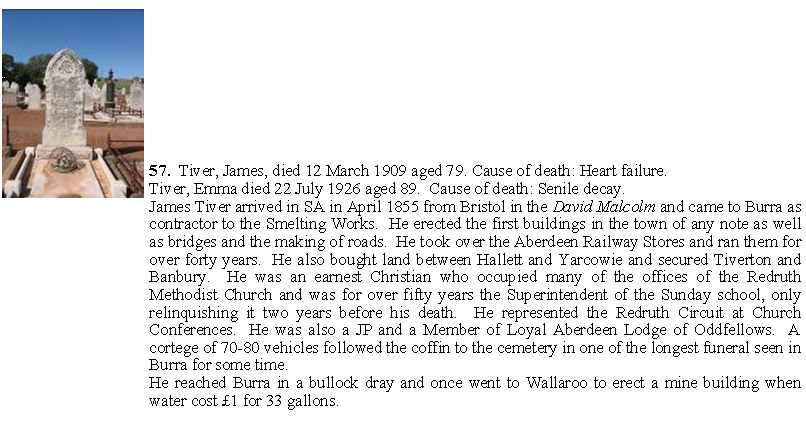
18
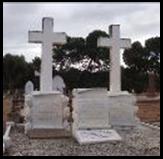
59. Lewis, John died 25 August 1923 aged 81 at Glen Osmond.
Lewis, Martha Anne died 3 June 1894 aged 47.
Lewis, Lancelot Ashley died 13 June 1938 aged 52 at Glen Osmond...
Lewis Grace Margaret died 23 May 1969 aged 76 at Adelaide.
John Lewis was born at Brighton (SA) in 1842
His primary interests were always agricultural and pastoral. He spent years on outback stations after leaving school. He was interested in Aboriginal welfare and in the preservation of the state’s flora and fauna. He was a member of the Aborigines’ Friends’ Association and Advisory Council and on the Flora and Fauna Board. He had interests in pastoral properties in Queensland, NSW, NT & SA. He was for long a resident of Burra and whilst here was active in many aspects of public life. He was a Town Councillor for a term in the 1880s. In business he was for 47 years identified with the stock firm of Bagot, Shakes & Lewis Ltd. He believed strongly in hard work and brought his family up on those lines. He was a long serving member of the Legislative Council and was made a Companion of the Order of St Michael and St George. He died at his residence ‘Benacre’ Glen Osmond on Saturday 25 August 1923. The body was brought to Burra by special train and there was a lengthy cortege for the funeral on Monday. Businesses closed in Kooringa from 2 to 3 p.m.
His children also had distinguished careers:
Gilbert Lewis had a brilliant military career serving in the Boer War, the Indian Army & WWI.
Essington Lewis was General Manager of BHP and Director of Munitions in WWII.
Lance Lewis was a fine soldier and athlete and Managing Director of the stock firm of Goldsbrough, Mort & Co. Ltd.
In WWI Eleanor (Nellie) Lewis ultimately became Area Superintendent for c. 300 Regimental Canteens of Southern Command in the UK. She married George Cowan: Commissioner of the Australian Trench Comforts Fund.
Jane (Jeanie) married Alex Melrose of Kadlunga, Mintaro.
Lance Lewis was the youngest son of John Lewis. He was born at Burra in 1885 and educated there and at St Peter’s College in Adelaide. He was a superb horseman and when 12 or 13 rode to Victoria to bring back stock for his father. He was a great footballer and polo player and worked for the firm’s office in Burra before enlisting in the 3rd Light Horse in 1914. He served at Gallipoli and later in Palestine, being severely wounded near Rafa. After the war his business ability was widely recognised in SA and he held many prominent positions including President of the Stockowners' Association of SA, Chairman of the Sailors & Soldiers' Distress Fund, Manager & Director of Messrs Goldsbrough, Mort & Co. Ltd. More than 1,000 people and 136 cars attended the funeral service at West Terrace Crematorium. There was a large body of returned soldiers and other mourners at Burra when the ashes were placed in the family burial plot.
Burra looked upon him as its own and it seemed quite fitting that his remains should be brought here and laid beside hose of his honored parents. In the beautiful sunshine a solemn hush fell on the crowd assembled, as the mourners, preceded by a large body of returned soldiers, walking four abreast came down the avenue. The latter took up their position four deep on the western side and the mourners on the eastern side at the foot of the grave. This sacred spot and the immediate surroundings was a scene of exquisite floral beauty never previously seen in Burra. By the midday train that day well over 400 floral tributes arrived and these, under the supervision of Mr K. M. Drew,l ocal manager of Messrs Goldsborough, Mort & Co. Limited, with Mr S. Clifford, and other members of the staff, had been carefully and tastefully laid out making an unforgettable scene.
19
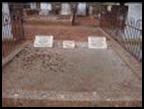
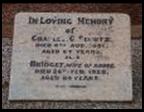
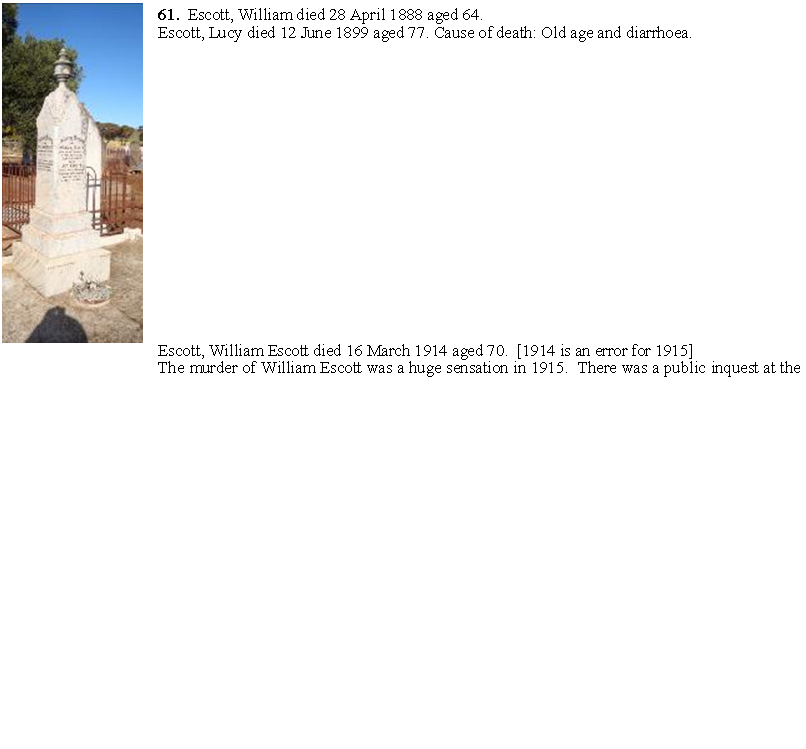
60. Schutz, Charles died 4 August 1901 aged 67. Cause of death: Cancer of the throat.
Schutz, Bridget died 26 February1925 aged 84. Cause of death: Cancer of the stomach.
Charles came to SA in May 1853 and began work at the Burra Mine. After some years he set up a stables supplying food for travellers’ horses and also supplying conveyances. For many years he ran horse drawn cabs in the town with a half-hourly service between the two ends and meeting all the passenger trains. In 1899 he sold the cabs to a rival, but continued his stables.
One of his advertisements gives an idea of his business in 1882:
‘Charles Schutz
Old Line of Cabs; Buses run every half hour,
Burra Livery & Bait Stables’
Another in 1884 points to the establishment of a rival to whom he later sold his business:
Notice. Charles Schutz informs the public that his cabs continue to run to the station and asks them to note that ‘T. Halls is no longer in my employ and is not authorized to act for me in any way, nor to use my name for his own business.’
The station cabs in Burra were notorious for underfed horses and for fierce rivalry in seizing passengers’ luggage and bundling them into their uncomfortable conveyances. One JP when adjudicating a case where two drivers were charged with racing along the main road expressed amazement that their horse could break into a canter.
20
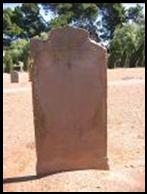
62. Prosser, Edward. Cause of death: Bronchitis.
Probably the person of this name who died 4 September 1857 aged 60.
This poorly preserved headstone has an inscription in Welsh.
Edward Prosser was a smelter by trade but was a very recent arrival when he died, having been in SA only seven weeks.
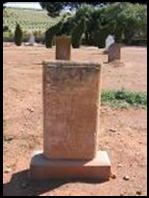
63. Clare, Amelia died 26 June 1849 aged 49, the wife of James Clare.
James may have been the son of S. Clare the carpenter who fitted the bellows to the first attempt at smelting in 1847. If so he was also employed there. Clare Sen. was dismissed for being too outspoken and he and his son turned up drunk on pay day.
[Directory of Early Folk by J. Carter.]
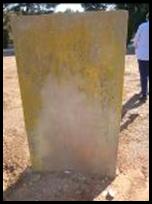
64. Benjamin, John died 1 September 1858. Cause of death: Tuberculosis.
From Jennifer Carter’s A Directory of Early Folk
John Benjamin was a shopkeeper and tailor formerly of Hindley Street. His shop was damaged in the floods of 1851. He was buried in the old Burra Cemetery, but the headstone was later moved to the new cemetery. It is inscribed in Yiddish. His wife was Sarah nee Levy and she went to NSW after his death.
Of eight children three were born in Burra and indicate the family was there by 1850.
The SA Register says of the 1851 floods that the water was four feet high in Thompson & Boord’s shop and the same in Benjamin’s.
In reporting the funeral the same source says:
Despite the stormy day the shops were closed on the 2 September and everyone turned out as a mark of respect to follow the deceased’s remains to the cemetery. He was a member of both the Freemasons and the Oddfellows, and members of these lodges turned out to form one of the largest funerals seen in Burra.
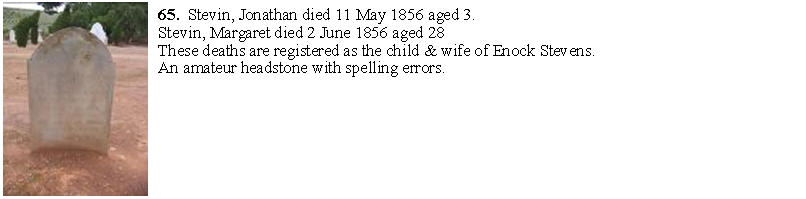
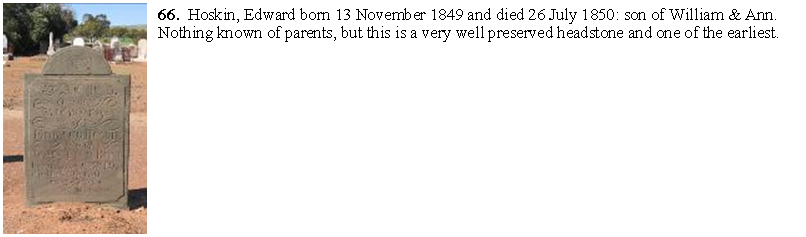
21
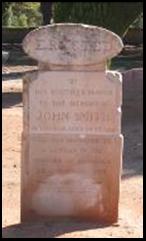
67. Smith, John died 24 Dec. 1849 aged 24.
A drunken runaway sailor named John Smith went to the house of a man named Gottlieb Kiernall and demanded a light for his pipe. This was given and he went away, but returned asking for another light. This too was given, but some angry words were exchanged. The deceased then put a candle up to the roof, threatening to burn the house. Kiernall’s wife tried to snatch the candle and it fell to the ground. A group of Smith’s supporters than started to throw stones and Kiernall’s pregnant de-facto wife was knocked to the ground. Kiernall struck Smith on the head with a stool, before going inside and locking the door. Smith briefly went away, but returned and broke down the door. Kiernall then seized an axe and buried it in Smith’s head. Smith died soon after.
Kiernall was tried in Adelaide for murder, but was found guilty of manslaughter and sentenced to transportation to Port Arthur in Tasmania for seven years. He was sent on the Lady Denison with nine other prisoners and three constables. The ship never arrived and was presumed lost in a gale off the west coast of Tasmania. Two years later it was rumoured that the ship had been taken over by the prisoners and sailed to California. One of the prisoners was said to be recognised on the Ovens goldfield by a constable, but lack of co-operation between the colonial police forces prevented any final solution to the mystery.
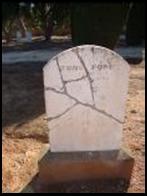
68. Kung Pong died 2 September 1872.
There is a tombstone for Kung Pong, dated 2 September 1872, but this was found at Mt Cone (just north of Burra) broken in pieces and has been restored and placed in the Kooringa Cemetery.
The translation of the inscription in Chinese characters reads: Kung Pong, from ‘The village of the white sand’ in the Ningpo Region of the Province of Chekiang (Zhetjiang) died 30 Seventh Month 1872 (presumably by the Chinese calendar).
There is no registration of death in SA that matches this and its provenance is quite unknown.
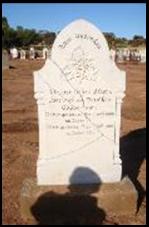
69. Topperwien, Dorothea died 10 March 1885 aged 58.
Topperwien, Heinrich died 20 April 1888 aged 73.
This is another of the German language headstones. In reporting his death the local paper says little more than that he was one of the town’s earliest settlers.
According to cemetery records this headstone should be on plot 418 near that of George Trevilyan in 414.
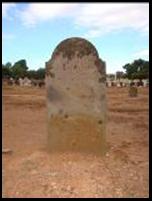
70. John, David died 20 November 1850. [Registered as 25 Nov. 1850.
This child of David John died from teething complications.
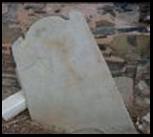
71. Riley, Charles died [13] Feb. 1850 aged 37.
Despite the name on this badly decayed headstone apparently being Charles. The registration of death and newspaper reports call him Patrick.
The friend ‘Robart Birrell’ who erected the headstone was the local brewer and the employer of the deceased who had been severely burned when a candle fell onto his bed while he was sleeping. He lingered for six weeks before succumbing to his injuries.
Note: headstone is leaning against the wall.
22
No headstone but the grave is the one next to the right as you face that of Susan and Thomas Hill.
72. Wonga, Jemmy/Jimmy died 27 June 1882 aged 45
Report of the inquest into his death.
An Aboriginal named Jimmy Wonga died at Burra Hospital as a result of burns received near Yatina. He deposed while dying that he had got drunk on brandy and had fallen into a fire without noticing it and on Sunday he couldn’t walk. He additionally deposed that Mr James of Mannanarie had given him one bottle of rum and Forrest a bottle of brandy at the same time and place.
Dr John I. Sangster said both legs were badly burned - the left from foot to thigh and the right to the knee. Bone was exposed and both legs were in a state of mortification.
The inquest in the local paper details extend over 2 columns.
Thomas James and David Forrest denied supplying liquor.
Verdict was death from burns received through falling into a fire while in a state of intoxication and ‘that from the evidence given every attention was paid to the deceased by Mr J.B. Carr JP and P-C Ormsby, and the telegrams which appeared in the Advertiser were absolutely false.
[The registration of death says: Jemmy Wonga, died 27 June 1882, aged 45, but the documents related to the cemetery records say burial was on 24 June!]
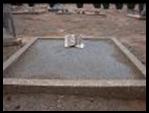
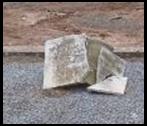
The Hill grave.
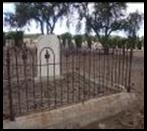
73. Theeuff, Emma died 13 May 1883 aged 19. Cause of death: Typhoid fever.
Theeuff, William died 27 May 1883 aged 8½. Cause of death: Typhoid fever.
Theeuff, Charlotte died 25 November 1923 aged 90. Cause of death: Senile decay.
Charlotte Theeuff nee Press arrived in SA on the Buffalo in 1838 with her parents. She recalled Adelaide when there were gum trees everywhere and Government House was a wooden structure and Aborigines were numerous and not always friendly. Her parents settled first at Hindmarsh. In 1852 she married William Theeuff and settled at Mt Lofty in a dugout. They later lived at Sheoak Log, Gawler and North-West Bend where most of the children were born. In 1876 her husband died. She then came to Burra and took up nursing. She lived many years in retirement. Of fifteen children eleven reached maturity and were alive when she died.
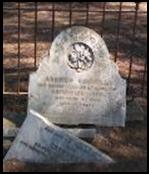
74. Wade, Catherine died 14 November 1899 aged 60
Inquest into the death by burning of Mrs Wade from the Burra Record 22 November 1899
Catherine Hartnett, daughter, said her mother came to assist with the washing and near the end sent her to lie down. While she was doing so her mother’s dress caught fire and Catherine got her hands badly burned trying to put it out.
D.A. Crosby saw the deceased after the fire, said she was perfectly sober, and said to him that a stick of fire had fallen out of the copper onto her dress. She had lived about 9 hours after the accident.
Letty Ford corroborated the comments about the cause and had wrapped the deceased in a blanket to extinguish the flames.
Dr Brummitt gave evidence relating to the extensive burns and the likelihood of severe shock as a result.
The verdict was accidental death as a result of her dress catching fire, with no blame attached to anyone.
Catherine Haretnett, daughter of the deceased was 20 years old and five months pregnant with her first child when the accident occurred.
23
24
25
26